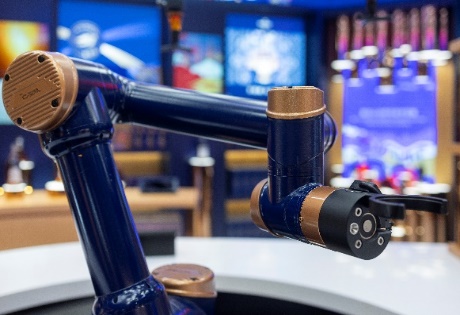

Pernod Ricard’s Martell has deployed an AI-powered VirtualBartender on its global cocktail platform, claiming to be the first brand in the cognac category to offer consumers a real-time conversational experience of this kind.
The tool, live on Martell’s website, allows users to query the AI by mood, flavour preference, occasion, or available ingredient and receive tailored cocktail recommendations in return. According to Martell’s published terms and conditions, the system runs on Microsoft Azure infrastructure hosted in Europe and operates under the EU AI Act. The brand instructs users not to submit personal data and includes responsible drinking reminders throughout the experience.
Martell describes the tool as drawing exclusively from “verified Martell sources,” including the house’s official website and published cocktail recipes. For health-related queries, the system routes responses to the International Alliance for Responsible Drinking. That is a deliberately narrow mandate: the AI does not freelance beyond the brand’s own content.
Redefining a category built on heritage
For much of its 310-year history, cognac’s marketing playbook ran on exclusivity, heritage, and the neat pour. That playbook has been under pressure for years. Younger legal-age drinkers across Africa, Asia, and the Americas increasingly reach for cognac as a cocktail base rather than a sipping spirit, and they discover it through TikTok reels and influencer bars, not print campaigns or gifting culture. Martell’s AI bartender is a direct response to that shift.
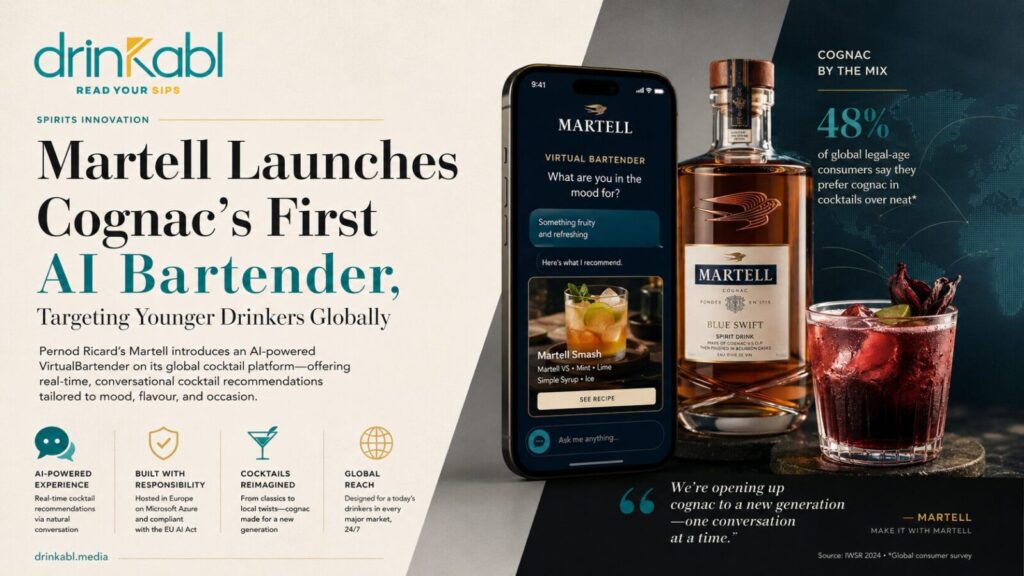
The Virtual Bartender is the digital arm of a broader campaign strategy. Martell’s “Make It With Martell” initiative, active across multiple markets, repositions cognac as a versatile cocktail ingredient and has been running activations in markets from Kuala Lumpur to Lagos. Cocktail formats promoted under the campaign include cognac-based Old Fashioneds, a French 125 variation, and a Martell Smash. The Nigerian market has its own localized angle: Martell’s regional platform already hosts a Chapman variation and a Zobo-infused serve built around Martell Blue Swift, which reflects how deliberately the house has been courting West African drinkers.
The cocktail-led push mirrors a pattern across the spirits sector, where brands are using mixability as an entry point for younger consumers and social-media-first discovery. Coverage of the Nigerian youth beverage market documented here in May put exactly this dynamic in context: younger drinkers in Lagos are reconfiguring their category choices faster than most brand teams had modelled, and premium imported spirits that translate to the cocktail glass are better placed than those that don’t. The piece can be found at Nigeria’s Gen Z Beverage Reset Goes Deeper Than Brands Priced In.
AI as brand infrastructure, not novelty
What Martell has built is closer to brand infrastructure than a gimmick. The tool functions as a recommendation engine, consumer educator, and cocktail discovery platform in one — available at any hour, without a bartender on shift. For a house trying to move cognac from special-occasion cabinet to everyday cocktail spirit, that kind of always-on engagement has obvious commercial logic.
The infrastructure itself carries compliance weight. Running under the EU AI Act, hosted in Europe on Azure, the system was built to avoid the kind of regulatory exposure that increasingly follows AI deployments tied to alcohol marketing. The warnings about AI-generated inaccuracies in Martell’s terms and conditions are there for a reason: European regulators are watching how alcohol brands deploy conversational AI, and the responsible-drinking guardrails embedded in the tool reflect that scrutiny.
Martell’s promotional activity for the Virtual Bartender has leaned heavily on paid social channels, particularly Instagram, according to industry observers tracking the campaign rollout. That is consistent with how premium spirits brands have been approaching digital consumer acquisition more broadly: social platforms as the discovery layer, brand website as the conversion point.
What this means for Africa
For markets like Lagos, Nairobi, Accra, and Johannesburg, the significance is commercial as much as technological. Urban middle-class consumers across these cities are already deep into cocktail culture; the question for global spirits brands has always been how to convert that engagement into brand loyalty rather than generic category adoption. An AI tool that can suggest a Zobo-twist or a Chapman variation using a specific Martell expression is, at minimum, a more relevant touch point than a generic heritage campaign.
Whether the Virtual Bartender registers as a meaningful commercial tool for African markets or simply a novelty depends largely on distribution, awareness, and whether Martell continues to localize its digital content with the same intentionality it brought to the Chapman and Zobo recipes. The house’s next market test will be how far this technology travels beyond the flagship digital campaign into the venues and outlets where most buying decisions actually happen.
READ MORE
Nigeria’s Gen Z Beverage Reset Goes Deeper Than Brands Priced In
Hot Air Balloons, Formula 1 and Live Music Power Heineken House Lagos