
East Africa’s beer market has a quality problem that ownership transfers cannot fix. As Asahi Group Holdings moves toward completing its $2.3 billion acquisition of EABL, the Japanese brewer is inheriting the region’s distribution scale, its flagship brands, and a last-mile gap that has never been systematically closed.
Draft beer depends on cold storage, stable CO2 pressure, clean lines, and trained staff. In markets where power reliability is inconsistent, cold chains break and warm beer foams. CO2 supply is uneven across secondary cities. Line cleaning frequency at independent bars and restaurants is not monitored by brewers and is not regulated. A keg leaves the depot within specification. What reaches the glass is a different calculation.
EABL understood this early. Senator Keg, launched in 2004 across more than 20,000 outlets, was specifically engineered around infrastructure constraints: low carbonation for warm-serve without excessive foaming, hand-pump dispensing to avoid refrigerated gas-pressure systems. It was a brewer embedding quality into the liquid rather than trusting the venue to preserve it. The product worked because EABL removed the variables the on-trade could not reliably control.
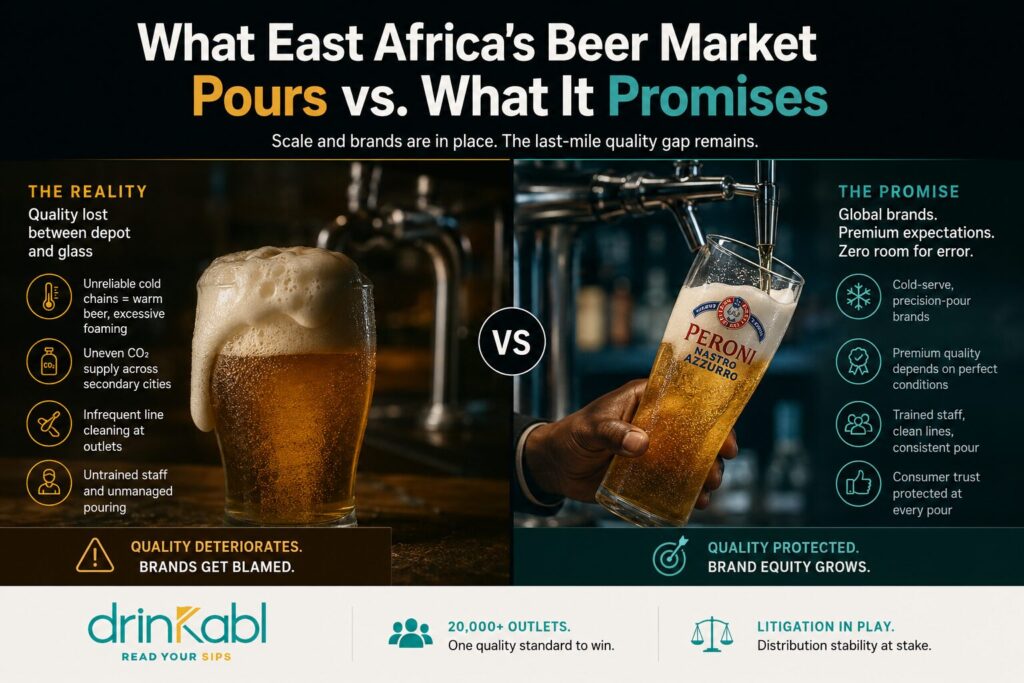
Asahi’s stated ambitions move in the opposite direction. The company has signalled plans to introduce Asahi Super Dry, Peroni Nastro Azzurro and Pilsner Urquell to East African consumers once the acquisition closes, expected in the second half of 2026. These are cold-serve, precision-pour products. Their quality proposition collapses if served warm, over-foamed or through an uncleaned line. A badly poured Peroni does not register as a venue failure. Consumers blame the brand.
Tusker recently ranked as Africa’s strongest brand, scoring 97.9 out of 100 on Brand Finance’s Brand Strength Index, built on familiarity and loyalty in its home market. That score reflects investment in the liquid. It does not reflect the consistency of what is dispensed across those 20,000-plus outlets. The two are different assets, and only one transfers in the Asahi deal. drinkabl
The distribution relationship sharpens the exposure. Bia Tosha Distributors, a former EABL partner since 2006, remains in active litigation after EABL terminated its contract over alleged violations of distribution routes in Nairobi, Machakos and Kajiado. The High Court dismissed Bia Tosha’s latest application to halt the Diageo-Asahi transaction on June 2, but the underlying dispute is before the Court of Appeal. Drinkabl.media’s reporting on the Kenya tax position in the EABL deal traces the same pattern: multiple unresolved claims sitting between the brewer and the market.
Asahi’s track record in Europe includes active draught quality programmes at venue level, covering equipment support, technician training and line-cleaning schedules. Whether that model works across East Africa’s fragmented, infrastructure-constrained on-trade is the question no acquisition announcement has addressed. As Drinkabl.media’s Tusker brand strength reporting noted that the brand’s position rests on consumer fundamentals. Protecting those fundamentals at a premium price point, through a distribution network in active litigation, is the harder task Asahi has signed up for.
READ MORE
Tusker Tops Africa on Brand Strength as MTN’s Lead Over Rivals Narrows