

The New Pour Summit ’26 made one thing clear: Africa’s next beverage breakthrough will depend as much on information as it does on innovation.
For years, conversations about Africa’s beverage industry have relied heavily on reports produced thousands of kilometres away. Market data has often arrived late, lacked local nuance, or treated 54 diverse markets as a single opportunity. Yet while global firms have been studying Africa, African operators have continued building brands in one of the world’s fastest-evolving beverage landscapes.
That imbalance was at the heart of one of the most important conversations during The New Pour Summit ’26 in Nairobi.
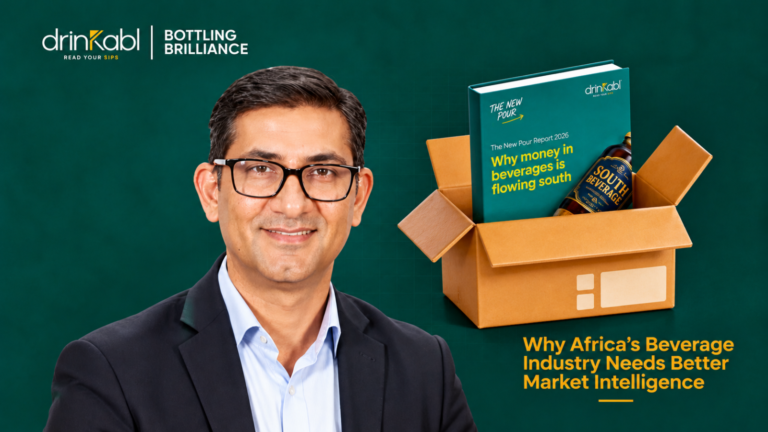
Beyond discussions on branding, distribution, innovation and investment, the summit introduced The New Pour Report 2026, Drinkabl Africa’s first industry intelligence publication. More than another market report, it represented an attempt to answer a longstanding question: Who is documenting Africa’s beverage story from an African perspective?
Intelligence is becoming a competitive advantage
The beverage industry has never lacked data. What it has lacked is context. Global research firms provide valuable insights into consumption, category performance and investment trends. But operators making decisions in Lagos, Nairobi, Accra or Kigali often face realities that global averages cannot fully explain. Consumer behaviour changes across borders. Distribution models differ dramatically. Regulatory environments evolve independently.
Even identical products can succeed in one market and struggle in another because culture, affordability, and retail structures differ.
As the New Pour Report argues, Africa is not one beverage market. It is 54 distinct consumer ecosystems, each requiring its own strategy rather than a continental template. That reality makes local intelligence increasingly valuable for everyone from multinational companies to emerging beverage founders.
Following signals before they become trends
One of the report’s strongest contributions is its focus on identifying where the market is heading rather than simply describing where it has been.
It highlights ten forces reshaping Africa’s beverage industry, including the rapid growth of non-alcoholic beverages, the expansion of ready-to-drink products, premiumisation, local flavour innovation, sustainability and changing consumer demographics.
These are not isolated trends. Together, they help explain why major global companies continue to reposition around African markets while local entrepreneurs increasingly attract investor attention.
The implication is straightforward: businesses that recognise these shifts early will be better positioned to respond than those relying solely on historical sales data.
Turning conversations into knowledge
Industry conferences often generate valuable discussions that disappear once delegates leave the venue. The New Pour Summit attempted something different.
Across sessions on market intelligence, route-to-market, innovation, capital, culture and advertising, practitioners shared experiences from building brands across African markets. The launch of The New Pour Report ensured many of those conversations were captured within a broader framework that businesses can continue using long after the event concluded. That matters because industries become stronger when knowledge is documented, challenged and improved over time.
Building Africa’s own reference point
The African beverage industry does not lack ambition. It does not lack entrepreneurs. It does not lack consumers. Increasingly, it is also proving that it does not lack investment.
What it has needed is a dedicated platform capable of connecting research, market developments and practitioner insight into intelligence that reflects the continent’s realities. The launch of The New Pour Report 2026 is an early step in that direction.
Whether it becomes a lasting reference for the industry will depend on continued research, wider collaboration and contributions from operators across the value chain.
But one message from The New Pour Summit ’26 was unmistakable. Africa’s beverage future should not only be built on the continent. It should also be understood through the continent’s own lens.