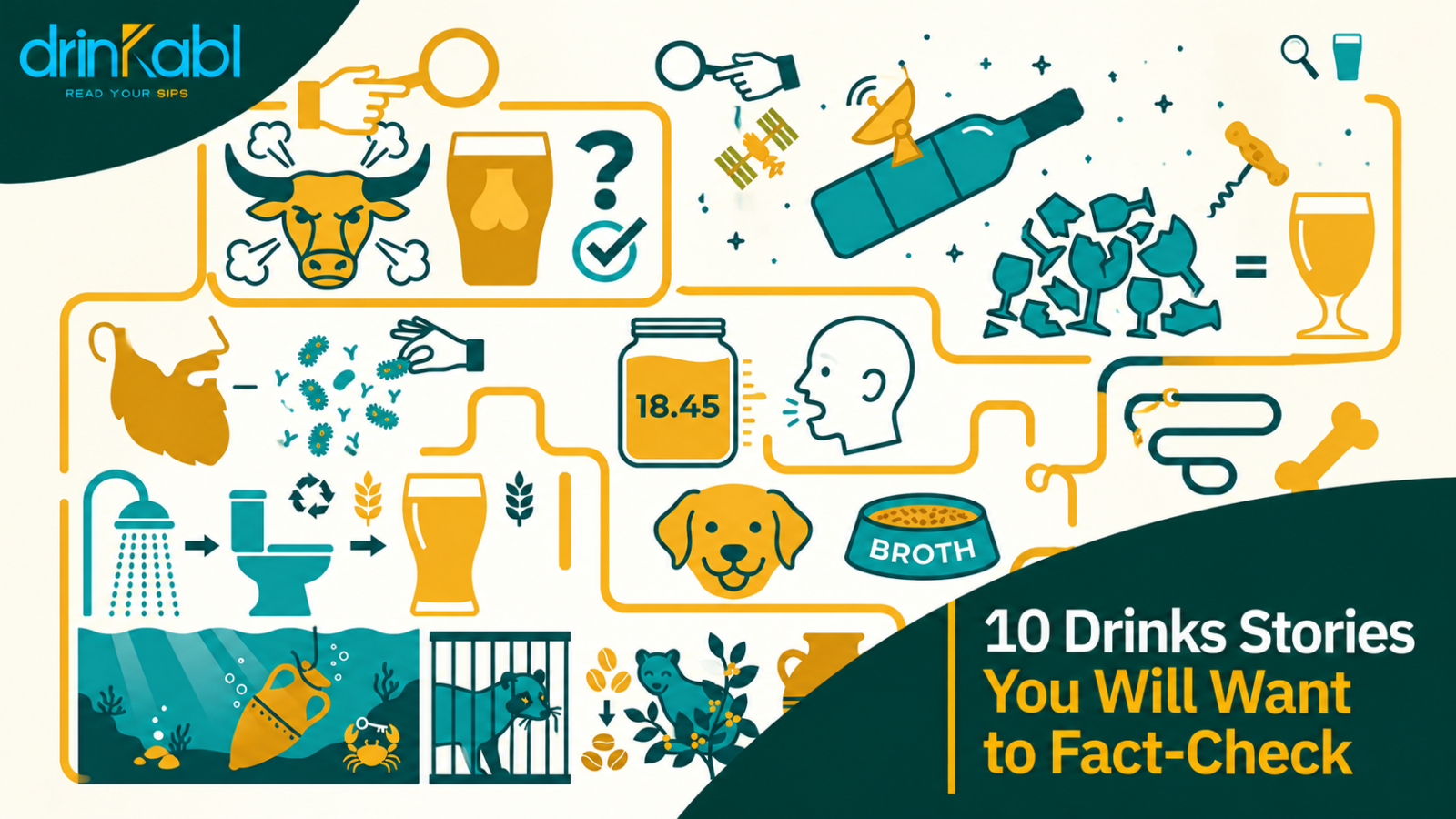

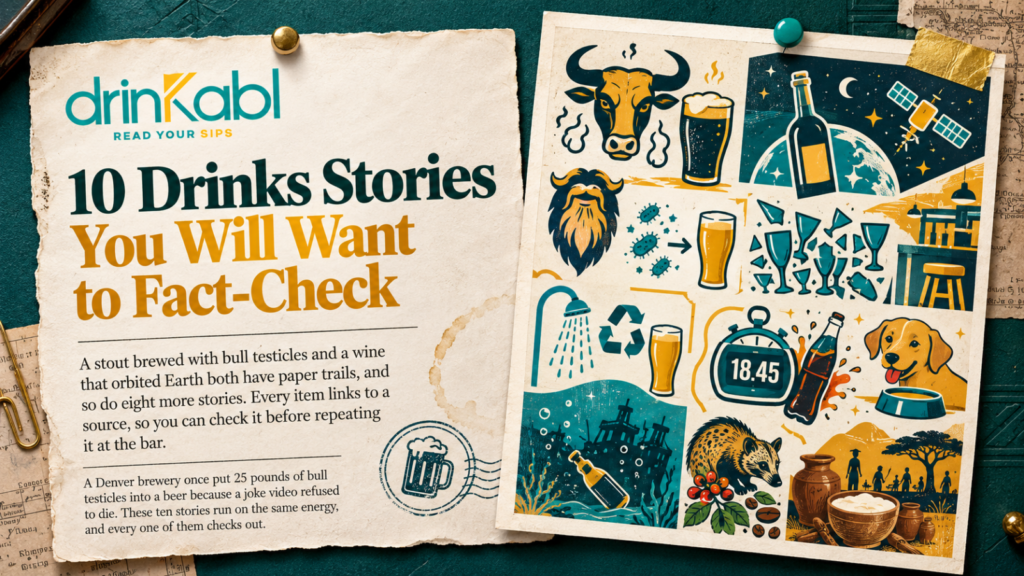
A stout brewed with bull testicles and a wine that orbited Earth both have paper trails, and so do eight more stories. Every item links to a source, so you can check it before repeating it at the bar.
A Denver brewery once put 25 pounds of bull testicles into a beer because a joke video refused to die. These ten stories run on the same energy, and every one of them checks out.
1. A Joke Video Forced a Denver Brewery to Brew Bull Testicle Stout
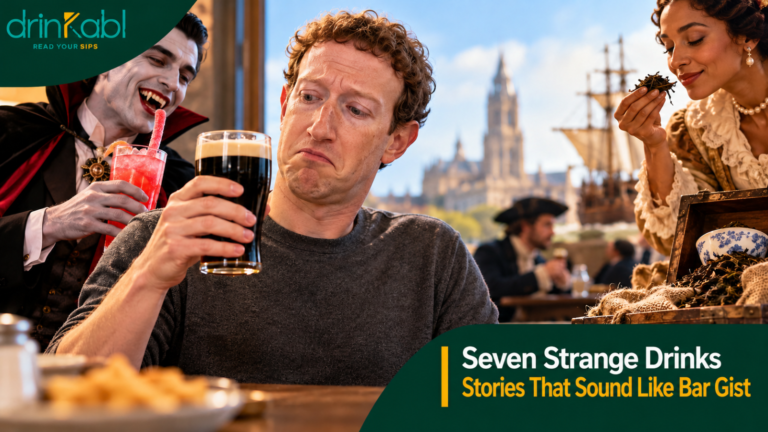
Wynkoop Brewing put 25 pounds of roasted, hand-sliced bull testicles into an eight-barrel batch of Rocky Mountain Oyster Stout. It began as an April Fool’s spoof video, and brewers and beer writers wrote in asking for samples.
The 7% stout debuted at the Great American Beer Festival in October 2012. Federal regulators first wanted information on bull testicles as a food additive, but the real label trouble came from the word oyster.
2. Wine Spent 438 Days on the International Space Station
Twelve bottles of Pétrus 2000 went up in November 2019 and came back in January 2021 after 438 days in orbit. Tasters in Bordeaux compared them with Earth-aged bottles and found the space wine subtly changed.
Christie’s then offered one bottle by private sale with an estimate near US$1 million. The lot came with a matching Earth-aged bottle and a corkscrew made from a meteorite. Three bottles were opened for the tasting and eight were kept for more experiments.
3. A Brewmaster’s Beard Gave Rogue Ales Its Yeast
Rogue Ales in Oregon sent nine hairs from brewmaster John Maier’s beard to a lab as a joke. The test found a wild yeast that could ferment beer, and it was not the brewery’s own house strain.
The result reached shelves as Beard Beer, with a label reminding drinkers that brewers have used wild yeasts for centuries. Maier has not shaved since 1978, and the brewery’s president pointed out that nobody is drinking a beard, only beer made with its yeast.
4. Sydney Pubs Lost Glasses Faster Than They Could Buy Them
On Boxing Day 1942 the Dee Why Hotel opened with 2,000 new schooner glasses and closed with 600. About 400 had been stolen, and more than 1,000 were too damaged to use again.
It was not a one-pub problem. One estimate for 1944 put losses across Sydney’s 600 hotels at 180,000 glasses a week, though other reports from that decade give much smaller totals. Stolen glasses even reached a black market that sold some back to the hotels they came from.
5. Recycled Shower Water Is Now a Beer You Can Order
Epic Cleantec first brewed with treated shower, sink and laundry water from a San Francisco high-rise in 2022, but that Kölsch could not legally be sold. Its first commercial beers, Shower Hour IPA and Laundry Club Kölsch, launched in November 2025 with Devil’s Canyon Brewing.
The IPA uses fonio, the grain Nigerians know as acha, and kveik yeast. A four-pack sold for US$19.99, so a Californian water-reuse pitch now leans on a West African grain.
6. One Man Drank Two Litres of Cola in 18.45 Seconds
Eric Booker set the world record for the fastest time to drink two litres of soda in Selden, New York, on 19 May 2021. His time was 18.45 seconds, and the soda was sugar-free cola.
He drank it from a jar marked with measurements rather than from a bottle. He already ran a YouTube channel built around soda chugging, and he has said the title was a long-held dream.
7. Winemakers Copied Shipwrecks and Started Ageing Bottles at Sea
In 2010 divers found 168 bottles of champagne, roughly 170 years old, in a Baltic shipwreck. Tasters called the condition close to perfect, though some said the first whiff smelled like wet hair.
Four years later Veuve Clicquot sank about 350 bottles in the Baltic to be recovered over 40 years. A Napa winery tried the same off Charleston, and US regulators stepped in over the risk of unsafe substances entering the bottles. A Croatian producer later lobbied for a rule change and now sells its sea-aged wine in the United States.
8. Busch Brewed a Beer for Dogs
Busch launched Dog Brew on National Dog Day, 26 August 2020. It has no alcohol and is a pork bone broth made with corn, celery and herbs.
A four-pack sold online for US9.99andwasneverstockedinshops.BuschpledgedUS1 from every case to an animal charity, up to US$50,000. The company’s own warning is plain, since alcohol and hops are toxic to dogs, so owners should keep their Busch to themselves.
9. Civet Coffee Has a Certification Problem
Kopi luwak is made from coffee cherries eaten by Asian palm civets, with the beans collected from their droppings. A cup can cost up to US$80 in the United States.
A 2016 study of plantations in Bali found that caged civets lived in conditions that failed basic animal welfare requirements. Nobody can tell caged-animal beans from wild ones, so UTZ and the Rainforest Alliance will not certify any kopi luwak.
10. Beer Connects the Living to Their Ancestors in Southern Ethiopia
Among the Gamo Boreda of southern Ethiopia, beer feasting marks status and seniority and is believed to connect the living with their ancestors. Pottery and oral tradition from the site of Ochollo Mulato point to large ritual feasts over eight centuries.
In Konso society, beer is daily food, a form of reciprocal exchange and a ritual libation. The same brew could pay for a day’s labour and also be poured for the dead.
Read more