
Convenience, flavour and changing drinking occasions are turning premixed beverages from a novelty into one of Africa’s fastest-growing beverage categories.
For years, Africa’s beverage conversation centred on a few familiar categories: beer, spirits, wine, soft drinks and, increasingly, water. A different kind of competitor is now showing up on the shelf, and it comes in a can.
Ready-to-drink beverages, including premixed cocktails, flavoured malt drinks and hard seltzers, are becoming one of the more closely watched growth areas in Africa’s beverage market. The New Pour Report 2026 names the “RTD Revolution” as one of ten trends driving the continent’s beverage industry, describing RTDs as one of Africa’s fastest-scaling frontiers. Format, the report argues, can matter as much as flavour.
Convenience, not conquest
The strongest case for RTDs has little to do with consumers abandoning beer or spirits. The real shift is that they now have more choices around the drinking occasion itself. A beer suits watching football, a premixed cocktail suits a gathering, a zero-alcohol drink fits a weekday, and a premium spirit gets saved for something more deliberate.
That reframes the opportunity. Rather than stealing share from beer, RTDs are expanding the number of moments in which a branded alcoholic drink feels like the right choice, alongside parallel shifts the report tracks in no-alcohol drinks, premiumisation and local flavours.
The numbers behind the trend
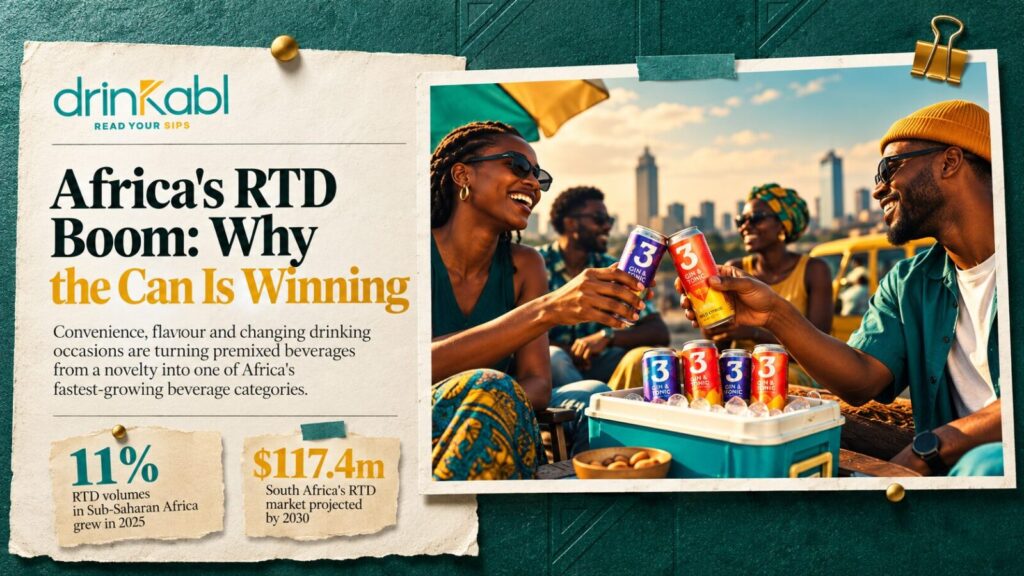
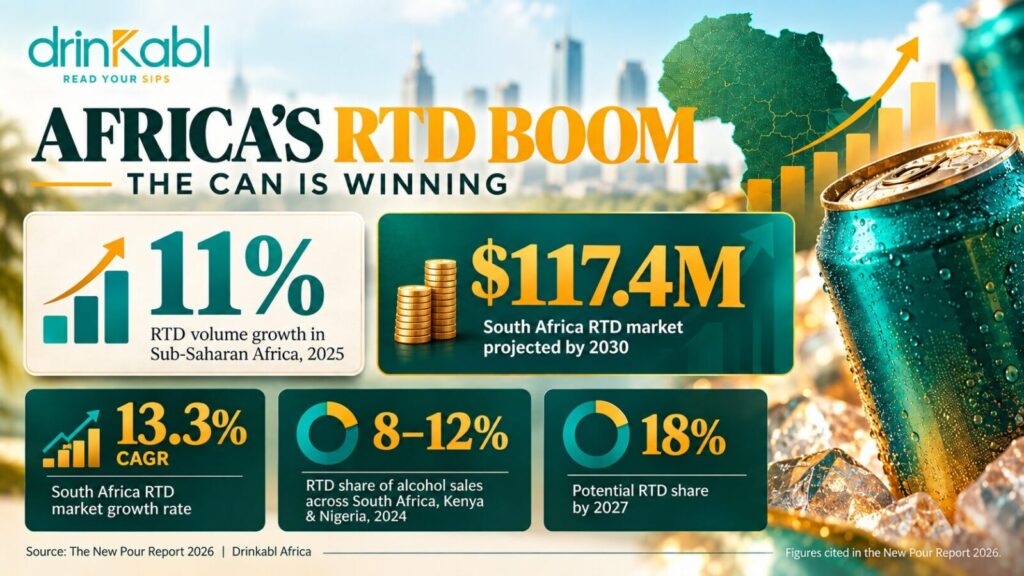
The New Pour Report puts South Africa’s RTD market on track for $117.4 million by 2030, growing at a 13.3% compound annual rate. It estimates RTDs made up 8% to 12% of alcohol sales across South Africa, Kenya and Nigeria in 2024, with room to reach 18% by 2027.
Regional data from IWSR points the same way: RTD volumes across Sub-Saharan Africa grew 11% in 2025, outpacing beer, spirits and wine. That growth won’t move at one speed everywhere. The report’s central argument, that Africa is 54 markets rather than one, applies here too: a format that works in Johannesburg may need a different price point or flavour in Lagos.
What the can changes
Packaging does more than hold the drink. A premixed beverage strips out the preparation that comes with cocktails and the complexity that comes with spirits, giving consumers something easier to buy, chill and carry.
For manufacturers, it hands over control of the finished experience: the flavour, strength, carbonation and presentation, rather than leaving that to a bartender or a bottle store. That shifts competition toward flavour and design as much as alcohol content, which is where Africa’s local ingredients start to matter.
Flavour as the next battleground
The report singles out African botanicals, baobab, hibiscus, moringa and indigenous grains, as an emerging source of differentiation. A global RTD brand arrives with a familiar international flavour profile; an African brand can instead ask what a distinctly African RTD should taste like.
That question is already producing answers. Zambian Breweries recently launched AB InBev’s MXD vodka RTD into its home market, while brands abroad, such as Smoove’s prebiotic RTD juice, are building entire propositions around African ingredients and culture. The opportunity is not an exotic spin on an imported product; it is giving ingredients consumers already recognise new relevance in a modern format.
Convenience has to be affordable
There is a tension at the centre of the opportunity. African beverage markets remain price-sensitive, and the report’s inflation analysis shows consumers trading down or shifting to illicit alternatives when costs rise.
A drink can be innovative and convenient, but if it sits beyond a consumer’s reach, the format alone will not build scale, particularly once packaging, production and distribution costs are added to the price. That leaves RTD makers with a basic question for every product: who is the consumer, and what will they pay for convenience? A premium canned cocktail aimed at affluent urban drinkers is solving a different problem from an affordable flavoured malt drink built for mass-market occasions, which is why portfolio structure will decide who wins as much as the format itself.
A middle ground between categories
RTDs sit in the space between established categories: less involved than a cocktail, more casual than a premium spirit, and closer to a soft drink in convenience while still delivering alcohol. That flexibility gives producers room to position a product as premium, youthful or culturally rooted depending on formulation and packaging.
It also dovetails with the report’s “sobriety boom” finding: African consumers are not giving up alcohol so much as widening the range of choices they consider acceptable.
Distribution decides how far it travels
None of this matters if a promising RTD cannot reach consumers reliably. Distribution remains one of the central structural challenges in African beverages, spanning formal retail, informal trade, hospitality outlets and, increasingly, digital commerce. A product built around convenience needs a distribution network that delivers the same promise: available in supermarkets, bars, events and convenience stores, not confined to a handful of premium outlets.
Established brewers already hold an advantage here, with cold-chain infrastructure, sales teams and retailer relationships in place. Smaller producers, like Kallucha’s fermented coconut water play, have a different edge: they can experiment faster, testing a flavour, occasion or cultural reference before a larger competitor commits to it.
The opening for local entrepreneurs
That speed is where the report sees the clearest opening for African entrepreneurs. It names RTDs and non-alcoholic drinks among the fastest paths to modern-trade shelf space, built on local stories and indigenous ingredients rather than scale alone.
African Originals in Kenya offers an early example, having launched the country’s first locally sourced RTD gin and tonic. The advantage comes from knowing which consumer, in which market, wants which drink, at which price, for which occasion, more than from being African at all.
The category still has to prove itself
RTDs carry strong signals, but they face the same pressures as the rest of the industry: inflation, taxation, regulation and distribution costs. Growth will not be even. Some markets will move faster than others, some flavours will disappear from shelves, and some brands will learn that good packaging cannot offset weak distribution or an unrealistic price. That is ordinary category development, not a reason to discount the opportunity.
What the can really represents
The bigger story sits behind the packaging. African consumers are being offered more formats, flavours and price points to participate in drinking culture, alongside the parallel rise of no-alcohol drinks, premium spirits and indigenous flavours.
If beer built its African business on familiarity, spirits on flexibility and soft drinks on mass convenience, RTDs are trying to combine convenience, flavour, portability and occasion into a single product. The companies that win this category will not necessarily be the ones that put the most drinks into cans. They will be the ones that understand why consumers wanted the can in the first place.
This story is part of Drinkabl Africa’s editorial series on The New Pour Report 2026, examining the market forces, consumer shifts and commercial opportunities shaping Africa’s beverage industry. Read the full report.