

After a brief pause, Drinkabl Africa’s Bottling Brilliance series is back, continuing its conversations on the ideas, people and commercial realities shaping Africa’s beverage industry. Its latest session, “Building Investable Businesses in Africa’s Beverage Industry”, held on Sunday, 11 October, featured David Idagu, founder of Building for Africa, in a discussion about capital, market intelligence and what it takes to build beverage businesses capable of scaling.
On Sunday, 11 October, Drinkabl Africa’s Bottling Brilliance series opened with a question facing beverage entrepreneurs across the continent: what makes a business attractive to investors? A compelling product and rising sales can attract attention, but they do not guarantee profitability or the ability to scale. For founders, the challenge is building businesses that can grow beyond the limits of their initial success.
The session, titled “Building Investable Businesses in Africa’s Beverage Industry”, featured David Idagu, founder of Building for Africa. The discussion unpacked findings from The New Pour Report ’26, launched at the inaugural New Pour Summit in Nairobi on 25 July 2026, and examined the barriers preventing African beverage businesses from attracting capital and capturing more value across the supply chain.
Sales alone do not make a business investable
Idagu argued that investors look beyond attractive products and compelling brand stories. They want evidence of repeat purchases, workable unit economics, reliable distribution and scalability. Unit economics measures the revenue and costs associated with selling a product or serving a customer. When discounting, delivery expenses and delayed payments consume margins, growing sales can leave a business financially weaker rather than stronger.
Corporate governance and operational independence also matter. A company that relies on its founder to make every decision or maintain every relationship can struggle to expand. Investors need confidence that systems, people and processes can support growth without the founder becoming a bottleneck.
The discussion also highlighted the importance of understanding competitors, pricing, packaging and substitute products. Founders can mistake personal conviction for market evidence, launching products without adequately examining what consumers already buy or what might persuade them to switch.
The case for local market intelligence
Idagu cautioned against relying exclusively on large international research firms, arguing that standardised approaches can miss local languages, cultural nuances and purchasing habits. Researchers and market participants with direct knowledge of local markets can help businesses understand differences in buying power, product preferences and distribution.
The discussion used Jaba Juice in Kenya to illustrate the need to examine the wider competitive environment. A beverage company must understand not only its direct competitors but also alternative products competing for the same consumer spending. Such intelligence can help founders make better decisions about positioning, pricing and packaging before committing scarce resources.
Yet better information cannot solve the financing problem on its own. Africa receives an estimated 3.8% to 4% of global foreign direct investment, a figure cited during the session. Idagu argued that greater intra-African investment is needed to turn the continent’s consumer demand into businesses capable of competing with better-capitalised international brands.
A discussion between Idagu and Temitope Joseph Olanrewaju explored whether market intelligence should prioritise identifying business opportunities or highlighting existing consumer needs. Their exchange pointed to a shared challenge: African businesses need to understand what consumers want while encouraging local investors to provide the capital required to serve those needs.
Capturing more value from tea and coffee
The beverage value chain offered a practical example of where investment could make a difference. African producers export tea and coffee, but greater value can be captured through processing, branding, packaging and distribution to consumers. Ethiopia’s annual coffee export revenue was cited at approximately US$3 billion, alongside an argument that producers capture only a limited share of the wider value chain. The precise value retained locally requires further verification.
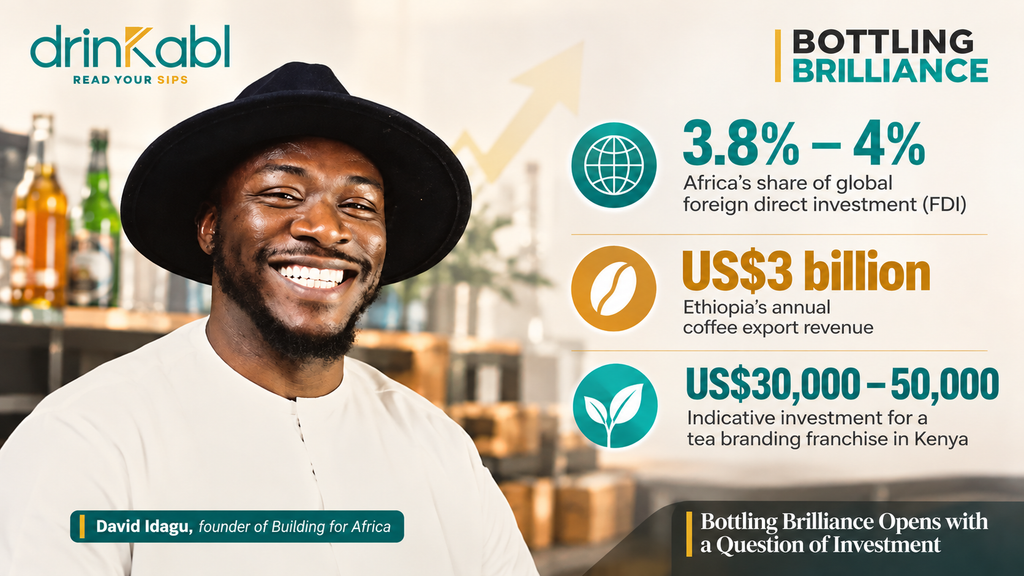
Idagu also discussed opportunities in Kenya’s tea sector, including branding franchises with indicative investment costs of US$30,000 to US$50,000. Other possibilities include supplying hotels and cafés with finished products and developing branded consumer experiences.
These opportunities require capital and careful execution. Businesses must manage supplier relationships, infrastructure constraints and distribution risks, rather than assume that demand will automatically translate into profit. Idagu encouraged collaboration and co-investment as ways for African investors and operators to share resources and support expansion across regional markets.
Bottling Brilliance returns to examine the data gap
The first session raised a question that leads directly into the next discussion: how can beverage businesses identify opportunities and make better decisions when reliable market intelligence is difficult to obtain?
On Sunday, 18 October, Bottling Brilliance will host Dharmendra Jain, founder and chief executive of Actnable AI, for a virtual session examining the data and insight deficit across African beverage markets. Drawing on The New Pour Report ’26, the discussion will explore how artificial intelligence, real-time analytics and actionable data models can help businesses understand shifting consumer behaviour and strengthen their market positions.
The session will examine intelligence gaps across African fast-moving consumer goods and beverage markets, the use of AI to interpret market signals, and how data can inform commercial decisions. For founders, marketers, distributors and investors, the focus is on turning information into practical advantages in pricing, product development and route-to-market strategy.

The webinar begins at 16:00 WAT on Sunday, 18 October 2026. It will be held virtually, with free admission and registration required. Interested participants can register here.
Bottling Brilliance is building a conversation around the conditions African beverage businesses need to grow. The first session examined what makes them investable. The next turns to the intelligence that can help them make better decisions.