
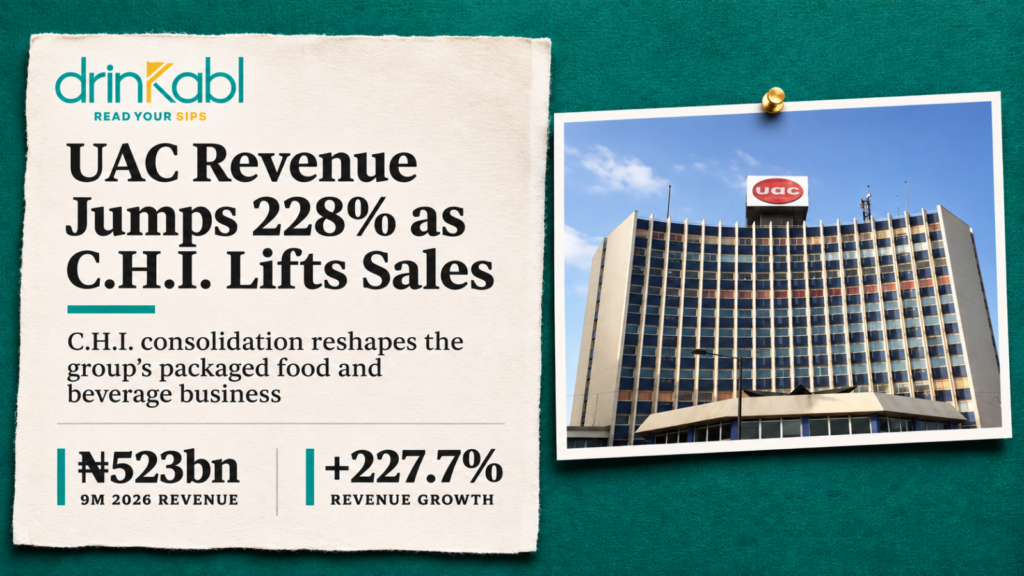
UAC of Nigeria Plc reported a 227.7% increase in revenue to ₦523 billion for the nine months ended September 30, 2026, as the consolidation of C.H.I. Limited significantly expanded its packaged food and beverages business. The results, released on October 30, also showed profit before tax rising 262.5% to ₦37.69 billion, reflecting stronger operating contributions from its consumer goods and paints operations.
The performance represents a major change in the group’s revenue composition following its October 2025 acquisition of C.H.I., the manufacturer of Chivita and Hollandia. However, the comparison with 2025 reflects an enlarged business rather than organic growth alone, as C.H.I. was not consolidated for the corresponding nine-month period last year. The unaudited financial results identify 2026 as the group’s first full year of consolidating the acquired business.
Beverages Take Centre Stage
Packaged Food and Beverages generated ₦436.20 billion in revenue during the nine-month period, compared with ₦56.94 billion in 2025, representing growth of 666.1%. The division contributed approximately 83.4% of UAC’s consolidated revenue, making it the group’s dominant business segment following the acquisition of C.H.I. Limited.
The division’s expansion brings Chivita, Hollandia and Capri-Sun alongside UAC Foods’ existing portfolio, which includes Gala, SWAN Spring Water, Supreme Ice Cream and Funtime. Beyond the enlarged product portfolio, the segment generated ₦55.89 billion in operating profit, up 557.3% from ₦8.50 billion a year earlier, demonstrating its growing contribution to group earnings.
The acquisition has substantially changed UAC’s position in Nigeria’s packaged beverage and consumer goods market. Earlier Drinkabl coverage documented how the transaction increased the packaged food and beverages division’s share of group revenue in 2025.
Other Businesses Deliver Mixed Results
The Paints division recorded revenue growth of 11.3% to ₦33.69 billion from ₦30.27 billion, contributing approximately 6.4% of group turnover. Its operating profit increased 21% to ₦5.78 billion, with management identifying a 21% third-quarter sales volume increase and the August relaunch of Sandtex Select among the factors supporting performance.
Elsewhere, Edibles and Feed revenue declined 27.4% to ₦51.30 billion, reflecting weaker finished-goods prices across agricultural commodities. Quick Service Restaurants also recorded a 3.4% revenue decline to ₦1.86 billion, although its third-quarter revenue improved 3.6% as store sales strengthened.
The results therefore show that UAC’s expansion is increasingly concentrated in packaged food and beverages, while its agricultural and restaurant operations continue to face different operating conditions.
Finance Costs Remain a Concern
UAC’s gross profit increased 262.1% to ₦142.55 billion, while operating profit rose 343.7% to ₦59.54 billion. Gross profit margin improved to 27.3% from 24.7%, indicating better profitability after production costs as the contribution from packaged food and beverages increased.
However, net finance costs climbed 316.8% to ₦23.94 billion from ₦5.74 billion, reflecting the additional borrowing associated with the C.H.I. acquisition. Despite the higher financing burden, profit after tax increased 307.1% to ₦21.91 billion, compared with ₦5.38 billion in the corresponding period of 2025.
Debt Reduction and Divestments
UAC also reported stronger cash generation, with free cash flow reaching ₦98.44 billion, supported partly by a ₦33.4 billion release of working capital. Net debt declined by ₦62.8 billion to approximately ₦231 billion, while its net debt-to-last-twelve-months EBITDA ratio improved to 2.2 times from 5.9 times at the end of 2025.
The group also confirmed agreements to dispose of its 73.29% interest in Livestock Feeds Plc and 43% holding in DP World Logistics Limited, subject to regulatory approvals at the reporting date. The transactions form part of management’s effort to streamline its portfolio and reduce debt.
For Nigeria’s beverage industry, the results provide a clearer indication of how the transfer of established beverage brands into local corporate ownership is changing the competitive structure of the consumer goods market. The next test for UAC will be sustaining the earnings contribution of its enlarged beverage operations while managing acquisition-related financing costs and completing its planned portfolio adjustments.