

National Breweries is losing ground in Zambia, but Delta Corporation believes the brewery’s production economics could give a future owner an advantage in Zimbabwe. Its decision to hold on reveals how manufacturing costs, brand ownership and regional competition can shape an African beverage company’s investment strategy.
When Alex Makamure began explaining why Delta Corporation was reluctant to sell its Zambian sorghum beer business, the argument had little to do with the brewery’s latest financial performance. The Executive Director of Finance was discussing something potentially more valuable: the cost of making beer in Zambia compared with Zimbabwe. His explanation was straightforward. Zambia offers a cheaper production base, and transferring ownership of the business to another operator could create a competitor capable of exporting cheaper beer into Zimbabwe.
It is an unusual defence of an underperforming asset. National Breweries, Delta’s Zambian subsidiary, has struggled to deliver the results expected of it, and its latest performance offers little reason for celebration. Yet Makamure’s explanation reveals that the company is looking beyond the immediate earnings of the brewery. What it controls in Zambia could influence the competitive conditions of its much larger Zimbabwean operation.
The decision also offers a practical illustration of a question running through Africa’s beverage industry: how should companies value an asset when its strategic importance extends beyond the market in which it operates? Delta’s answer is that National Breweries may be worth considerably more to the group than its standalone financial performance suggests.
The economics behind the decision
Speaking during Delta’s November 2026 analyst briefing, Makamure acknowledged that management was uncomfortable with the performance of its regional businesses. He nevertheless indicated that the company believed recovery remained achievable, describing the Zambian operation as strategic and arguing that its ownership should not be surrendered without considering the wider consequences.
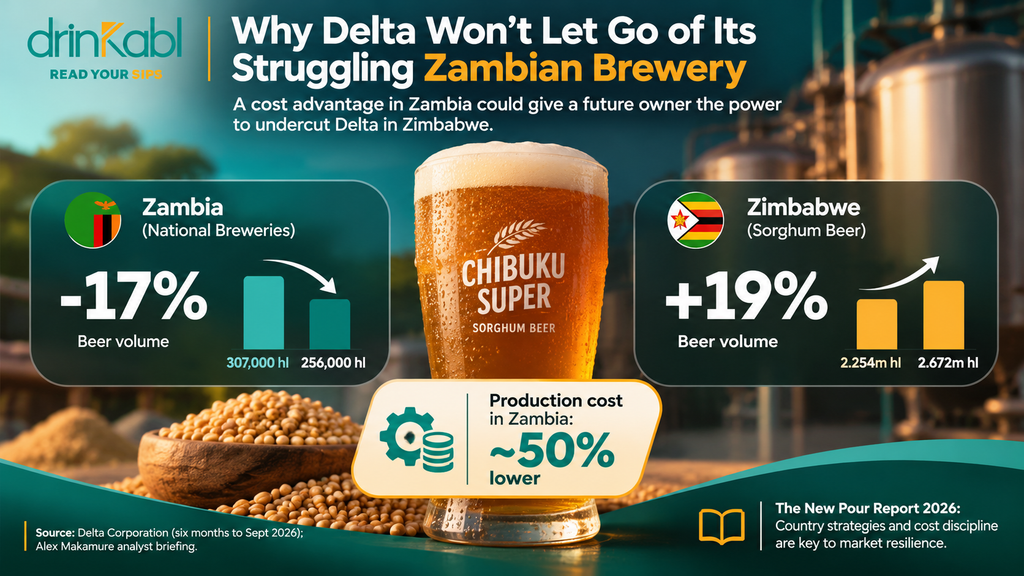
His explanation centred on the cost of producing Chibuku Super, Delta’s sorghum beer brand. Makamure said the cost structure per hectolitre in Zambia was approximately half that of Zimbabwe, with maize prices also around half the level observed in Zimbabwe. That difference creates a production advantage that could become commercially significant if another operator gained control of the facility and the associated production capability.
He also referred to the company’s experience producing beer in Zambia for sale into Zimbabwe. In his account, the exercise had already demonstrated that a Zambian production base could serve the neighbouring market. He illustrated the price difference by putting the Zambian product at approximately US$0.50 against US$0.90 in Zimbabwe, although the transcript does not specify the precise pricing unit or basis of comparison.
The implication was unmistakable. If Delta surrendered the Zambian business, a new owner could potentially use its lower production costs to manufacture competing sorghum beer and export it into Zimbabwe at a price that challenges Delta’s existing offering. Makamure described the possibility of such an entrant undercutting and destabilising the Zimbabwean business as a strategic consideration that management could not ignore.
The analyst briefing provides the wider context for the argument, although the detailed cost and pricing comparison comes from Makamure’s recorded explanation rather than a published comparative cost schedule.
A difficult business to defend
The immediate problem is that National Breweries has not yet translated its strategic importance into consistent operating performance. For the six months ended 30 September 2026, its volumes declined 17 per cent to 256,000 hectolitres, compared with 307,000 hectolitres in the corresponding period a year earlier. The business remained loss-making, although Delta reported an improvement in margins and a narrowing of the loss.
The company’s explanation identifies several pressures. Competition from unregulated alcohol, a resurgence of illicit beverages and weaknesses in route-to-market execution have restricted sales. Route to market refers to the distribution network and commercial arrangements that move products from the brewery through wholesalers and retailers to consumers. In a market where cheaper unregulated alternatives are readily available, weaknesses in that network can quickly become a problem for a formal producer.
There are, however, signs that some of the operational difficulties are easing. Packaged products accounted for 95 per cent of National Breweries’ volume during the reporting period, while better electricity availability, a firmer Zambian kwacha and lower cereal and import costs helped improve margins. Delta’s immediate recovery priorities include rebuilding distribution, expanding underserved markets and improving retail execution.
The difficulties also have a history. Delta’s 2025 annual reporting described a 30 per cent decline in NatBrew volumes, with electricity load-shedding and delays in commissioning diesel generators disrupting production. Higher maize prices, currency depreciation and the cost of running generators further weakened margins. The latest improvement in production conditions therefore does not automatically resolve the distribution and consumer affordability problems that have accumulated over several years.
Zimbabwe changes the calculation
The strategic argument becomes clearer when National Breweries is considered alongside Delta’s domestic sorghum beer operation. Zimbabwe’s sorghum beer business increased volumes by 19 per cent in the six months to September, reaching 2.672 million hectolitres. Chibuku Super alone recorded 27 per cent growth, supported by improved product availability, stronger distribution coverage and continuing brand loyalty.
The contrast is striking. While the Zambian subsidiary is losing volume, the same broader category is performing strongly in Zimbabwe. The latter is therefore a market Delta has an incentive to protect, particularly when its flagship Chibuku proposition remains an important part of its domestic beverage portfolio.
Delta’s overall half-year results reinforce the difference in scale between its domestic and regional operations. Group revenue increased 18 per cent to US$607.5 million, while operating income rose 13 per cent to US$112.2 million. The company’s presentation attributed the stronger first-half performance primarily to Zimbabwean volume growth, with regional operations remaining a drag on profitability.
The sorghum beer segment generated US$153 million in revenue, representing approximately a quarter of group revenue. Although that figure includes the broader sorghum beer business rather than Zambia alone, it demonstrates why protecting the category’s competitive position matters to the group.
There is also a wider manufacturing question. A brewery’s value is determined partly by its capacity, distribution network, brand rights, procurement arrangements and access to neighbouring markets. Selling a subsidiary can therefore transfer more than a factory and its current earnings. It can also transfer production knowledge, equipment, market access and the ability to compete across borders.
The New Pour Report’s warning about African markets
This is where the findings of The New Pour Report 2026 become particularly relevant. Its analysis of African beverage markets argues that the continent cannot be approached as one uniform commercial environment. Page 25 makes the case for country-specific strategies, while pages 26 and 27 examine how inflation, affordability and portfolio diversification influence the ability of beverage operators to withstand difficult trading conditions.
Delta’s Zambian experience illustrates both arguments. The company is operating across two neighbouring markets where the same product category faces different consumer economics, input costs and competitive conditions. A production advantage in one country could become a commercial disadvantage in another if the company loses control of how that advantage is deployed.
The report’s discussion of the shadow market also provides useful context. On pages 21 to 23, it examines how illicit products compete with legitimate operators through lower prices, while regulatory and economic pressures can push consumers towards unregulated alternatives. Delta’s latest assessment of National Breweries identifies precisely these forces among the reasons for its declining volumes.
The lesson is that lower production costs alone cannot guarantee a successful beverage business. A producer still needs reliable distribution, consumer acceptance, competitive pricing and the ability to protect its formal market position. Delta may possess a cost advantage in Zambia, but it must first demonstrate that it can convert that advantage into sustainable sales and profitability.
The risk of holding on
There is another side to Makamure’s argument. Retaining National Breweries protects Delta against the possibility of creating a stronger competitor, but it also means continuing to carry an operation that has struggled for years. The recovery requires investment, management attention and a credible response to the distribution and illicit-trade pressures that have weakened its performance.
Some reactions to the newZWire post on LinkedIn questioned whether openly discussing the cost advantage could alert potential competitors to an opportunity. Others suggested that rival Zimbabwean brewers could consider establishing production operations in Zambia themselves. These are legitimate strategic questions, although the comments do not establish that any competitor has plans to pursue such a move.
There is also a question of whether Delta can capture the potential regional advantage itself. The company has previously demonstrated the ability to produce in Zambia and export into Zimbabwe, but its latest results show that the subsidiary still needs a stronger domestic commercial foundation. A production advantage is only useful if it can be converted into reliable supply, profitable sales and sustainable market access.
For now, Delta’s stated position is recovery rather than disposal. Its immediate priorities are to rebuild distribution and improve retail execution, while management continues to view Zambia as strategically important to the group. The challenge is to ensure that the commercial logic of retaining the business eventually becomes visible in its financial performance.
Makamure’s explanation leaves Delta with an interesting strategic calculation. The company is holding on to a brewery that is losing volume because the same brewery, under different ownership, could become a source of cheaper competition in its home market. In this case, the value of an asset is measured not only by what it earns today, but also by what a competitor might be able to do with it tomorrow.