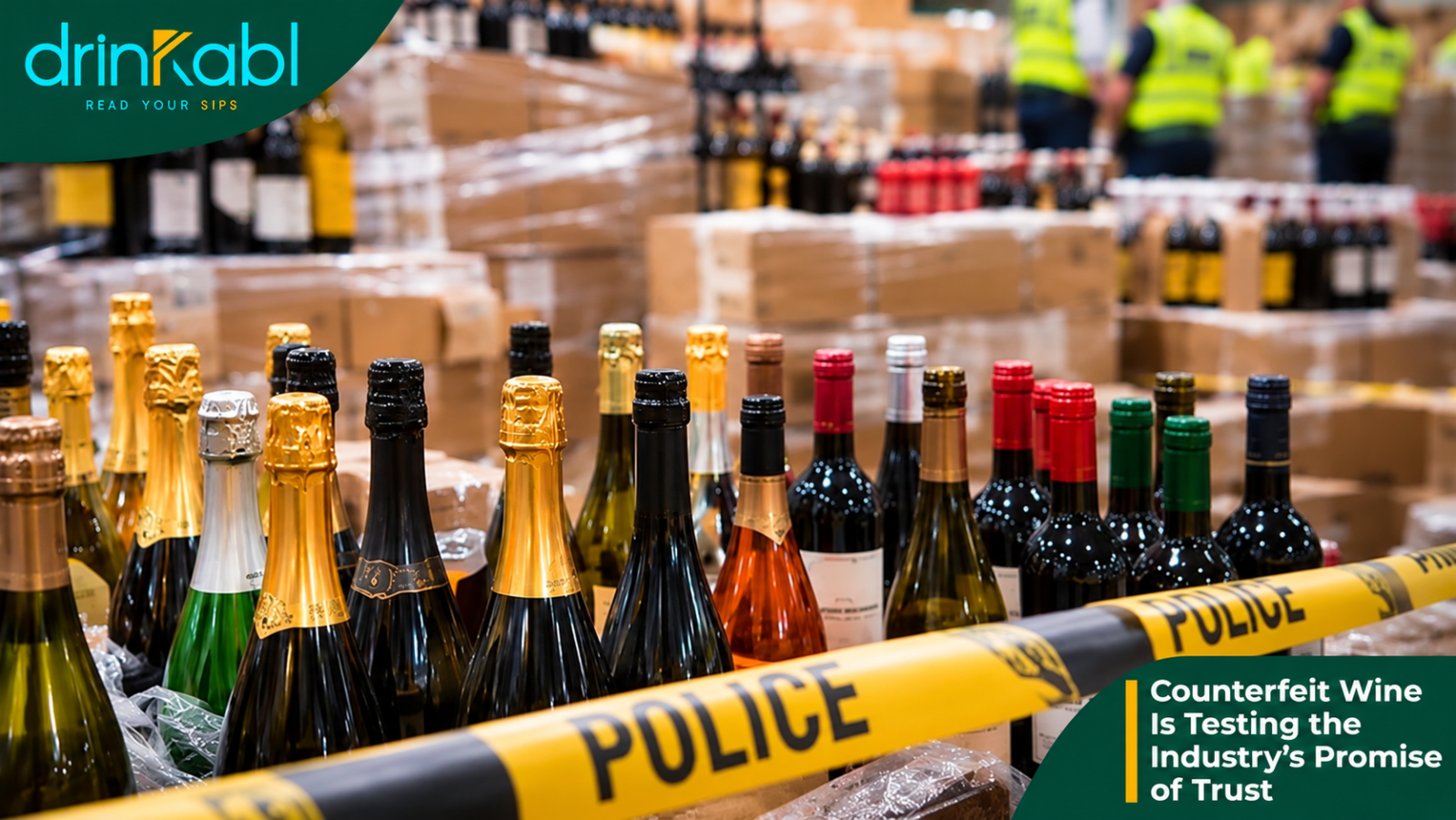

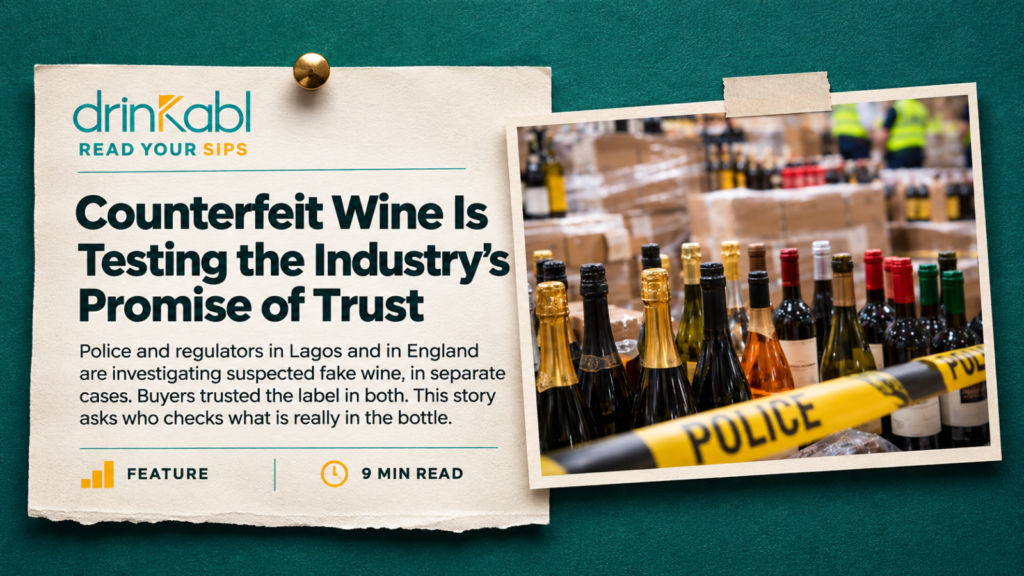
Police and regulators in Lagos and in England are investigating suspected fake wine, in separate cases. Buyers trusted the label in both. This story asks who checks what is really in the bottle.
On 13 October, officers from the National Agency for Food and Drug Administration and Control (NAFDAC), Nigeria’s food and drug regulator, raided a two-storey building at Zamfara Plaza, inside the Trade Fair Complex on the Badagry Expressway in Lagos. The agency said it caught some suspects in the act and recovered drums, filters, a heating device and packaging materials, in what it describes as the repackaging of wine, whisky and energy drinks. One of the two men arrested, Okafor, called himself a drinks dealer and gave a matter-of-fact account of his work. “I change the bottle of the drink,” he said, explaining that the bottle was never the problem and that the drink in the original had gone bad.
The raid is one of several this year that point at the same trade, in which a trusted label does the selling and the liquid underneath does not have to match it. Wine is an easy target because so much of its price sits on the label, and few buyers can judge what is inside before they pay. This feature follows the fakes from a Lagos parking store to a wine buyer in Essex, and asks who can check what a bottle really holds, and why so few of them do.
A plaza raided twice
NAFDAC said the October raid uncovered more than 20 stores hidden in makeshift parking spaces, where suspects were allegedly blending and counterfeiting popular brands, revalidating expired drinks for resale and stockpiling banned imports. It valued the seizure at more than ₦2 billion. It was not the first visit, because in April the same plaza was raided and more than 1,800 cartons of counterfeit and adulterated drinks worth about ₦350 million were recovered. A senior enforcement officer said the October suspects had moved from an earlier location after action against them, though she did not say where from.
The complex’s management said it was never meant to host such trade, that it had begun looking into how the activity took root, and that it would work with regulators to stop it. NAFDAC said it would trace where the products and raw materials came from and who was paying for the operation. In September, police sealed a suspected factory at Yafin in Badagry and arrested a 48-year-old man, Anaebo Emeka Hilary, recovering adulterated drinks, empty bottles, assorted wine labels and production utensils. Both cases are at the suspect stage, and the agency and the police are describing what they allege, not what a court has found.
Why the bottle is the easy part
Wine fraud takes three common forms. Some makers copy a brand’s packaging and sell cheaper wine under its name. Others refill genuine bottles with something else, and a third group lies about provenance, passing a wine off as coming from a grander vineyard, region or year. Okafor’s alleged trade belongs to the second kind, and it gets easier once new bottles can be bought in bulk.
David Francis, a director of the Alliance Against Counterfeit Spirits, told an April workshop organised by the Spirits and Wines Association of Nigeria that fake glass has been arriving from China since the pandemic. In the old days, he said, the supply of genuine bottles put a ceiling on what a counterfeiter could make. Data presented there recorded 998,838 counterfeit packaging items seized across Cameroon, Côte d’Ivoire, Ghana, Nigeria and Togo between 2023 and 2025, and the premises raided in Nigeria by the alliance’s teams rose from 36 to 66 to 105 over those years. Those figures cover spirits and say nothing specific about wine, and the rise in raids may reflect more enforcement as much as more crime.
The expensive end
The same logic works at the top of the market, where a label is worth thousands. In 2024, French, Italian and Swiss investigators dismantled a network in which Italian printing houses recreated the corks and labels of famous French wineries, and the forged bottles sold for up to €15,000 each. The investigators put the profits above €2 million and arrested seven suspects. This August, the UK’s Food Standards Agency arrested a 34-year-old man in Essex on suspicion of fraud by false representation after a sale of suspected counterfeit wine worth more than £500,000. He was bailed, and two days after the announcement the agency corrected it to withdraw the claim that the wine had sold at nearly £10,000 a bottle.
Maureen Downey, an authentication specialist, has claimed that criminal groups have spent about $500,000 on the same digital printing equipment legitimate producers use. If that is right, imperfect printing is a weaker clue than it used to be. Okafor’s alleged method needs no printing press at all, only a bottle with a respected name on it and a buyer who does not look closely.
How much is fake
The figure most often attached to this problem is that around 20 per cent of the world’s wine is counterfeit, a guess credited to bodies such as Interpol and the World Trade Organisation. It traces back at least to 2013, when a Bordeaux newspaper published it and a leading wine magazine questioned it, and nobody has produced a global count to support it. Downey has said she means all wine, measured by value, and that she counts adulteration and misrepresentation as counterfeiting. An interviewer once put to her that a 2016 OECD estimate for all counterfeit goods stood at 2.5 per cent, and she answered that there is far more fake wine than people want to believe.
Nigeria has its own contested number. The Spirits and Wines Association of Nigeria cites a 2024 survey that puts illicit trade at about 40 per cent of the spirits and wine market. Its members include Diageo, Pernod Ricard, Bacardi, Moët Hennessy, Guinness Nigeria and Nigerian Breweries, whose brands are the ones being copied, so the association has a direct stake in how large the problem looks. That does not make the figure wrong, but it is a brand owners’ estimate, and the raids above are what the public record shows for certain.
What is in the bottle
A fake label and a dangerous drink are separate problems. A copied wine can be harmless, and a convincing bottle can hold liquid made with no quality control. Francis told the workshop that 14 consumers died in Brazil in late 2025 after drinking methanol-tainted counterfeit alcohol, and that sales of legitimate spirits there fell by about 70 per cent. The public accounts of the Lagos and Badagry cases do not mention methanol, and nobody should assume every refilled bottle carries it. What the cases do show is that a buyer cannot read a drink’s chemistry from its colour or its smell.
Seals, QR codes and serialised tags can show whether a bottle has been opened or copied, and they give honest producers a way to prove a bottle is theirs. They do little when the person checking is a retailer who never scans anything, or a customer at a bar counter. None of them tests the liquid, which means someone has to open the bottle, take a sample and send it to a laboratory. NAFDAC said it would follow the products and raw materials back to their source and find out who employs the people it caught, and the public statements so far stop short of naming any of them. Okafor’s own explanation sums up the trade, since in his account the bottle was sound and only the drink had failed, and for a customer at a counter the bottle is usually the only part of the product on offer to judge.