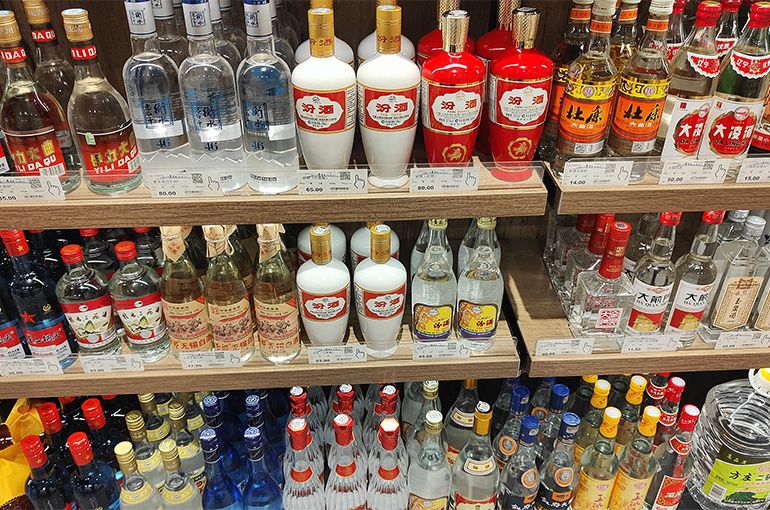

A flood of factory-grade bottle caps, moulds, and glass from China has dismantled the production ceiling that once limited counterfeit spirits across West Africa, with public health and fiscal consequences now measurable at nine-figure dollar values.
Momentum had been building within Africa’s anti-counterfeiting enforcement networks long before the COVID-19 pandemic reconfigured global supply chains. For years, the illicit spirits trade operated with an informal ceiling: genuine bottles, however misused, imposed physical constraints on scale. That ceiling, investigators now say, no longer exists.
Speaking at a one-day workshop organised by the Spirits and Wines Association of Nigeria in Lagos, David Francis, Experience Executive and Non-executive Director at the Alliance Against Counterfeit Spirits, identified a structural inflection point in the counterfeiting market, one driven by the emergence of factory-grade “dry goods” from Chinese manufacturers.
“What we’re now seeing particularly since the COVID-19 pandemic is the emergence of fake bottles. And fake bottles are genuinely problematic for us because at least in the old days of genuine bottles you had some kind of restriction in terms of the amount that could be produced.”
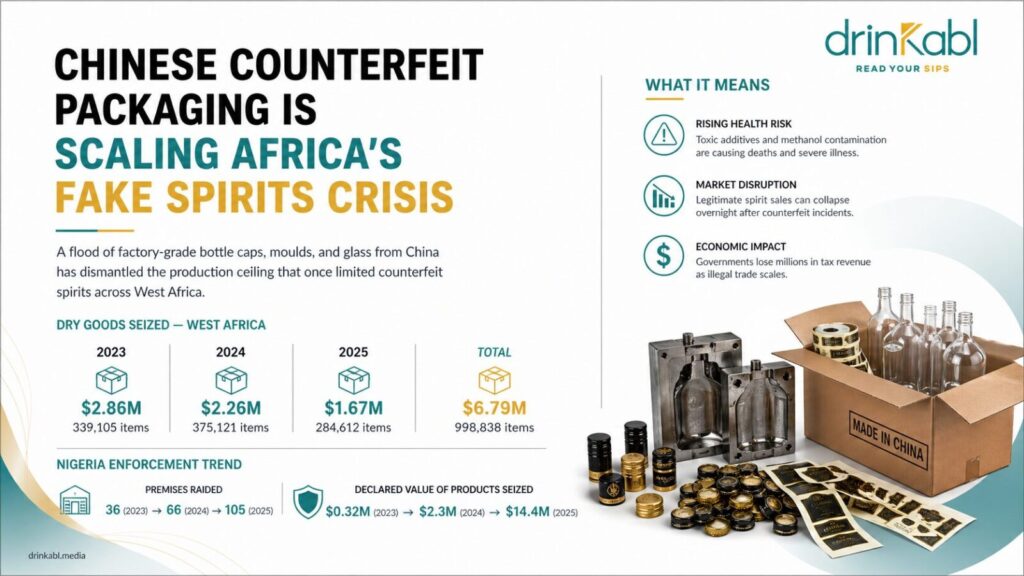
The shift has altered the economics of counterfeiting entirely. Where illicit producers once required access to legitimate packaging, they can now source complete production infrastructure, glass moulds, branded labels, Cognac-style caps, and export-ready cartons, directly from overseas suppliers operating at industrial scale. A single enforcement action in Shandong province netted approximately 12,000 fake bottles along with production moulds, while separate raids recovered nearly 50,000 Cognac caps and 70,000 Cognac bottles positioned for export.
The scale of seizures across West Africa reflects that structural shift. Enforcement data presented at the workshop recorded nearly one million dry goods intercepted between 2023 and 2025, with a combined declared value exceeding $6.7 million.
Dry goods seized — West Africa
| 2023 | 2.86M | 339,105 items |
| 2024 | 2.26M | 375,121 items |
| 2025 | 1.67M | 284,612 items |
| Total | 6.79M | 998,838 tems |
Nigeria’s trajectory within that dataset is particularly acute. Premises raided by AACS enforcement teams rose from 36 in 2023, to 66 in 2024, to 105 in 2025. The declared value of products seized across those three years climbed from $317,000 to $2.3 million to more than $14.4 million, a pattern that investigators attribute partly to improved enforcement reach and partly to the expanding value density of counterfeit operations as assembly capability increases.
Across the five-country footprint of Cameroon, Côte d’Ivoire, Ghana, Nigeria, and Togo, combined premises raided more than doubled from 75 in 2023 to 162 in 2024, before settling at 157 in 2025, with total seizure values reaching $14.6 million in the most recent year.
The public health dimension of the trade is not theoretical. Francis cited a cluster of fatalities in Brazil in late 2025, in which methanol-tainted counterfeit alcohol was linked to 14 consumer deaths. The market consequence was swift: legitimate spirit sales in the country fell by approximately 70 percent almost overnight, demonstrating the degree to which a single well-publicised incident can destabilise an entire category regardless of producer culpability.
Michael Ehindero, Managing Director of SWAN, framed the issue in categorical terms at the workshop’s opening, noting that illicit products are frequently produced without quality controls, regulatory oversight, or any consideration of safe alcohol levels, and may contain toxic additives that create long-term health consequences beyond acute poisoning risk.
SWAN, whose membership spans Bacardi, Diageo, Guinness Nigeria, Moet Hennessy, Nigerian Breweries, and Pernod Ricard Nigeria, positioned the workshop as the opening of a sustained industry campaign. The association also pointed to reputational spillover effects: government advisories issued to visitors during high-traffic periods such as the “Detty December” festive season have begun to explicitly reference counterfeit alcohol risk, a development that industry participants say erodes brand equity across the legitimate market indiscriminately.
Ehindero’s call for stronger public-private collaboration and intelligence-sharing signals that the industry’s near-term strategic posture will likely centre on upstream interdiction, targeting the Chinese dry goods supply chain before it reaches domestic assembly points, as the more scalable enforcement lever than raids on individual production premises.
Read More:
- SWAN Convenes Abuja Stakeholder Forum as Nigeria’s ₦472bn Illicit Spirits Crisis Reaches BreakingPoint
- Vaniti Lagos Fires Back at Fake Drinks Allegations
- NB’s Boidin Speaks On Lending Costs, Tax Volatility, Collapsing Beer Volumes At Pre-AGM
- Heavy Drinking Leaves Next-Day Cognitive Fog, Study Warns Young Adults