
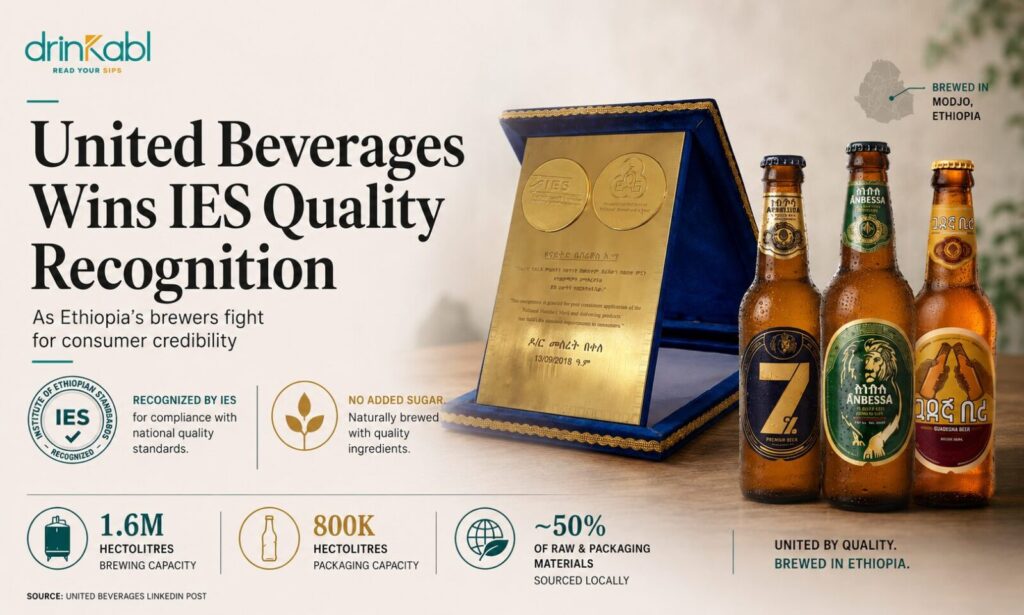
United Beverages Share Company has received recognition from the Institute of Ethiopian Standards (IES) for compliance with national quality standards, according to the company’s LinkedIn post published this week. The brewer, which markets Anbessa, SEVEN, and Guadegna beers from its Modjo facility in Oromia State, said the recognition validates its “No Added Sugar” commitment and natural-ingredient brewing approach, claims the company has not independently verified through third-party testing. According to the company, WALiiN is currently not available in the market.
IES is Ethiopia’s national certification body, responsible for standards marks administration and quality compliance verification across food, beverage, and manufacturing sectors. Recognition from the institute carries weight at the retail and distribution level, where compliance with national standards can influence stocking decisions, particularly in institutional or regulated channels.
For United Beverages, the timing is commercially deliberate. The brewer has positioned its portfolio against a field dominated by Heineken Ethiopia, BGI Castel, Habesha, and Dashen, leaning on ingredient transparency where larger players compete primarily on volume and distribution reach. Quality certification from a government body provides a reputational signal that advertising spend cannot replicate. Drinkabl.media’s recent coverage of Habesha Breweries showed how Ethiopia’s established brewers are reinforcing brand credibility through parallel means, underscoring how contested that space has become.
The broader sector context is unforgiving. Actual beer output sits at an estimated 11 million hectolitres, well short of projections, with rising taxes and security pressures named as primary causes. Malt beer carries an excise burden of 40% or ETB 28 per litre, whichever is higher, compressing margins across a market where retail prices generally stay below USD 1 per bottle. In that environment, differentiation on quality grounds offers a route to premium shelf positioning that volume-first strategy cannot guarantee.
United Beverages operates from a single plant with a brewing capacity of 1.6 million hectolitres and a packaging capacity of 800,000 hectolitres. The company sources around 50% of its raw and packaging materials locally, with plans to move toward full local sourcing. Greater domestic sourcing reduces FX exposure on inputs, which matters more as the birr remains volatile against import-priced alternatives.
The IES recognition does not disclose the specific standard category or certification scope. UB has not indicated whether the recognition covers its beer portfolio, including Anbessa, SEVEN, and Guadegna, or a specific production process. According to the company, SEVEN won the 2025 Monde Selection Gold Award and is Ethiopia’s first beer of its kind at 7% ABV. That detail determines how broadly the credential can be applied in distribution conversations or government procurement channels, where standards compliance is often assessed at product rather than company level.
READ MORE