

Habesha Breweries has launched Habesha Academy, a digital learning platform aimed at embedding continuous workforce development across its operations as the Ethiopian brewer enters a pivotal stage of growth.
The platform, announced this week, was built in partnership with two Ethiopian edtech firms: Muyalogy, a full-service online learning provider with over 55,000 registered users, and Jiret, a human capital management platform that integrates learning management with hiring, onboarding, payroll, and performance systems. Habesha described the initiative as designed to make growth “continuous, accessible, and part of everyday work.”
The timing is not incidental. Habesha is mid-stride through a capital market transition that has no precedent in its 16-year history. The Ethiopian Capital Market Authority approved the company’s share registration on December 31, 2025, covering over 3.5 million existing shares and a new rights issue. An ESX listing is expected to follow. Revenue climbed 28.6% to ETB 7.76 billion in 2024. The company is preparing to operate as a public issuer, under mandatory annual disclosure requirements, against a competitive field that includes Heineken and BGI Ethiopia. For a brewer moving at this speed, workforce capability is no longer a support function. It is an operational input.
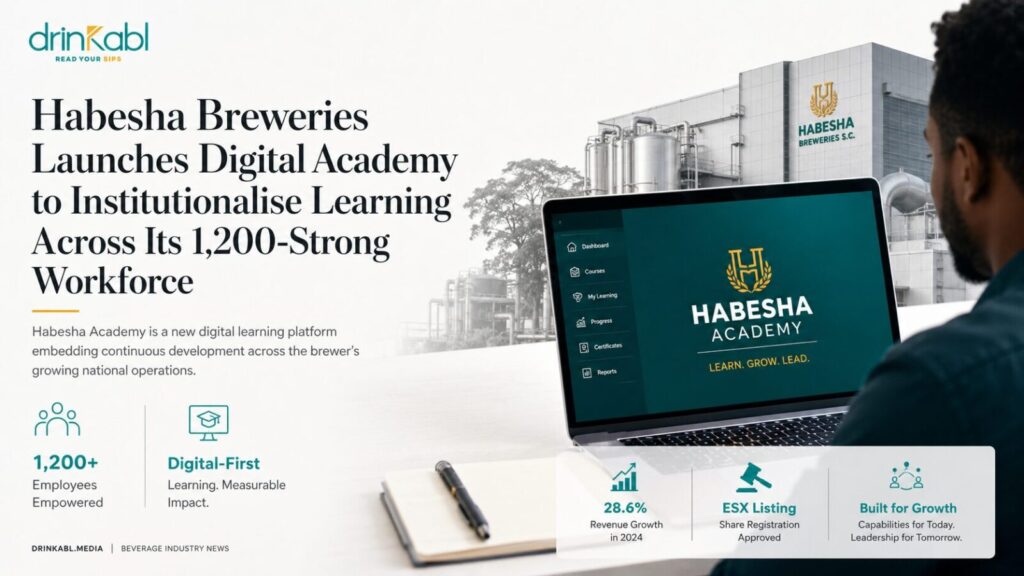
Habesha’s existing people infrastructure already runs deeper than most breweries in the region. The company has operated individual development plans, leadership coaching, and performance appraisals using the 9-Grid Talent Matrix. What Habesha Academy does is digitise and scale that architecture: moving learning off the calendar and onto the platform, accessible to a workforce that workforce analytics firm Revelio Labs placed at approximately 1,208 employees as of December 2025.
The platform choice reflects a deliberate local bet. Muyalogy, founded in 2022 by Misikir Adane, Natnael Adane, and Ewnetu Abera, has positioned itself as a leading corporate learning partner in Ethiopia, offering curriculum development, course production, and a white-label learning management system under the Jiret brand for organisations seeking fully customised training environments. Jiret’s suite spans SCORM and xAPI-compatible content delivery, learner progress analytics, automated certifications, and integrated coaching tools. The Muyalogy-Jiret architecture is already deployed across corporate, higher education, and government clients in Ethiopia, giving Habesha a vendor that understands the operational realities of the local market rather than one applying a global template.
That local grounding matters more than it might appear from the outside. Ethiopia’s skills gap is real, and it sits inside some of the country’s most commercially significant industries. Habesha sources 100% of its key brewing ingredients within Ethiopia, including barley, through a programme backed by the IFC, Rabobank, and ING. A workforce that cannot keep pace with the operational complexity that ambition requires is a supply chain risk, not just an HR problem.
The Habesha Academy launch also lands at a moment when Ethiopia’s beverage sector is quietly intensifying its people development posture. Coca-Cola Beverages Africa named Ethiopia one of its top-performing markets and recently won Top Employer certification for 2026. East African Breweries’ “Learning for Life” programme, though Nairobi-based, has trained over 10,000 people in business and hospitality skills. For Habesha, building an internal academy formalises something that peer companies have already proved generates competitive returns.
What the academy’s content catalogue covers, how learning completion ties to performance outcomes, and how Habesha plans to verify impact across its distributed workforce, including operations at the Debre Birhan plant, remain to be disclosed. Those details will matter to investors watching the ESX listing process, for whom human capital quality is increasingly a priced variable in beverage sector valuations. The next test of Habesha Academy will not be its launch. It will be whether the platform shows up in how the company performs once its shares begin trading.
Read More: