
Nigeria’s coffee industry received institutional backing this week as two key agricultural bodies formalised a research and production partnership
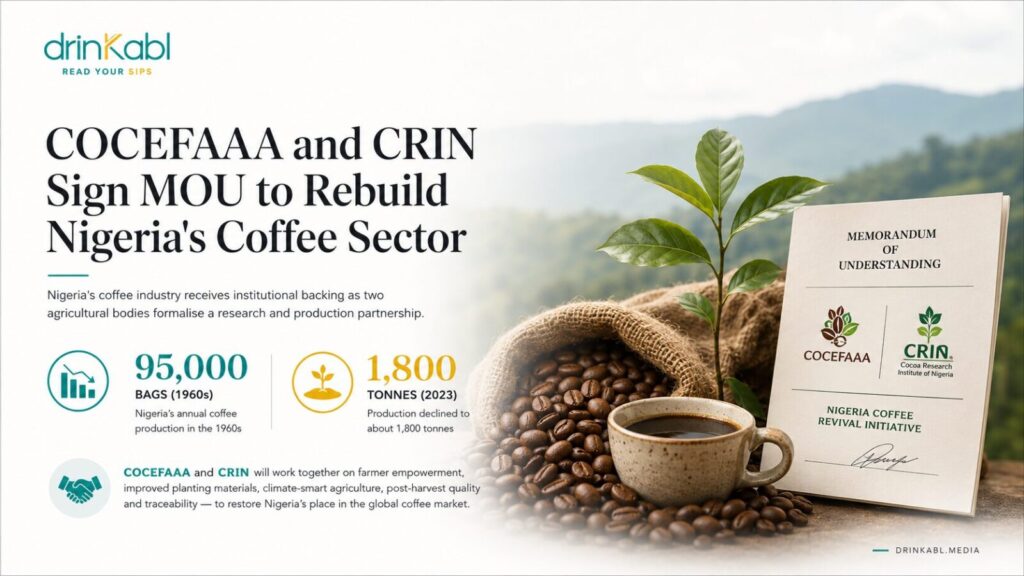
The Cocoa and Coffee Farmers Alliance Association of Africa and the Cocoa Research Institute of Nigeria have signed a Memorandum of Understanding under the Nigeria Coffee Revival Initiative, committing both organisations to a joint programme covering farmer empowerment, improved planting materials, climate-smart agriculture and post-harvest quality enhancement.
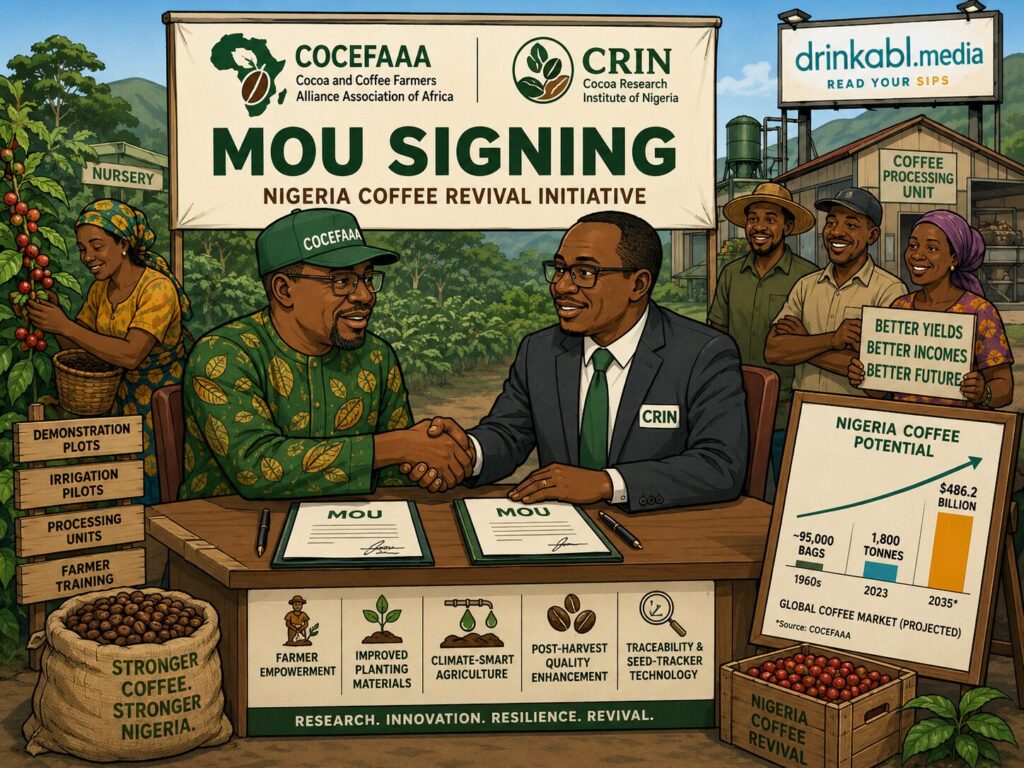
The agreement gives research muscle to Nigeria’s coffee revival push. Under the MOU, COCEFAAA and CRIN will establish commercial processing units, demonstration plots and irrigation pilot projects, and deploy traceability and seed-tracker technology to improve transparency across the supply chain. The partnership also commits both bodies to training farmers and extension officers with the aim of raising productivity and tightening quality standards across the cocoa and coffee sectors.
Speaking on the partnership, COCEFAAA Global President Adeola Adegoke said the agreement was a direct attempt to recover ground Nigeria has long ceded in the global coffee market. “This collaboration represents a strategic step toward restoring Nigeria’s position in the global coffee market while improving the livelihoods of thousands of farmers across the country,” Adegoke said in a statement on Wednesday. He added that the initiative is expected to support job creation, strengthen rural economies and expand export opportunities.
The scale of the task is not small. According to FAO data, Nigeria’s area dedicated to coffee cultivation stagnated at around 1,450 hectares between 2016 and 2023, with production holding at approximately 1,800 tonnes over the same period. That is a steep fall from the roughly 95,000 bags the country produced annually in the 1960s, when Nigerian coffee was a commercially significant export commodity. The decline maps closely to the country’s shift toward oil revenue in the 1970s and 1980s, which pulled farmers and government investment away from export crops.
The global coffee market is a worthwhile target to reclaim. COCEFAAA has cited the market at USD 284.8 billion in 2025, projected to reach USD 486.2 billion by 2035, driven by steady consumption growth across Asia and an expanding café culture in African cities, including Lagos.
Adegoke said COCEFAAA and CRIN will work alongside cocoa- and coffee-producing states, research institutions, academic organisations, NGOs and industry stakeholders to implement the programme. Aligning CRIN’s research capacity with farmer organisations across multiple states is a meaningful structural step — wait, that contains an em dash. Corrected below.
Adegoke said COCEFAAA and CRIN will work alongside cocoa- and coffee-producing states, research institutions, academic organisations, NGOs and industry stakeholders to implement the programme. Aligning CRIN’s research capacity with farmer organisations across multiple states is a meaningful structural development. CRIN has been Nigeria’s primary applied research body for cocoa, coffee, kola, cashew and tea since its establishment in Ibadan in 1964.
The MOU follows a series of initiatives earlier this year aimed at rebuilding Nigeria’s coffee industry. In early May, the Federal Government, COCEFAAA, and the National Coffee and Tea Association of Nigeria flagged off a 1,000-hectare coffee cultivation project in Ondo State in partnership with Lingzhi Global Nigeria Limited. At that event, Ondo State Governor Lucky Aiyedatiwa’s representative said the project would directly engage over 2,000 farmers and create thousands of additional jobs across processing, packaging, transportation and export. COCEFAAA used the same occasion to call on the Federal Government to finalise and implement a National Coffee Strategy covering subsidised inputs, extension services and export incentives.
The AFAN National Publicity Secretary, Femi Oke, has separately called for urgent investment and policy support for cocoa, arguing the crop had lost the prominence it once held as one of Nigeria’s leading agricultural exports.
Nigeria’s cocoa sector, by contrast, has been generating record export revenue, partly driven by supply disruptions in Côte d’Ivoire and Ghana. Data from the National Bureau of Statistics shows cocoa export earnings in the first quarter of 2025 reached N1.23 trillion, more than 200% above the N421.78 billion recorded in the same period of 2024. The NBS recorded N3.63 trillion in total cocoa export earnings over the 12-month period from June 2024 to June 2025.
Sunbeth Global Concepts Ltd, one of Nigeria’s largest cocoa exporters, has announced it is constructing a 70,000-metric-tonne cocoa processing plant and an 80,000-metric-tonne cashew processing facility in Sagamu. Managing Director Olasunkanmi Owoyemi made the announcement at the Africa Cocoa Finance and Investment Forum held at the London Stock Exchange. Both facilities are scheduled for commissioning in March 2027.
The practical question now is whether the institutional framework being assembled, from MOUs and demonstration plots to seed-tracker technology and capacity-building programmes, can mobilise private investment at the scale Nigeria’s coffee rehabilitation requires. The Federal Government’s promised National Coffee Strategy, still pending finalisation, is where that answer begins.
Read More