
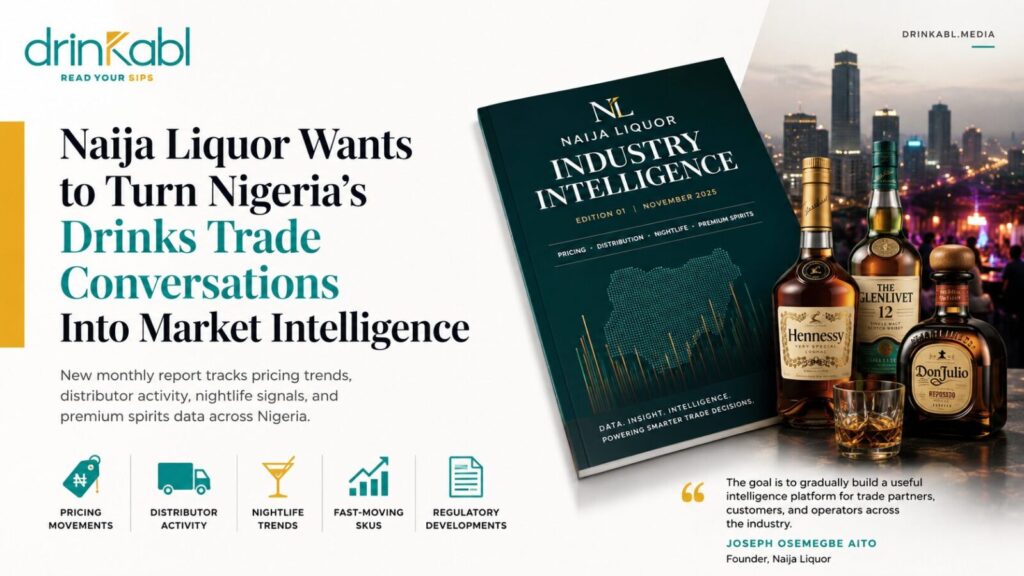
Naija Liquor has launched the first edition of Naija Liquor Industry Intelligence, a monthly trade publication built around pricing trends, distributor activity, nightlife signals, retail movement, and premium spirits data from Nigeria’s wines and spirits market.
For years, large parts of Nigeria’s beverage trade have operated on instinct, phone calls, and fragmented distributor conversations. One importer hears whisky prices moved in Abuja. A sales rep notices cognac slowing in Lekki lounges. A retailer quietly flags rising demand for tequila in Port Harcourt. The information exists, but rarely in one place.
Joseph Osemegbe Aito, founder of Naija Liquor and a former Pernod Ricard sales executive, says that gap is exactly what the company wants to close.
“Important pricing movements, nightlife trends, promotional activity, and trade sentiment are often sitting in silos, but rarely organized into something the industry can consistently learn from,” Aito wrote on LinkedIn while announcing the report’s release.
That observation will sound familiar to anybody who has spent time inside Nigeria’s alcohol trade. The market is large, noisy, fragmented, and surprisingly opaque for an industry that moves serious money every year. Reliable syndicated data is limited. Importers guard numbers aggressively. Distributors speak in fragments. WhatsApp groups often carry more useful market intelligence than formal presentations.
Naija Liquor appears to be betting that operators are finally ready for something more structured.
The report promises coverage across pricing movements, distributor activity, nightlife trends, fast-moving SKUs, activations, and regulatory developments. It also leans heavily into premium wines and spirits, a category Aito has consistently positioned himself around since leaving corporate FMCG roles to build Naija Liquor.
That positioning matters.
Nigeria’s premium spirits market has expanded noticeably over the past decade, even through inflation shocks and naira volatility. Cognac, single malt whisky, tequila, cream liqueurs, and premium ready-to-drink products have all gained visibility across urban nightlife channels. Importers have responded with more aggressive portfolio expansion, while distributors increasingly compete on speed, exclusivity, and route-to-market execution instead of simple availability.
Coverage of Nigeria’s premiumisation trend has already been tracked in Research across several African beverage markets, particularly as younger urban consumers shift toward experience-led drinking occasions.
Aito himself has spent years speaking publicly about route-to-market inefficiencies, distributor structure, and field execution inside Nigerian FMCG. His background gives the publication a commercial tone that feels closer to trade-floor conversation than academic market analysis.
That comes through clearly in the launch note.
“The goal is to gradually build a useful intelligence platform for trade partners, customers, and operators across the industry,” he wrote.
The ambition is sensible. The hard part will be consistency.
Trade intelligence publications only become valuable when readers trust the information flow month after month. That means accurate pricing checks, credible channel sampling, and enough distributor access to spot changes before they become obvious to everybody else. It also means separating genuine market signals from nightlife hype, something Nigeria’s alcohol market struggles with constantly.
Still, the timing is not accidental.
Pressure across the beverage industry has intensified over the past 18 months. Currency instability has distorted imported spirits pricing. Consumers are trading down in some categories while splurging selectively in others. Hospitality operators are adjusting inventory faster. Suppliers want sharper visibility on what is actually moving.
Naija Liquor has increasingly tried to position itself beyond simple retail. The company has already drawn attention for its anti-counterfeit authentication technology and supply-chain monitoring efforts, according to interviews published by The PUNCH and BusinessDay in 2025.
That wider intelligence positioning may become commercially useful if the company can build trust among importers, distributors, and hospitality operators who typically guard market information closely.
“The goal is to gradually build a useful intelligence platform for trade partners, customers, and operators across the industry.”
Joseph Osemegbe Aito, LinkedIn post announcing Naija Liquor Industry Intelligence
What operators will watch now is whether the publication evolves into a serious industry reference point or remains an interesting internal document with public circulation.
The next few editions will probably decide that. If Naija Liquor can consistently surface pricing movement early, identify fast-moving categories before competitors react, and map nightlife behaviour with credibility, the report could become required reading across parts of the trade. If not, it joins the long list of Nigerian industry publications that launched loudly and faded quietly once the operational workload kicked in.