
Zenith Global Commercial is opening free public access to its Market Intel infograph library, a visual intelligence resource for food and beverage executives that translates major corporate moves, M&A transactions, and category shifts into commercial interpretation rather than raw news.
Akos Petri, the firm’s Managing Director and a former director at Zenith Global Ltd, launched the initiative against a specific backdrop: the past 18 months produced some of the most consequential deal-making in the beverage industry in years, and the volume of those signals has outpaced most executives’ ability to process what they mean for their own portfolio, category, or next move.
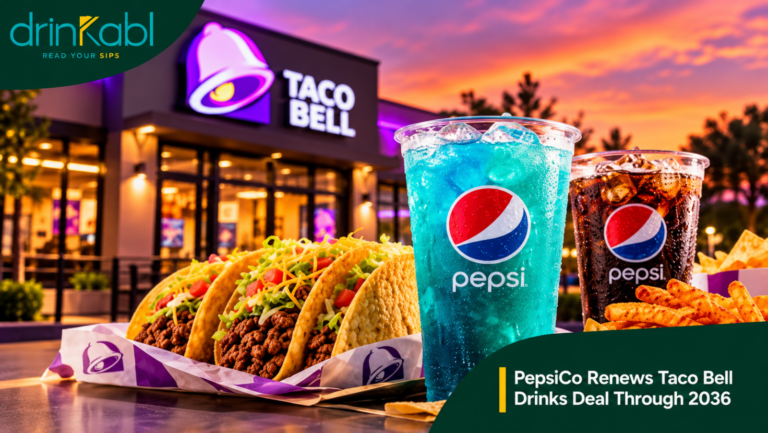
The transactions are not abstract. PepsiCo’s USD 1.95 billion acquisition of prebiotic soda brand Poppi is not just a deal. It marks the moment one of the world’s two largest beverage companies formally committed capital to gut health as a structural category, not a trend to monitor. Coca-Cola HBC’s USD 2.6 billion agreement to acquire a controlling stake in Coca-Cola Beverages Africa is not just a bottling transaction. It will bring 14 additional African markets, including Ethiopia, Kenya, and South Africa, under a single Coke bottler, reshaping distribution dynamics and competitive pressure for every beverage brand operating or entering those markets. Celsius Holdings’ USD 1.8 billion acquisition of Alani Nutrition pulled two of the fastest-growing energy drink brands in North America under one roof. Keurig Dr Pepper’s EUR 15.7 billion move on JDE Peet’s restructured the global coffee category in a single announcement.
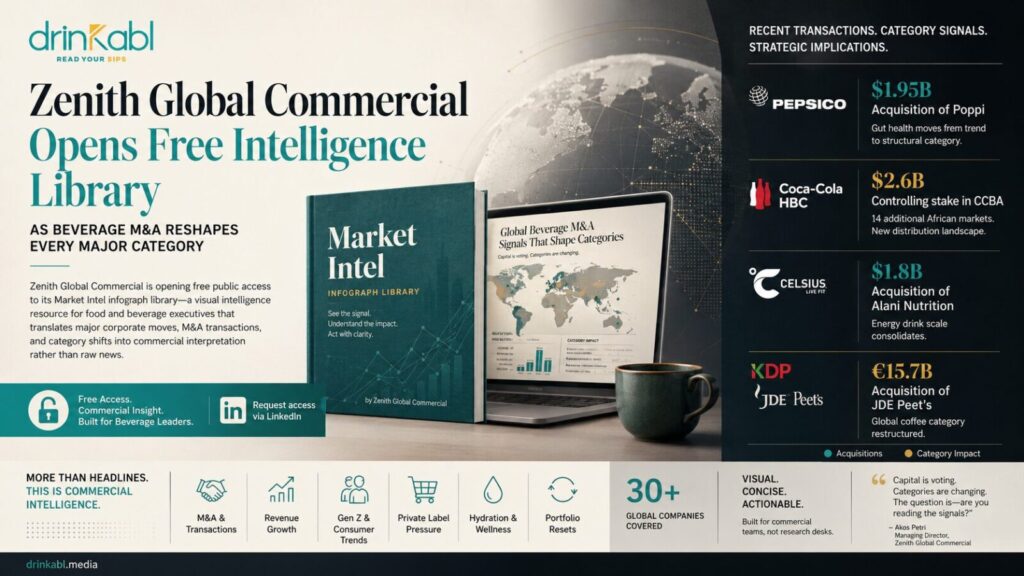
Each of those transactions tells a category story. Together, they map where capital thinks beverage growth is coming from. The Petri argument is that most executives see the headline and miss the implication.
The Zenith library covers companies including Coca-Cola, PepsiCo, Nestlé, Unilever, Danone, Mars, Mondelez, and McDonald’s, with topics ranging from M&A and revenue growth to Gen Z behaviour, private label pressure, hydration strategy, and portfolio resets. The visual format is the point. A one-page infograph on a Diageo portfolio exit can sit in a pre-meeting briefing; a 30-page analyst report cannot. The audience is a commercial team, not a research desk.
The exit side of the ledger is as instructive as the acquisition side. Diageo’s structured retreat from African beer, which included the sale of Guinness Nigeria to Tolaram, the divestiture of Guinness Ghana to Castel Group, and the pending sale of its East African Breweries stake to Asahi, tells a story about where a global spirits major assessed its competitive odds in beer on the continent. Heineken followed a parallel path, exiting its Democratic Republic of Congo unit. Regional operators watching those exits can draw a direct line to their own competitive environment: multinationals are pulling back from African beer, which creates space but also removes the floor that their distribution infrastructure and category investment provided.
This publication’s March 2026 assessment of Africa’s beverage sector mapped exactly those dynamics, noting the structural retreat of the world’s biggest alcohol groups from markets they shaped for decades. The tools for reading those global signals and translating them into regional strategy have largely been priced for multinationals. Petri’s proposition is that visual, freely accessible interpretation can lower that threshold.
Zenith Global Commercial’s client history includes engagements with Nestlé, Danone, Capri-Sun, and the Irish Food Board, built on more than three decades in the sector. The library’s access model is a lead-generation mechanism and is straightforwardly presented as one: request access via LinkedIn. Whether the depth and update frequency justify sustained use is what the content itself will have to prove.
The next major test for the library’s relevance is already visible in the pipeline. Coca-Cola HBC’s CCBA transaction is expected to reshape African beverage distribution in markets this publication covers directly, and the intelligence gap around what that means for local competitors, contract manufacturers, and channel partners is exactly the kind of question a well-maintained visual library should be answering.
Read More