

As regulators tighten restrictions on alcohol marketing and changing consumer habits reshape drinking culture, Africa’s beverage industry faces a critical question: how do brands grow when traditional pathways are closing?
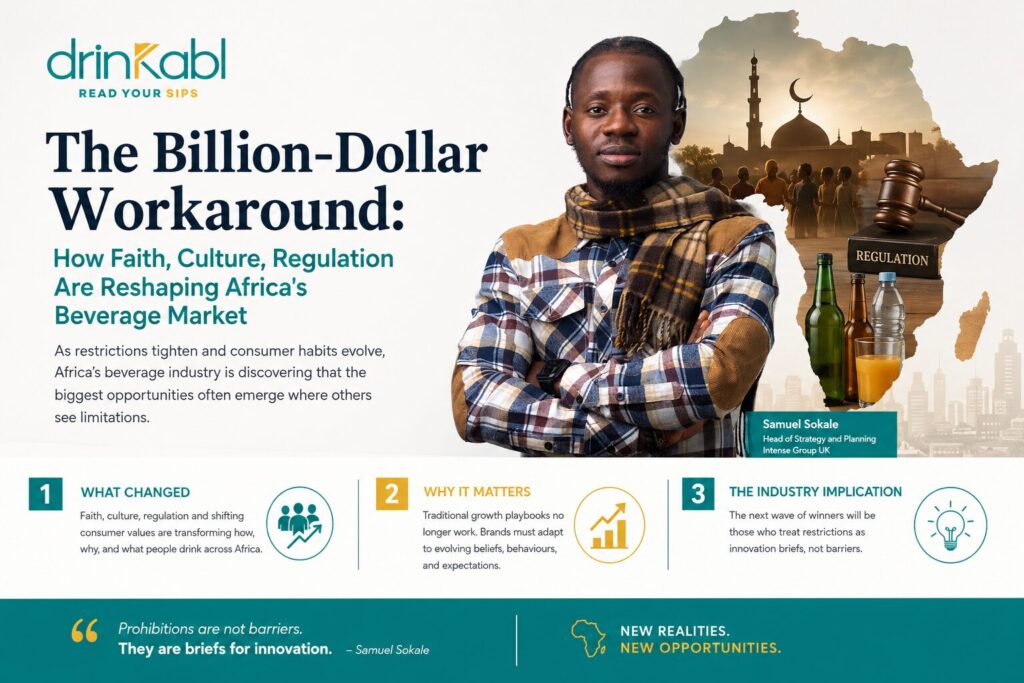
For decades, beverage companies have viewed religious restrictions, cultural prohibitions, and regulatory barriers as obstacles to growth. Yet some of the industry’s most successful innovations have emerged not despite these constraints, but because of them. That was one of the central themes explored during a recent edition of Bottling Brilliance, Drinkabl Africa’s thought leadership webinar series, where marketing strategist Samuel Sokale, Head of Strategy and Planning at Intense Group UK, challenged conventional thinking about restrictions, innovation, and growth in Africa’s beverage landscape.
His argument was simple but provocative: what many brands describe as barriers are often untapped opportunities. Or as he put it: “Prohibitions are not barriers. They are briefs for innovation.”
When Restrictions Become Opportunities
Businesses often frame restrictions as dead ends. Alcohol regulations limit advertising. Religious beliefs discourage consumption. Cultural norms shape who drinks, what they drink, and when they drink it. For many organizations, these realities are viewed primarily through the lens of lost revenue. Sokale believes that perspective is fundamentally flawed, according to him, marketers frequently become trapped by the labels attached to situations. Once something is defined as a “restriction” or a “prohibition,” businesses unconsciously begin treating it as a wall rather than a market signal.
“Labels have a fantastic way of reconfiguring our minds towards reality,” he explained.
The challenge, therefore, is not merely understanding restrictions. It is understanding what those restrictions reveal about changing consumer needs and unmet market opportunities. This shift in perspective becomes particularly relevant in Africa, where religion, culture, and commerce intersect in ways that are often more visible than in many Western markets.
The Beverage Industry Has Already Solved This Problem
One of the most overlooked stories in Africa’s beverage industry is how companies have responded to regions where alcohol consumption faces significant religious limitations. For years, discussions about alcohol restrictions in parts of Northern Nigeria have often focused on what brands cannot do. The more interesting story may be what brands have done instead. Faced with religious and cultural constraints around alcohol consumption, beverage companies invested heavily in non-alcoholic alternatives, building entire product categories around local consumer realities rather than fighting against them, the result is a thriving market for malt drinks, juices, and other non-alcoholic beverages.
What initially appeared to be a limitation became a catalyst for innovation, portfolio diversification, and market expansion. This is the essence of what Drinkabl Africa’s webinar described as the “billion-dollar workaround.” Rather than attempting to challenge cultural realities, successful beverage companies adapted to them. In doing so, they unlocked entirely new revenue streams.
Culture Can Build a Brand, and Eventually Limit It
The relationship between culture and beverage brands is often double-edged. Many of Africa’s most successful beverage brands achieved growth because they became embedded in cultural rituals, traditions, and social practices. However, culture is not static. As consumer behaviour evolves, the same cultural associations that once drove growth can eventually become barriers.
The discussion highlighted the example of schnapps brands whose identities have historically been tied to traditional ceremonies, libation rituals, ancestral blessings, and community celebrations.
For generations, these cultural occasions provided natural consumption opportunities. Today, however, demographic shifts, urbanization, religious change, and generational differences are reshaping those rituals. The challenge facing such brands is not necessarily declining relevance. The challenge is that the cultural context that originally powered their growth is changing. Brands that fail to recognise these shifts risk becoming trapped by their own heritage. The lesson is not to abandon tradition, the lesson is to continually reinterpret tradition in ways that remain relevant to contemporary consumers.
Sometimes the Best Strategy Is Doing Nothing
One of the most practical insights from the conversation came from Sokale’s experience working on the launch of an alcoholic beverage brand in Northern Nigeria. A major experiential activation had been planned as part of the campaign rollout, then circumstances changed. A crackdown on alcohol-related activities in parts of the region created an environment where proceeding with the activation could expose distributors and retail partners to unnecessary risk. the response was not to push harder, neither was it to stop. The campaign’s experiential component was cancelled, and resources were redirected toward distribution-focused strategies that aligned better with the prevailing environment.
The decision serves as a reminder that strategic thinking is not always about action, sometimes it is about restraint. “Strategy is as much about what you choose not to do,” Sokale noted. In a business environment increasingly obsessed with speed and constant activity, that lesson remains particularly relevant.
The Rise of Adaptive Brands
The beverage industry is entering a period of profound transformation. Across Africa, several forces are converging simultaneously:
- Growing health and wellness consciousness
- Rising demand for moderation and low-alcohol alternatives
- Increased regulatory scrutiny
- Religious and cultural influence on consumption
- Demographic shifts driven by younger consumers
- Rapid digital transformation
Taken together, these forces are creating new pressures on traditional beverage business models. They are also creating new opportunities. the brands most likely to succeed will not necessarily be those with the largest advertising budgets or the most established market positions. Instead, success may belong to organizations capable of adapting to cultural evolution in real time.
As Sokale observed, brands must remain fluid because culture itself is fluid. Companies that continuously monitor shifts in behavior, values, and social norms will be better positioned to identify the next wave of growth before it becomes obvious. Those that fail to do so risk becoming reactive rather than proactive.
Why This Matters
For years, many beverage companies have viewed religious restrictions primarily as a threat to alcohol sales. The evidence increasingly suggests a more nuanced reality. In several cases, those same restrictions have helped create robust markets for alternative beverage categories, encouraging innovation that might never have occurred otherwise. The broader lesson extends beyond alcohol, across Africa, changing consumer values, demographic transitions, regulatory developments, and evolving cultural norms are reshaping the commercial landscape. Companies that interpret these shifts as barriers may find themselves defending shrinking opportunities. those that interpret them as innovation briefs may discover entirely new markets.
Final Pour
Africa’s beverage industry is not standing still, consumer expectations are evolving. Cultural practices are changing. Regulatory environments are becoming more complex. New generations are redefining how, why, and what they drink. The future will not belong to brands that attempt to resist these realities. It will belong to brands that understand a simple but powerful truth: Growth often begins where conventional thinking sees limitations.
In a market shaped by faith, culture, regulation, and rapid social change, the biggest opportunities may not lie in overcoming restrictions at all. They may lie in learning how to innovate around them.
READ MORE