


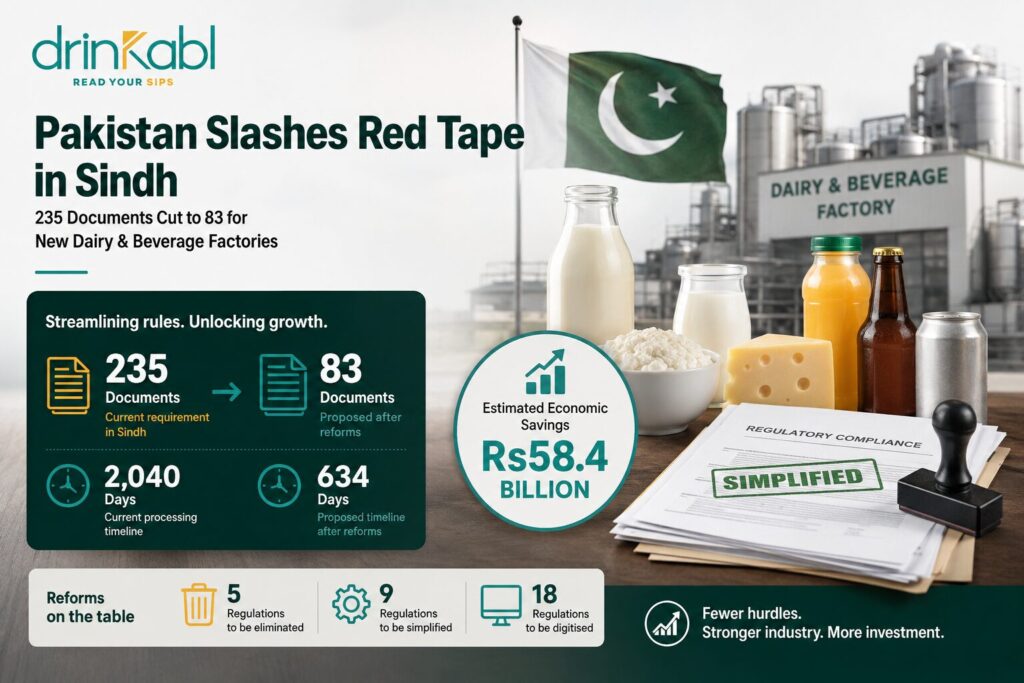
Pakistan is moving to dismantle layers of regulation facing its dairy and beverage industries, proposing reforms that could slash factory documentation requirements and generate an estimated Rs58.4 billion in economic savings.
The Cabinet Committee on Regulatory Reforms has reviewed 40 regulatory requirements spread across 25 federal, provincial and local government departments, exposing a compliance system officials say is constraining investment and industrial growth.
The sharpest example is Sindh, where establishing a food processing unit can require as many as 235 documents. According to the government’s regulatory mapping, 57% of the paperwork is duplicated, while the estimated processing timeline can stretch to 2,040 days.
The reforms team wants to cut the documentation burden to 83 and reduce processing time to 634 days. Five regulations have been proposed for elimination, nine for simplification and 18 for digitisation and streamlining. Eight would remain unchanged.
For beverage and food manufacturers, the proposals strike at a familiar industry problem: multiple regulators demanding overlapping approvals, registrations and renewals.
Food Standards Remain Fragmented
One of the most consequential issues is the harmonisation of food standards across Pakistan. Provincial governments had been directed to adopt national standards set by the Pakistan Standards & Quality Control Authority, but implementation remains pending.
That fragmentation creates an additional compliance layer for businesses operating across provincial markets and potentially complicates investment in processing, warehousing and supply chains.
Officials also discussed food business licensing and product registration requirements under the Sindh Food Authority. Reform proposals include eliminating some requirements and extending renewal periods from annual approvals to three or five years.
The committee also reviewed environmental approvals, labour processes, warehouse registration, boiler and vessel permits and building approvals.
Digitisation and integration with the Sindh Business One Stop Shop are being considered, alongside time-bound approvals and improved tracking systems.
Regulation Versus Investment
Federal Board of Investment Minister Qaiser Ahmed Sheikh said the objective of the reforms is to improve Pakistan’s investment environment and ease the cost of doing business.
Special Assistant to the Prime Minister on Industries and Production Haroon Akhtar Khan also warned that excessive and overlapping regulations remain an impediment to foreign direct investment.
The debate carries particular weight in Pakistan’s dairy economy. The wider sector contributes about 14.04% to national GDP and supports nearly eight million rural families, while the country ranks among the world’s largest dairy producers.
Yet industry representatives argue that the volume of regulation has not necessarily translated into stronger product quality. That tension sits at the centre of Pakistan’s reform push: whether regulators can move from repetitive compliance requirements towards a system built around safety, quality assurance and faster business approvals.
For beverage manufacturers, the proposed overhaul could reduce administrative costs and shorten investment timelines. The bigger test, however, will be implementation across provincial governments, where resistance and fragmented regulatory authority remain unresolved.