

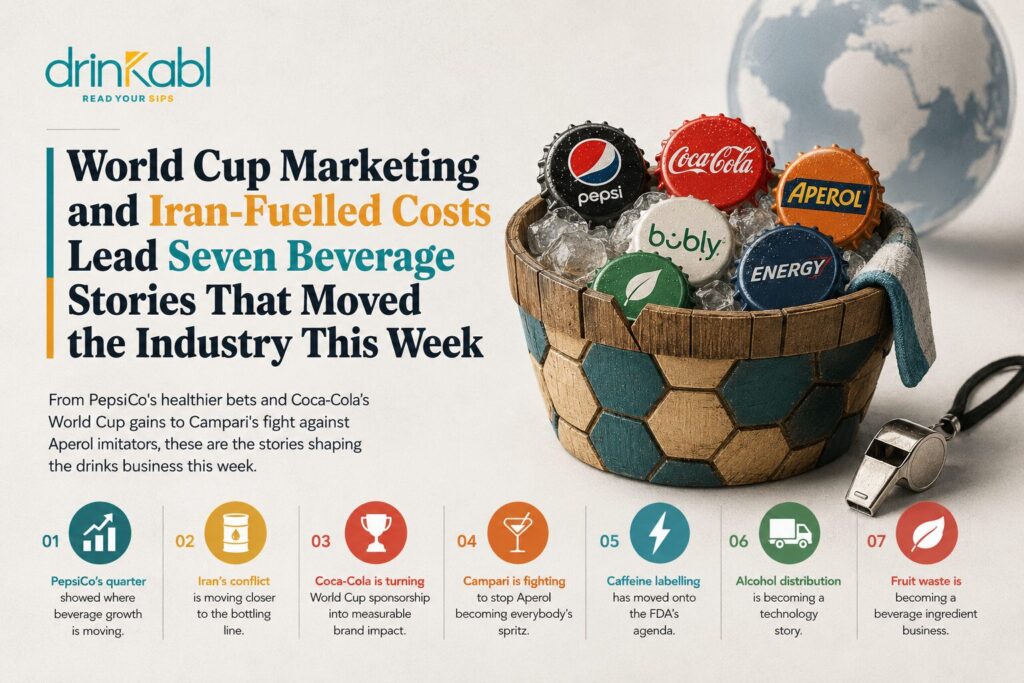
The global beverage industry spent the week confronting a familiar contradiction: consumers still want novelty, but the cost of delivering it is getting harder to ignore. From PepsiCo’s healthier beverage bets and Coca-Cola’s World Cup marketing gains to Campari’s battle against Aperol imitators, these are seven stories that shaped the drinks business this week.
PepsiCo’s quarter showed where beverage growth is moving
PepsiCo reported second-quarter revenue of $24.18 billion, up 6.4%, as stronger beverage and international performance helped the company beat revenue expectations. But the more important signal was in what consumers are buying.
Prebiotic sodas, zero-sugar drinks and other health-focused products are gaining importance as financially stretched consumers become more selective. PepsiCo maintained its 2026 outlook, even as it warned that elevated oil prices linked to the Iran conflict could increase packaging and logistics costs.
For beverage companies, the message is uncomfortable but clear: innovation must now deliver against health expectations without losing sight of affordability.
Iran’s conflict is moving closer to the bottling line
Geopolitical instability is becoming an operating cost story. PepsiCo’s warning over commodity, packaging and logistics expenses illustrates how elevated oil prices can travel through beverage supply chains. Fuel affects distribution, while energy and raw material volatility can place additional pressure on packaging economics.
African bottlers may be particularly exposed where imported packaging inputs, currency weakness and long inland distribution routes already compress margins. The distance between a geopolitical crisis and a beverage shelf is becoming shorter.
Coca-Cola is turning World Cup sponsorship into measurable brand impact
As the FIFA World Cup moves through its decisive stages, Coca-Cola’s sponsorship is producing more than visibility.
YouGov ranked Coca-Cola second among five official sponsors studied for advertising impact, recording a 9.7-point increase in Ad Awareness, a 14.7-point rise in Buzz and an 8.1-point improvement in Consideration among U.S. World Cup fans.
The company has combined global creative with limited-edition packaging, Panini sticker tie-ins and physical fan activity.
For African beverage marketers, the lesson is not simply to sponsor bigger events. It is to build several consumer touchpoints around one cultural moment.
Campari is fighting to stop Aperol becoming everybody’s spritz
Success has created a new problem for Campari.
Aperol accounts for roughly 26% of Campari’s revenue, but cheaper lookalikes and competing spritz products are crowding into a category that reached almost four billion servings globally in 2024.
Campari is responding with trademarks, legal action, venue certification and pre-made Aperol Spritz kegs as it tries to protect the relationship between Aperol and the spritz occasion.
It is a classic brand problem: when a product becomes synonymous with an occasion, competitors begin monetising the occasion too.
Caffeine labelling has moved onto the FDA’s agenda
The U.S. Food and Drug Administration has added draft guidance on labelling caffeine content in foods and beverages to its 2026 Human Foods Program Guidance Agenda.
The development could have particular implications for energy drinks, functional shots and other high-caffeine products.
For Africa’s expanding energy drink market, the bigger question is whether regulators will eventually demand clearer caffeine communication as category penetration increases.
Alcohol distribution is becoming a technology story
Southern Glazer’s is changing how it sells.
The U.S. beverage alcohol distributor is cutting about 1% of its workforce as it expands a hybrid commercial model combining field sales, inside sales and digital commerce for some customers. The company said the shift reflects changing customer engagement patterns.
The significance goes beyond job losses.
Beverage distribution has traditionally depended on armies of sales representatives, physical account visits and relationship-led selling. Southern Glazer’s move suggests data, digital ordering and technology-assisted sales are becoming more central to route-to-market.
African distributors should be watching.
Fruit waste is becoming a beverage ingredient business
Del Monte and Treatt launched an upcycled fruit extract range this week, using fruit by-products to create clean-label beverage ingredients.
The initial range includes pineapple, watermelon, mango and cantaloupe extracts, combining Del Monte’s fruit supply with Treatt’s extraction and beverage formulation expertise. The African opportunity is difficult to miss.
Across fruit-producing markets, the commercial question is whether processors can move beyond selling raw agricultural output and begin extracting more value from processing side streams.
This week’s biggest beverage stories ultimately point in the same direction. Growth is becoming harder won. The winners will not simply launch more drinks. They will understand changing health expectations, defend valuable consumption occasions, digitise distribution, extract more value from ingredients and build brands capable of converting cultural moments into measurable demand.
For Africa’s beverage industry, these are not distant global developments. They are early signals of the competitive pressures arriving next.