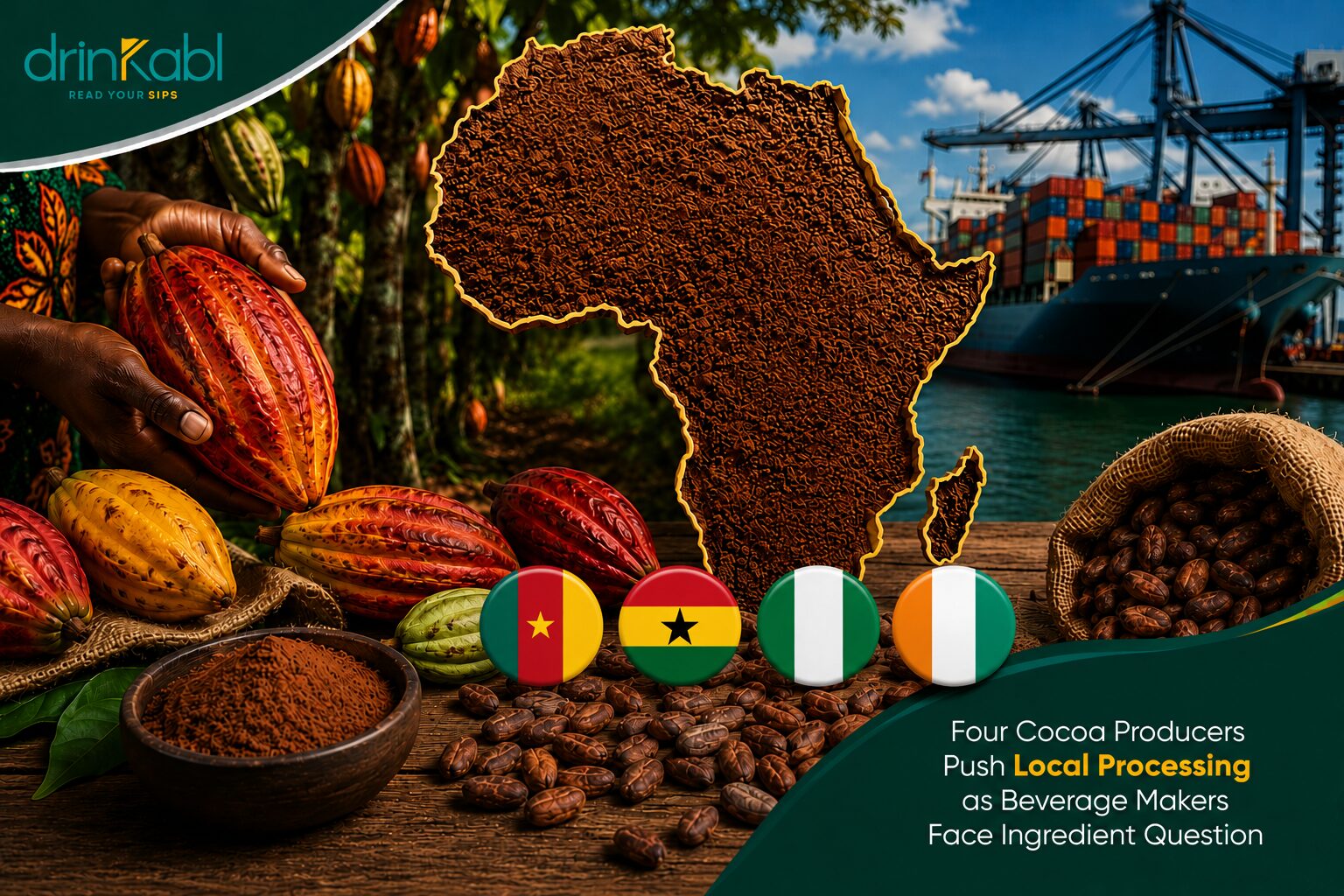

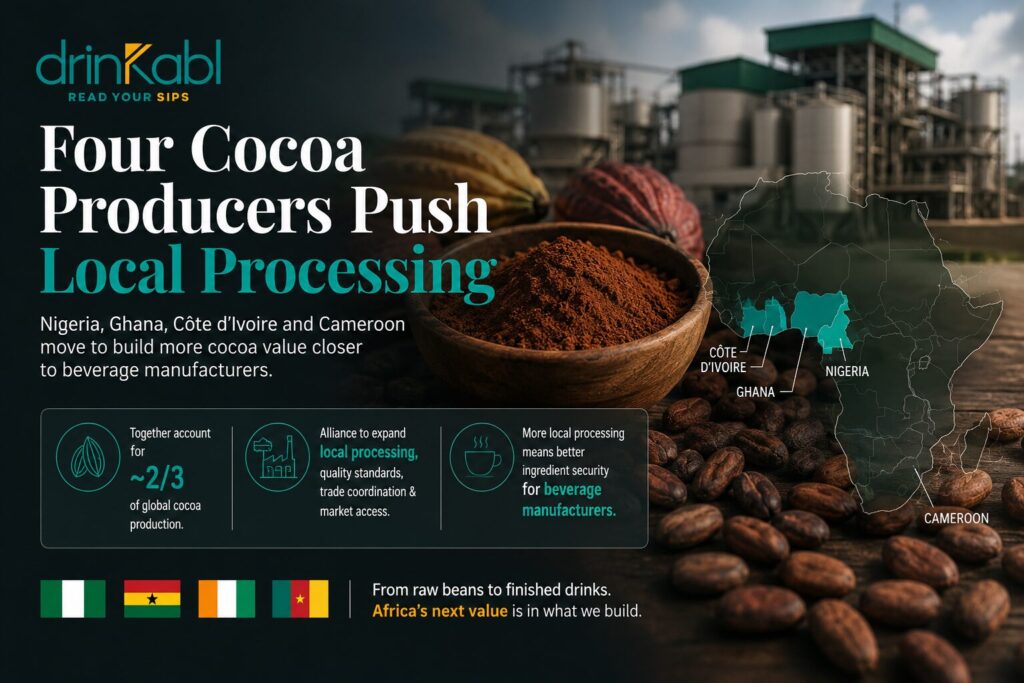
Nigeria, Ghana, Côte d’Ivoire and Cameroon are preparing a joint cocoa value-addition alliance that could put more processing capacity closer to the beverage manufacturers buying cocoa powder and other cocoa ingredients.
The four countries are expected to sign the Abuja Declaration at the Cocoa Value Addition Summit in Nigeria on July 14. Together, they account for roughly two-thirds of global cocoa production and plan to coordinate positions on processing, quality standards, trade negotiations and market access.
For the beverage industry, the more important question is what happens between the cocoa farm and the formulation room.
Cocoa powder is a core input across chocolate malt drinks, powdered beverages, café mixes and dairy-based formulations. Processing turns raw beans into cocoa liquor, butter and powder, creating the ingredients manufacturers can actually use in finished products.
Africa grows much of the raw material. The new alliance wants more of that conversion to happen at origin.
From Bean Exports to Beverage Inputs
The timing matters. Cocoa markets have spent the past two years moving through severe price and supply disruption. Processing plants in Ghana and Côte d’Ivoire have previously struggled to secure affordable beans as global traders competed for supply, leaving some local grinders operating below capacity.
Drinkabl.media’s earlier coverage of the cocoa market traced the same pressure from volatile futures into farmer earnings and processing economics. cocoa
For beverage manufacturers, unstable cocoa processing is not a distant agricultural problem. It can affect ingredient availability, procurement costs and the economics of cocoa-heavy formulations.
Nigeria’s own industrial push is already moving in that direction. Sunbeth Global Concepts is building a 70,000-metric-tonne cocoa processing facility in Sagamu, Ogun State, with commissioning scheduled for March 2027.
Johnvents also secured $40.5 million from British International Investment in 2025 to more than double processing capacity at its Ondo State factory from 12,000 to 30,000 tonnes annually. The company exports cocoa butter and powder.
A separate €85 million financing agreement between EIB Global and Nigeria’s Bank of Industry has also placed cocoa and dairy value chains inside a wider industrial funding push. Drinkabl.media’s reporting on the financing highlighted the growing strategic weight of local cocoa supply for beverage manufacturers.
More grinding capacity does not automatically mean cheaper cocoa powder. Bean prices, factory utilisation, energy costs and access to finance will still shape processor margins, but it changes where part of the value chain can sit.
Traceability Is Becoming a Procurement Issue
The proposed alliance is also expected to coordinate its response to the European Union Deforestation Regulation. Under the current EU timetable, the rules begin applying to large and medium operators from December 30, 2026, with micro and small operators following from June 30, 2027. Cocoa and coffee are among the covered commodities.
The regulation requires operators to demonstrate that covered commodities are not linked to deforestation. For cocoa supply chains built around large numbers of smallholders and intermediaries, that means more detailed origin and traceability records.
Recent analysis has warned that compliance costs can move down the cocoa chain towards cooperatives and farmers, particularly where digital records and geolocation systems remain weak.
For beverage procurement teams, traceability is therefore moving beyond sustainability reporting. A cocoa supplier’s ability to document origin can increasingly affect market access and buyer confidence.
That puts processors with stronger farmer mapping and internal controls in a different commercial position from suppliers still dependent on poorly documented aggregation networks.
The Beverage Opportunity Is Further Down the Chain
The four-country alliance will be judged by what gets built after the declarations are signed. For Africa’s beverage sector, success would mean more than exporting processed cocoa instead of raw beans. The harder industrial test is whether local processors can deliver consistent cocoa powder specifications, reliable volumes and traceable supply to manufacturers building products for African and international consumers.
That opens a wider product question.
If more cocoa processing happens close to origin, African beverage companies have a stronger base from which to develop cocoa drinks, powdered mixes and other formulations around locally processed ingredients. The commercial value will sit with companies capable of turning processing capacity into dependable industrial inputs and, eventually, finished brands. Africa already grows the bean.The next contest is over who processes it, who formulates with it and who owns the drink sold to the consumer.