

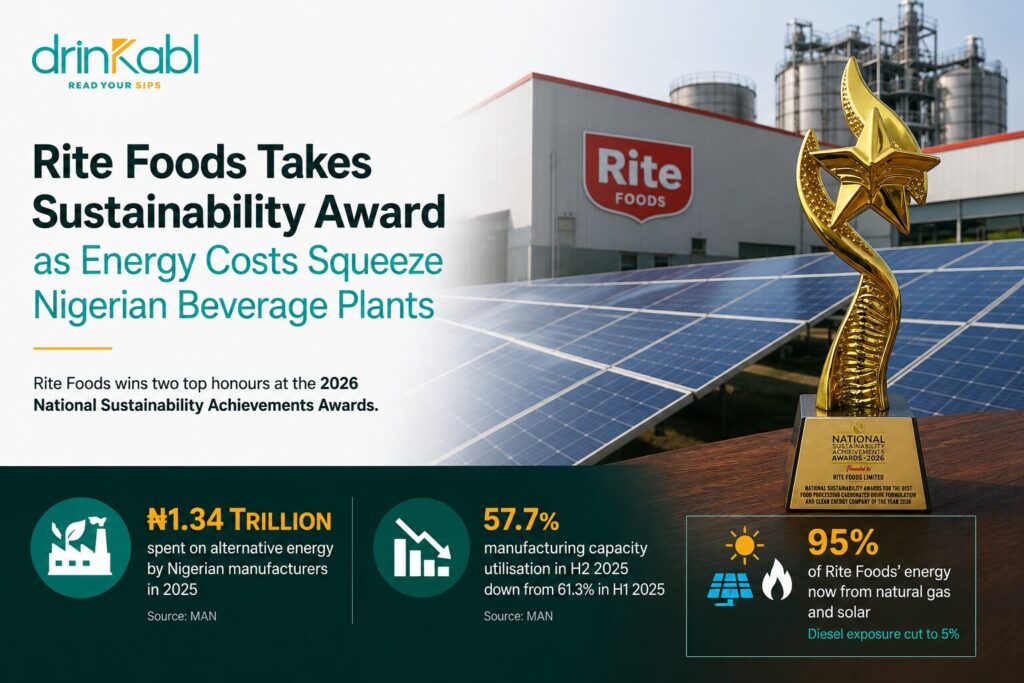
Rite Foods has won two categories at the 2026 National Sustainability Achievements Awards, putting its clean-energy strategy under fresh attention as Nigerian manufacturers spend more to keep factories powered.
The Nigerian beverage manufacturer was named Clean Energy Company of the Year and received the Best Food Processing Carbonated Drink Formulation award at the July 3 event in Lagos. The awards are organised by ESG Impact Consulting Limited, which assesses companies across sustainability and environmental impact criteria.
For beverage manufacturers, the clean-energy recognition carries the harder commercial story.
Nigeria’s factories spent ₦1.34 trillion on alternative energy in 2025, up from ₦1.11 trillion a year earlier, according to the Manufacturers Association of Nigeria. Manufacturing capacity utilisation fell from 61.3% in the first half of 2025 to 57.7% in the second.
Energy is no longer a utility problem sitting outside beverage strategy. It is a production cost, margin and capacity question.
Rite Foods Cuts Its Diesel Exposure
Rite Foods said earlier this year that natural gas and solar now account for 95% of its energy mix, leaving diesel at 5%. The manufacturer also reported a 95% reduction in diesel costs following the shift.
That exposure matters in food and beverage manufacturing, where the sector spent ₦229.41 billion on alternative energy in 2024, up from ₦182.76 billion in 2023, according to MAN data reported by The Guardian.
Drinkabl.media’s earlier energy investigation found that inefficient equipment, leaking compressed-air systems and poorly insulated boilers can push factory energy losses higher even after manufacturers pay to generate their own power.
The commercial difference is straightforward. A beverage producer that reduces diesel dependence cuts exposure to fuel costs before a bottle reaches the distributor.
For Rite Foods, which produces Bigi carbonated soft drinks and Fearless energy drinks at its Ososa facility in Ogun State, energy efficiency sits directly inside manufacturing economics.
The company’s Ososa plant has also become part of a wider transparency push. Drinkabl.media’s March coverage examined Rite Foods’ decision to open the facility to regulators, journalists and consumer advocates during World Consumer Rights Day.
The Award Now Needs Harder Measurement
Seleem Adegunwa, managing director of Rite Foods, said the latest recognition would push the company to continue investing in responsible manufacturing and cleaner technologies. The award gives Rite Foods another sustainability credential. The next test is disclosure.
A 95% natural gas and solar energy mix tells the market how the factory is powered. Beverage manufacturers increasingly face a harder set of questions around actual emissions reductions, water intensity, packaging recovery and energy consumed per unit of production.
Nigeria’s energy economics are forcing that conversation faster. Manufacturers cannot treat sustainability solely as an ESG (Environmental, Social, and Governance) communications line when alternative power spending has climbed to ₦1.34 trillion. For beverage plants running energy-intensive filling, cooling and processing equipment, cleaner power must increasingly prove its value in operating costs and production resilience.
Rite Foods has collected the award. The more useful industry benchmark will be whether its energy strategy delivers measurable manufacturing gains that competitors can compare.