
Africa does not have a shortage of drinks.
Across the continent, brewers work with local grains, distillers are rediscovering indigenous spirits, coffee and tea remain major agricultural industries, while a younger generation of founders is experimenting with juices, functional beverages and new drinking occasions.
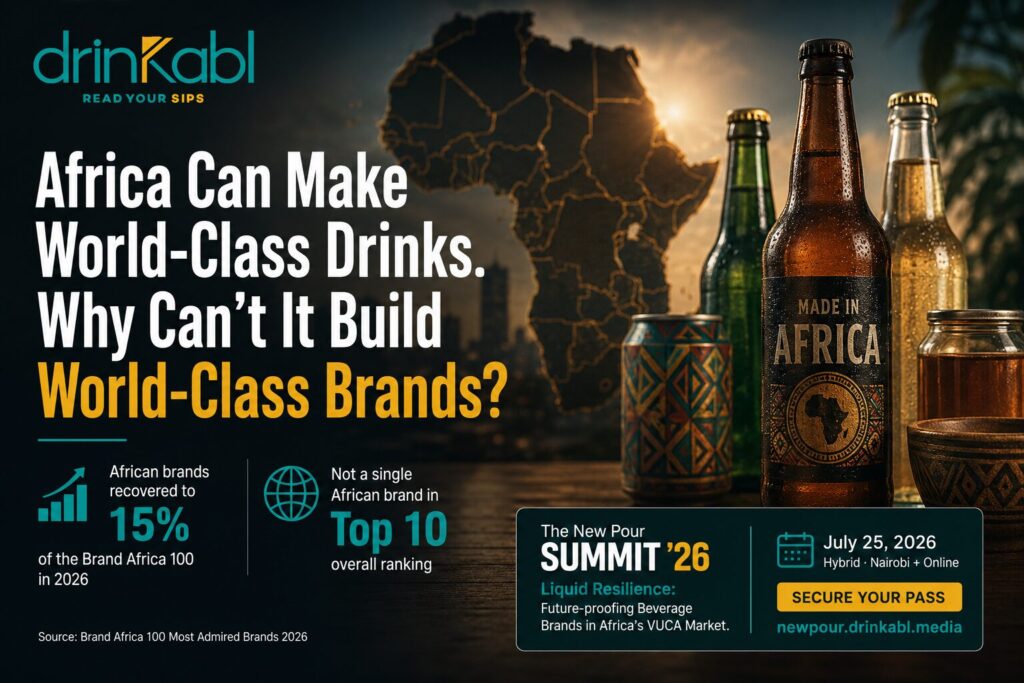
The harder question is what happens after the liquid enters the bottle. Africa still struggles to turn its production, culture and consumer knowledge into brands capable of commanding loyalty at home and scaling across borders. The 2026 Brand Africa 100 ranking offers an uncomfortable measure of that gap. African brands recovered to 15% of the continent’s 100 most admired brands, up from a historic low of 11% in 2025. Yet not a single African brand appeared in the overall top 10. For beverage companies, that gap deserves closer attention.
A Good Drink Is Not Yet a Brand
Much of Africa’s beverage conversation still begins with production. Can the company source ingredients? Can it manufacture at scale? Is the packaging attractive? Can distributors place the product on shelves? All matter. But none automatically answers the consumer’s simplest question: why this drink?
A beverage becomes commercially powerful when it owns an occasion, identity or cultural meaning that competitors struggle to copy.
That is a question that sits squarely inside the work of Hazem Kaddour, Managing Director of VML Morocco and one of the professionals set to speak at The New Pour Summit ’26.
Kaddour’s career has moved through advertising, planning and brand strategy, with experience spanning both global and local brands. His professional focus is on building meaningful brands through strategies that respond to changing human needs and behaviour. For African beverage marketers, the relevance is difficult to ignore. The continent is not short of cultural codes, rituals or drinking occasions. Yet “the African consumer” is still too easily treated as a single market segment.
A 24-year-old drinker in Casablanca does not necessarily interpret status, value or social drinking in the same way as a consumer in Lagos, Nairobi or Accra. Even within individual countries, income pressure, language, religion, nightlife and retail access can dramatically reshape beverage choices.
The problem begins when cultural relevance is treated as decoration added after the commercial strategy has already been written.
A local phrase enters the campaign. An African soundtrack is selected. A familiar face appears in the advert, but what consumer tension does the brand actually own? That distinction separates a visible campaign from a meaningful brand.
“Data is one of the biggest hurdles when you enter the African market… it’s limited. Africa is still a market where you tap in the dark to some extent. I guess that’s also part of being the foundation builder.”
KANESSA MULUNEH Founder Nyle
“Building meaningful brands through consistent strategies that address adaptive challenges.”
Hazem Kaddour
Managing Director, VML Morocco
Investors Are Asking a Different Question
The brand problem, however, is only one side of the bottle. Founders often see a promising drink. Investors see manufacturing control, margins, governance, distribution and the ability to survive expansion.
Africa’s private capital market recorded 530 deals worth $5.1 billion in 2025. Deal volume increased 8% year on year, according to reporting based on the African Private Capital Association’s 2025 activity data, capital is moving, but capital does not remove operational weaknesses. This is the territory Kanessa Muluneh increasingly works within.
Muluneh, founder of Nyle and another speaker joining The New Pour Summit ’26, has built her work around connecting capital, businesses and opportunities across African markets. Nyle describes its focus as helping companies, entrepreneurs and investors navigate opportunities on the continent, including market entry and investment evaluation.
Her own experience also crosses the founder-investor divide. Muluneh has launched six businesses and sold four for a combined sum of more than $9.5 million, according to Disrupt Africa. That perspective raises a harder question for emerging beverage founders.
Are they building products for shelves, or companies capable of scale? An attractive bottle with strong social media engagement may win consumer attention. It does not prove that a company can maintain supply, finance working capital or enter another African market without breaking its economics.
Muluneh has also argued that growth needs more than capital. In discussing Nyle’s investment approach, she has emphasised the role of people who understand both African markets and the wider global landscape.
For drinks businesses, that distinction matters.
- Money can buy equipment.
- It can expand a sales team.
- It can finance inventory.
But capital cannot automatically tell a beverage company why a consumer in a new market should care about its brand.
Africa’s Next Beverage Giant Will Need Both
This is where Africa’s brand and investment problems begin to meet. The continent’s next major beverage company is unlikely to be built by creativity alone. A culturally sharp campaign cannot compensate indefinitely for weak distribution, poor governance or an inability to finance growth.
Capital alone will not solve the problem either. A well-funded beverage company can still spend heavily building a brand consumers do not emotionally understand. The stronger businesses will need both cultural intelligence and commercial architecture.
They will need strategists capable of interpreting changing consumers and operators who understand what investors require before committing capital.
Those two sides of the growth equation are reflected in the work of Kaddour and Muluneh, and in a wider industry conversation that is becoming increasingly urgent as African beverage businesses look beyond survival towards regional scale.
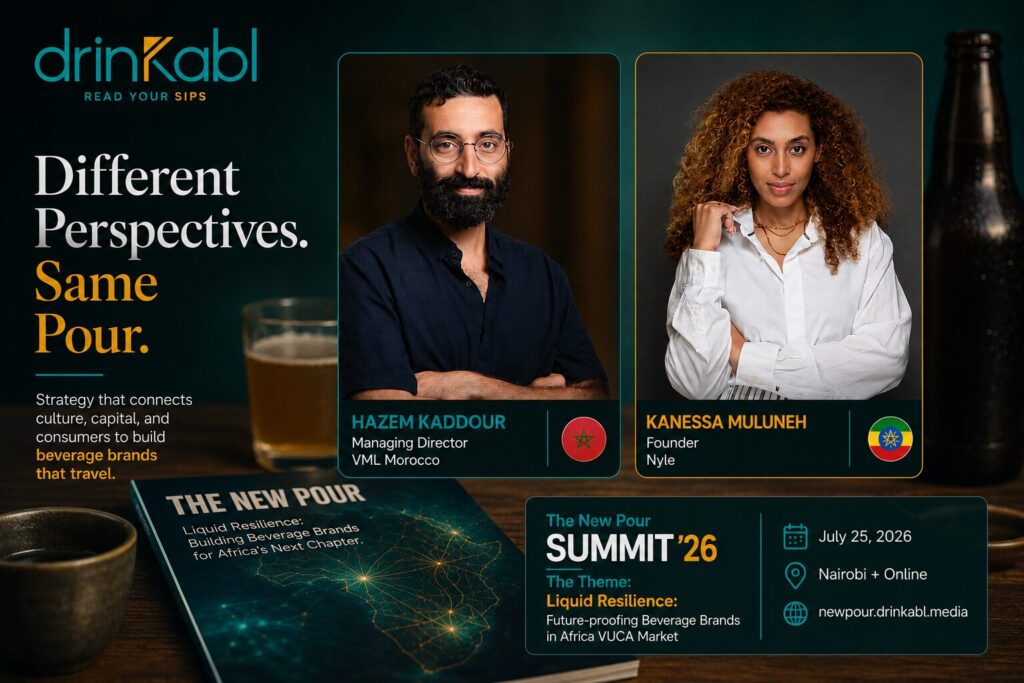
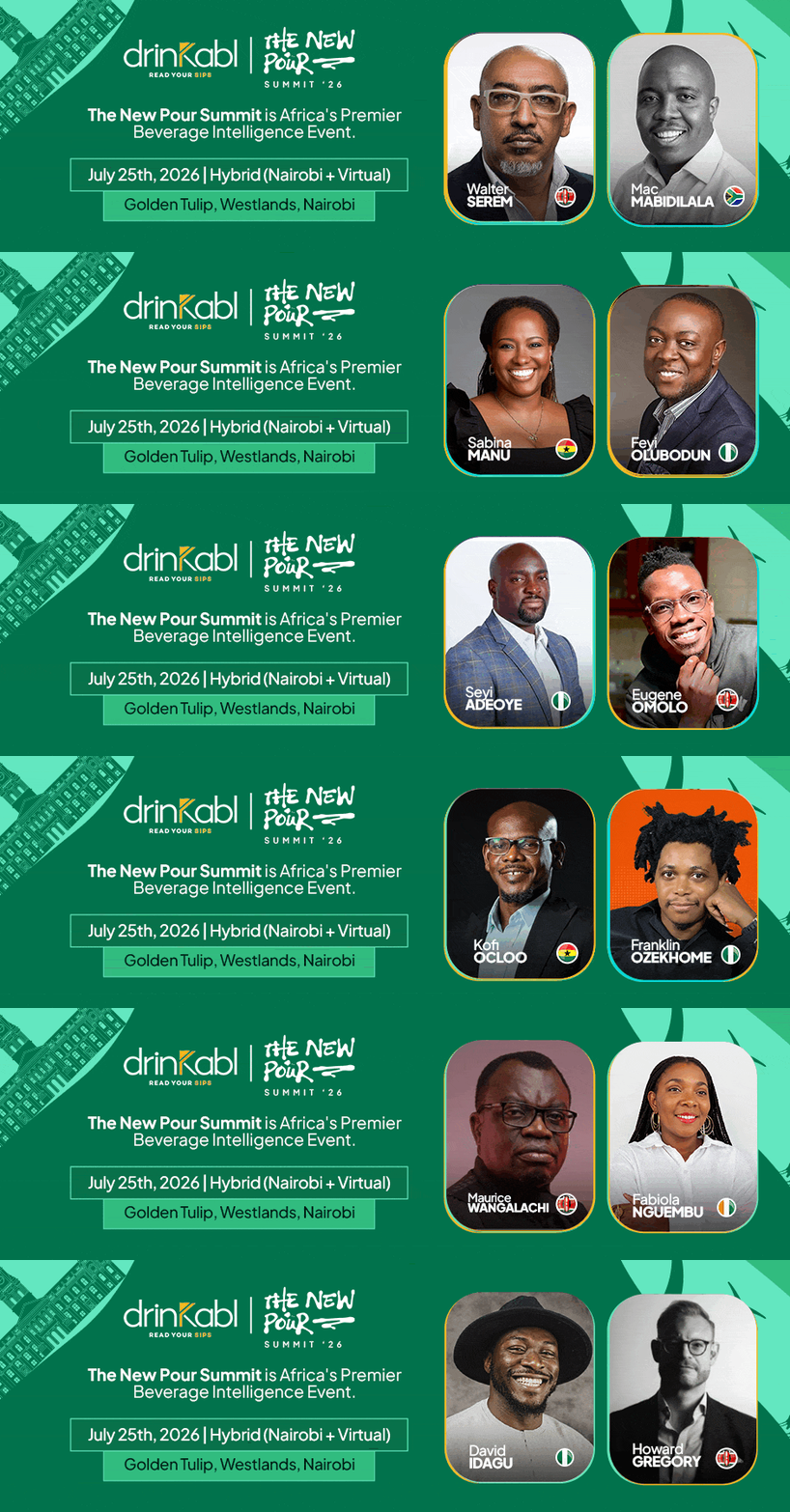
On July 25, both professionals will join beverage operators, investors, marketers and strategists in Nairobi and online for The New Pour Summit ’26. Under the theme of Liquid Resilience, the Summit will examine market intelligence, capital, advertising, consumer behaviour and brand positioning as part of a broader conversation about building beverage businesses in Africa’s volatile markets.
The question is no longer whether Africa can make world-class drinks, It is whether the industry can build, finance and retain the brands around them.
Secure your pass for The New Pour Summit ’26
READ MORE
- Nigerian Beverage Plants Are Haemorrhaging Money on Energy, And Most Have No Idea Where
- Rite Foods Pushes Beverage Safety, Transparency on Consumer Rights Day
- Vanguard Honours Rite Foods’ Seleem Adegunwa as Beverage Industry Trailblazer of the Year