
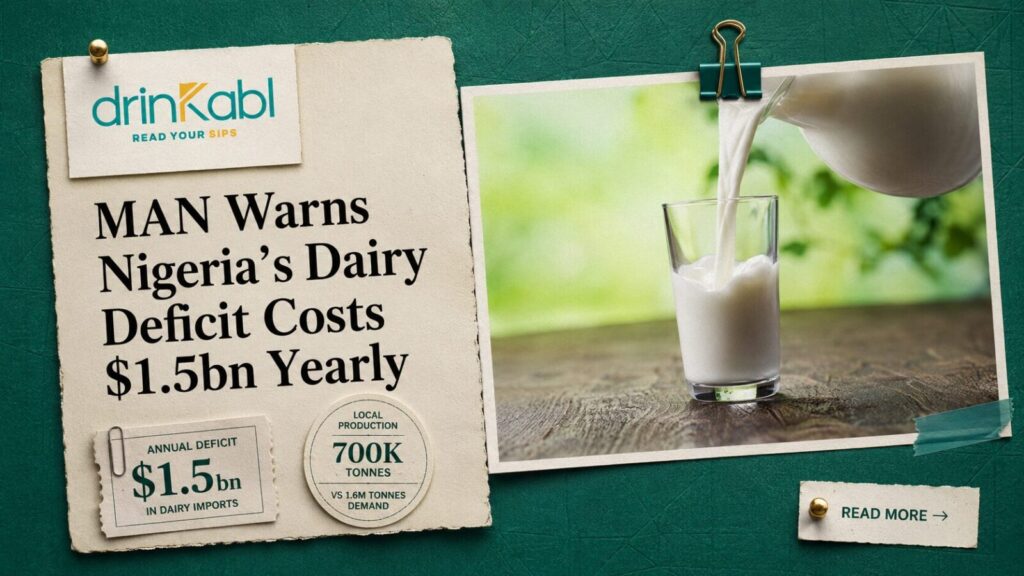
Nigeria’s dairy sector is running at roughly 60 percent of what the market needs, and the country now spends more than $1.5 billion a year importing milk and dairy products to close the gap, the Manufacturers Association of Nigeria says.
MAN puts annual production at about 700,000 metric tonnes, against national consumption of 1.6 million metric tonnes. The country holds more than 20 million cattle, yet most local breeds yield less than a litre of milk a day, compared with 20 to 30 litres from dairy cows in developed markets.
The shortfall traces to weak infrastructure rather than herd size. “Despite the enormous potential, several structural challenges continue to constrain the growth of Nigeria’s dairy sector,” MAN said, pointing to poor cold-chain logistics, limited milk collection systems, thin storage capacity and restricted farmer financing. Security pressures around grazing land compound the problem.
Nigerian manufacturers are wrestling with a similar calculus elsewhere. Drinkabl.media’s look at Nigerian Breweries’ shift toward renewable energy showed operators paying upfront for supply reliability rather than absorbing recurring cost shocks. Dairy processors face the same trade-off over milk collection and cold storage.
Investment is already flowing. MAN named commitments from Nestlé Nigeria, which has put more than N1.8bn into demonstration farms, Arla Foods, which has spent over $15m in Kaduna State over five years, and WAMPCO-Campina Plc, which has committed more than N80bn to smallholder backward integration. Federal officials are courting more of it: the livestock ministry is reviewing proposals for public-private partnerships to expand milk output.
A parallel push is underway on policy. Stakeholders meeting in Abuja last November validated an implementation framework for the National Dairy Policy, and MAN’s dairy sub-sector group told Minister Maiha in March that supply still falls well short of demand despite years of backward integration spending.
Not every producer agrees on how far intervention should go. When the debate turned to soft drinks last year, CPPE warned that new taxes on sugar-sweetened beverages would cost jobs rather than fix consumption habits. That tension between regulation and production capacity now shifts to dairy as the sector courts more backward integration deals.
MAN wants government backing for dairy clusters, ranching systems and pasture development alongside the collection and cold-chain investment already promised. Whether the PPP proposals under review at the ministry translate into new milk output, or add to a long list of unrealised dairy pledges, will decide how quickly the import bill actually falls.
READ MORE