
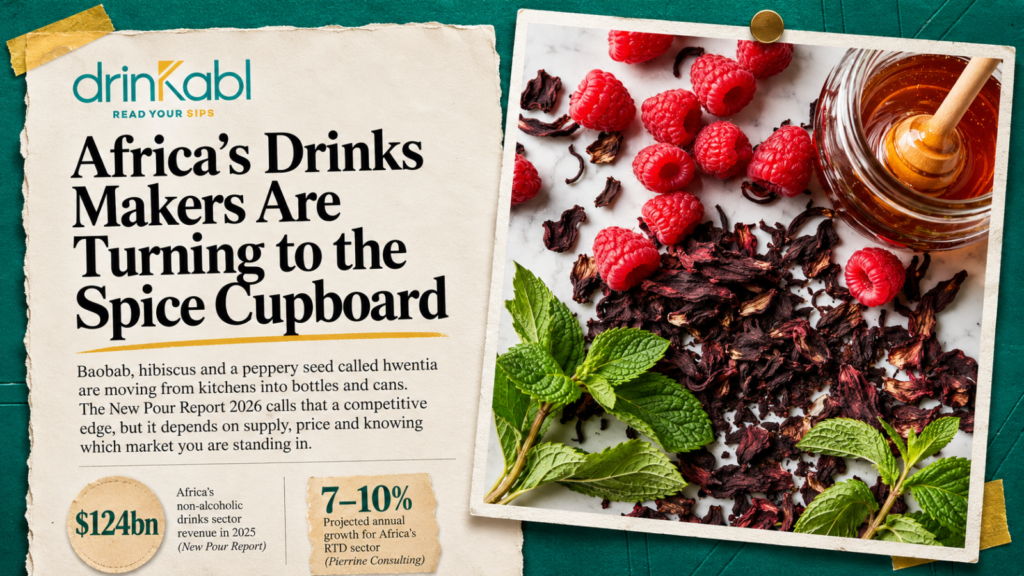
Baobab, hibiscus and a peppery seed called hwentia are moving from kitchens into bottles and cans. The New Pour Report 2026 calls that a competitive edge, but it depends on supply, price and knowing which market you are standing in.
Senegal’s most common style of coffee, café Touba, takes its defining flavour from the seed of a tree called Xylopia aethiopica. The same seed turns up across West Africa under other names. The Akan of Ghana call it hwentia, and it is also sold as uda. Ghanaian cooks steep it in sobolo, a hibiscus drink, alongside other herbs and spices.
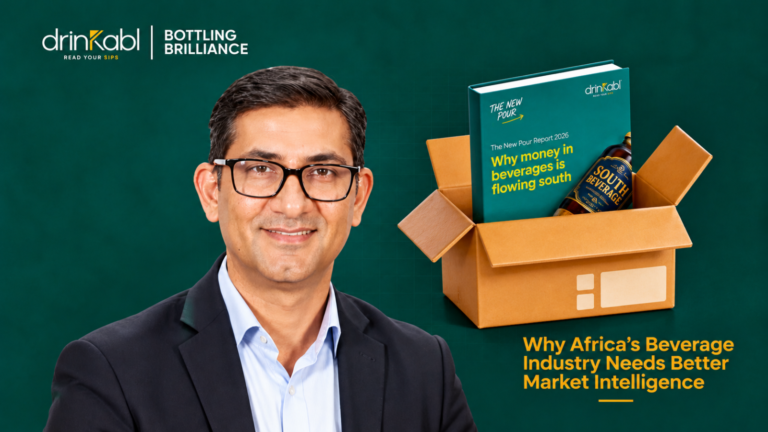
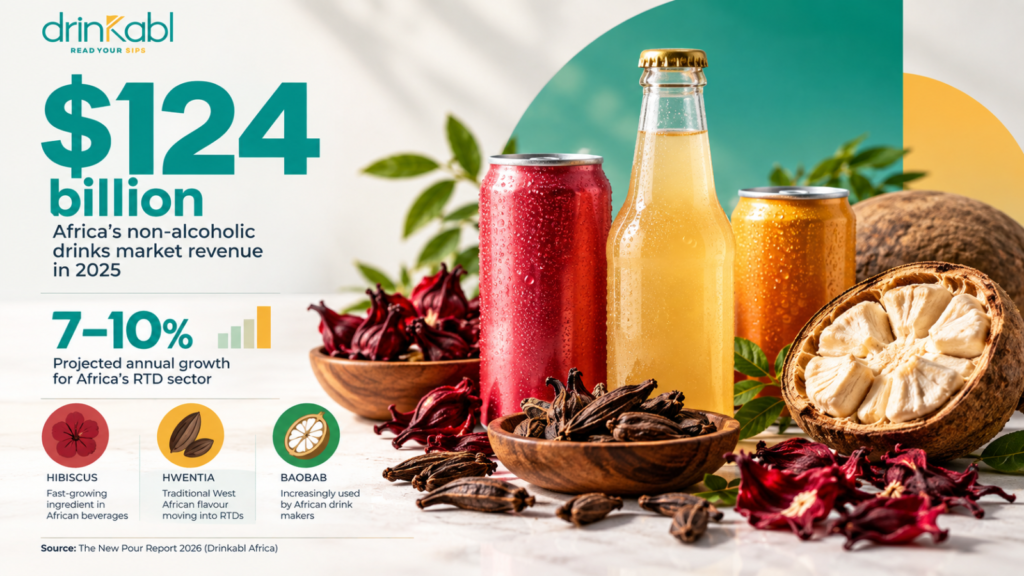
Nobody invented that flavour for a product launch. It was already in kitchens, markets and cups, and people already knew what it meant. That head start is the subject of trend five in The New Pour Report 2026, which argues that local ingredients are becoming one of the stronger advantages available to African beverage brands. The report puts Africa’s non-alcoholic drinks sector at USD 124 billion in revenue in 2025. This piece looks at how an ingredient becomes a commercial advantage in that market, and where the argument is still unproven.
What the ingredient brings with it
A new flavour has to be explained to drinkers. A familiar one has already been explained, often by a grandmother. Consumers do not need to be told what hibiscus tastes like in Accra, or that hwentia is warm and smoky. The brand’s job is to put that knowledge into a format people will buy today.
The report says craft breweries in South Africa and Nigeria are experimenting with baobab, hibiscus, moringa and indigenous grains. It names Chi in Nigeria and TruFruit in South Africa as brands putting local natural ingredients into juices and smoothies. Sabina Manu, marketing and innovation director at Guinness Ghana Breweries, told the report that “flavour is king in what we consume”. She pointed to Hwentia/Uda in West Africa and to berbere, the Ethiopian chilli-based spice blend, and masala in East Africa.
Why a can suits a pantry
Fieldwork by Pierrine Consulting across Nigeria, South Africa and Kenya, cited in the report, names functional beverages, plant-based ready-to-drink products and locally sourced formulations as the fastest-growing sub-categories. Ready-to-drink, or RTD, simply means a finished drink sold in a can or bottle, with no mixing required. Pierrine projects Africa’s RTD sector to expand by 7 to 10 per cent a year.
The report’s playbook for local entrepreneurs turns this into a route to market. RTDs and non-alcoholic drinks, it says, are the fastest paths to shelf space in modern trade, meaning supermarkets and organised retail. It lists locally sourced ingredients, transparent formulations and wellness influencer partnerships as the most effective tools for building trust right now. A small producer cannot outspend a multinational on advertising. It can, in theory, offer a flavour the multinational’s formulation team has never tasted.
The part that happens before the label
Turning a spice or a fruit into a product that sits on shelves for years is a supply problem first. A maker needs enough of the ingredient, of consistent quality, in every season, from suppliers who can scale when the drink sells. A flavour that works in a sample bottle can fail when the order triples.
The report does not publish sourcing data, and this piece cannot invent any. Manu’s remarks point to why the question matters. She argues that testing local ingredients can strengthen the circular economies they come from, and adds that producers “can build with what we grow and what we know”. That only holds if growers and processors can meet what a manufacturer needs.
Fifty-four conversations, not one
There is no single African flavour to sell. Seyi Adeoye, chief executive of Pierrine Consulting, tells the report that brands treating the continent as one opportunity will lose to those treating it as 54 separate conversations, noting that Lagos consumers differ from those in Accra, who differ again from Nairobi.
The flavours in Manu’s list bear this out. Hwentia belongs to a West African kitchen. Berbere belongs to an Ethiopian one. A brand that blurs them into a generic “African” taste risks speaking fluently to no one. The report’s advice to global brands is to build separate playbooks for at least Nigeria, South Africa, Kenya, Ghana and Egypt.
The price problem
The strongest objection comes from the report’s own findings on inflation. High inflation from 2023 to 2025 constrained growth, it says. Nigeria’s market contracted, South Africa managed only modest expansion, and consumers traded down to cheaper options. A premium botanical drink built on provenance is asking shoppers to pay more at exactly the moment many of them were paying less.
The report’s answer is portfolio structure. It says operators with both a premium line and an accessible line held up best through Nigeria’s 2023 to 2024 contraction, while those selling only at one end were squeezed hardest. That is a finding about beverages in general, however, and it does not test botanical drinks specifically. The report offers no sales figures for any single botanical product.
Kanessa Muluneh, founder of Nyle, told the New Pour Summit press conference that data is often difficult to source in African markets. Brands with compelling stories, she said, gain a disproportionate advantage because of it. The argument for local ingredients rests on that kind of evidence, which is real but hard to put a number on.
In Senegal, a single seed already tells drinkers what a cup of coffee should taste like. Whether a bottle in Accra or a can in Lagos can earn the same recognition is a question with no sales figures attached yet.
This story is part of Drinkabl Africa’s editorial series, The New Pour Report 2026: The Stories Behind the Data, examining the market forces, consumer shifts and commercial opportunities shaping Africa’s beverage industry. Read the full report.
Read more