
There are serious stories in the beverage business. Stories about acquisitions, factories, taxes, inflation, regulation, and the price of sugar. And then there are the stories that make you stop halfway through reading and ask: “Wait. People actually did that?”
The beverage business has produced some wonderfully strange moments over the years. People have paid extraordinary amounts for water. Bartenders have been asked to make drinks that sound like someone lost a bet. Beer glasses have disappeared from pubs by the thousands. Someone decided that ice needed to become a luxury product.
None of these stories will change the global beverage industry. But they say something rather interesting about people. Apparently, once someone has a drink in front of them, almost anything can happen.
Here are 10 beverage stories that sound made up but are, in fact, real.
1. Sydney Had a Full-Blown Beer-Glass Crisis
Let’s start with something familiar to anyone who has ever left a bar thinking, “this glass would look nice at home.” In 1940s Sydney, apparently a lot of people had exactly that thought.
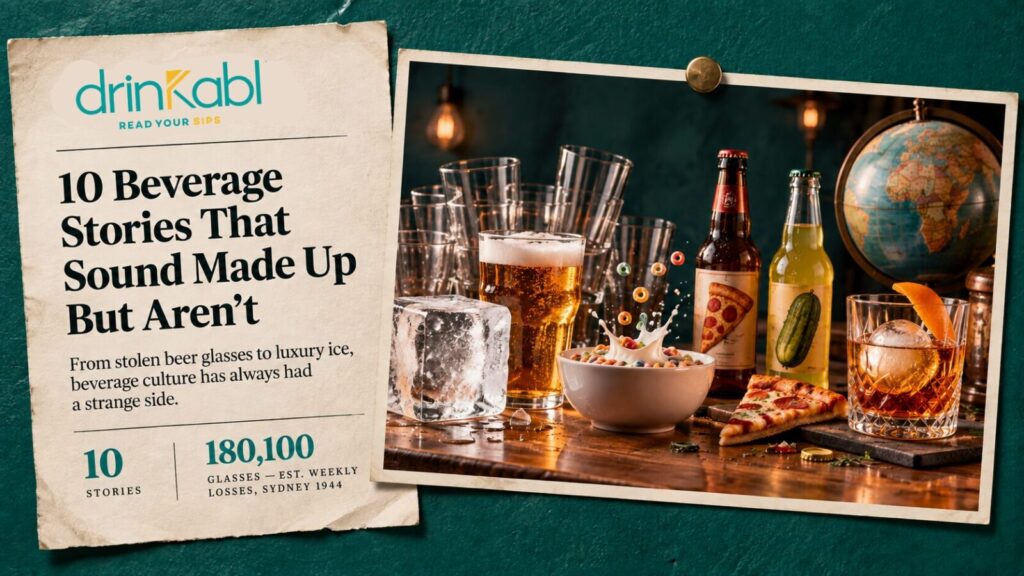
Historical records show Sydney pubs were losing enormous numbers of beer glasses to customers. In 1944, losses across the city’s roughly 600 hotels were estimated at around 180,100 glasses a week, lost to theft and breakage.
One publican reportedly started Boxing Day with 2,000 new schooner glasses and was left with only 600 by closing time. Eventually, some pubs put up warning signs asking customers not to take the glasses. One hotel even told drinkers that if they needed glasses, they should see an optician rather than help themselves to the pub’s.
That instinct hasn’t really disappeared. Nisbets research, cited by Morning Advertiser, found that 27% of British adults admit to stealing tableware from a bar or restaurant.
The light lesson: put a brand’s logo on something and hand it to a customer for long enough, and it starts looking like a souvenir.
2. Someone Decided Ice Should Be a Luxury Item
Ice is the thing you get for free in a drink. Someone looked at it and thought: “we can charge for this.” And people paid up.
Luxury ice has become a real business. In 2020, California-based Gläce Luxury Ice was selling a bag of 50 hand-carved cubes and spheres for US$325, or $6.50 an ice cube.
More recently, the luxury-ice trade has gone further still. A Greenland startup called Arctic Ice harvests centuries-old glacial ice from Greenland’s fjords and ships it to high-end bars in Dubai, where a six-pack of cubes can retail for around $100.
Think about that. You could buy ordinary ice, or six cubes that have had a more interesting childhood than most people.
The light lesson: premiumisation can make almost anything feel luxurious, even frozen water.
3. Someone Bottled the Sweet Milk Left in the Cereal Bowl
Every Nigerian child who has ever eaten cereal understands the basic technology here. You pour milk, add cereal, eat the cereal, and the milk left behind tastes like breakfast. Then someone in America decided to just sell the milk.
That’s essentially Cow Wow, a Los Angeles company that packages organic, low-fat “cereal milk” in flavours like Fruity Trudy and Chocolate Chip Cathy, styled to taste like what’s left in the bowl after the cereal is gone.
If you’ve ever finished your cereal and quietly drunk the leftover milk straight from the bowl, you’ve already been doing this beverage innovation at home for free.
The light lesson: sometimes a beverage innovation is simply something people have been doing at home for years, packaged nicely enough to sell.
4. There Is Such a Thing as Pizza Beer
Beer with pizza is normal. Pizza in beer is a different story, and yes, it’s real.
Mamma Mia! Pizza Beer is a brown ale brewed with tomato, basil, oregano, and garlic, the culinary equivalent of putting the entire argument for pizza-and-beer pairing into one bottle. Chicago home brewers Tom and Athena Seefurth created it after using leftover pizza herbs in a home-brew competition.
Tomato, herbs, and garlic are flavours humans already enjoy. Beer is already used in cooking. Pizza is already beloved. Someone just decided to combine all three.
The light lesson: there’s a thin line in beverages between “innovative flavour profile” and “who asked for this?”
5. Pickle Juice Soda Exists
If pizza beer didn’t convince you that beverage innovation has no fear, meet pickle soda.
In 2017, Grandpa Joe’s Candy Shop in Ohio and Pennsylvania started selling pickle-flavoured soda made with pure cane sugar. Reactions ranged from delight to disgust, but demand was reportedly high enough that orders took days to process.
This is exactly how strange beverages survive. Someone has to be willing to say, “I know this sounds disgusting, but what if people actually like it?” Sometimes they do. Sometimes they don’t. Either way, someone gets a headline.
The light lesson: in beverages, curiosity is sometimes a stronger sales tool than common sense.
6. Some Water Bottles Cost More Than the Water Inside Them
Bottled water is normally one of the simplest products in the beverage business: water, bottle, label, done. Luxury water had other ideas.
Fillico Jewelry Water, from Osaka, Japan, decorates its bottles with Swarovski crystals and gold inlay, with prices running into the thousands of dollars depending on the edition.
And in 2010, a single 750ml bottle of Acqua di Cristallo Tributo a Modigliani, housed in a 24-carat solid gold bottle, sold at a Mexico City charity auction for $60,000, earning it a Guinness World Record.
At that point, you’ve stopped buying water. You’re buying a story, and the water just happens to be inside it.
The light lesson: in premium beverages, people aren’t always paying for the liquid. Sometimes they’re paying for the story attached to it.
7. Bartenders Get Asked to Make Some Truly Strange Things
Bartenders have a special relationship with human creativity. People walk up to a menu with dozens of carefully designed cocktails and say: “can you make me something nobody has ever had before?”
Bartenders interviewed by The Takeout described requests ranging from martinis built to taste like a Caesar salad to virgin versions of classic cocktails and drinks assembled from whatever ingredients a guest happened to be craving that night. None of these are mainstream orders, but they show how far customers will push a bartender’s imagination.
This might be the most relatable item on this list. Everyone knows someone who has looked at a perfectly normal drinks menu and decided to become a mixologist, usually after two drinks.
The light lesson: people don’t just consume beverages. They like to customise them until they can claim the drink is uniquely theirs.
8. Provenance Ice Turned Frozen Water Into a Story
The luxury ice story is worth a second look, because it gets stranger. The selling point isn’t just that it’s frozen. It’s clarity, shape, purity, slow freezing, and where it came from.
A perfectly clear sphere looks nothing like the cloudy cube sitting in your freezer since Tuesday. High-end bars use large, clear cubes because they melt more slowly and change how a premium drink presents. But the industry has taken this further, into ice harvested from remote natural environments, including glacial ice pulled from Greenland’s fjords for bars thousands of miles away.
So somewhere in the world, someone is looking at a glass of whisky and thinking: “the whisky is excellent, but do you know where the ice came from?”
The light lesson: once consumers start caring about provenance, even ice becomes a storytelling device.
9. The Internet Turned a Rare, Dangerous Practice Into a “Trend”
This one needs a serious footnote. Stories have circulated for years about people trying to consume alcohol through unconventional routes, including vodka-soaked tampons.
It sounds like an urban myth, and mostly, it is. There is a real physiological basis for alcohol absorption through mucosal tissue, but research has found the supposed popularity of this practice has been greatly exaggerated, with no documented medical cases confirming it as any kind of widespread trend. Medical reviews describe it as dangerous, not popular.
The strangest part of this story isn’t that someone, somewhere, may have tried it. It’s how quickly the internet can turn an unusual or isolated rumour into something that sounds like “everyone is doing this.” They aren’t. And please don’t.
The light lesson: a strange beverage story can get much stranger once the internet gets hold of it.
10. Sometimes the Strangest Beverage Is the One Nobody Thought Would Work
This may be the biggest lesson of all. Cereal milk sounded strange. Pickle soda sounded strange. Pizza beer sounds strange. Luxury ice is objectively strange if you think about it long enough.
Yet beverage history is full of products that initially sound ridiculous and then find an audience, because people don’t always buy drinks simply because they are thirsty. They buy curiosity, nostalgia, identity, and experience. They buy something to photograph and something to tell their friends about. And sometimes, apparently, they buy a bottle of water because the bottle looks like jewellery.
That may be the strangest thing about beverages: the liquid is only half the product. The other half is whatever story we’ve decided to attach to it.
So, What Have We Learned?
Mostly that humans are remarkably creative when it comes to drinking. We will steal the glass. We will pay hundreds of dollars for ice. We will drink cereal milk without the cereal. We will put pizza ingredients into beer. We will make soda taste like pickles. We will turn water into a luxury product. And then we will walk into a bar and ask the bartender to invent something nobody has ever tasted.
None of this is particularly serious, and that’s precisely why it’s interesting. The beverage industry often talks about innovation as though it always means a new factory, a new technology, or a new billion-dollar category. Sometimes it does. But sometimes innovation is simply somebody asking, “what if we tried this?” and finding enough people willing to say, “actually, that’s not bad.” Or, at the very least, “I’ll try it once.”
And in beverages, sometimes once is enough to create a market.