
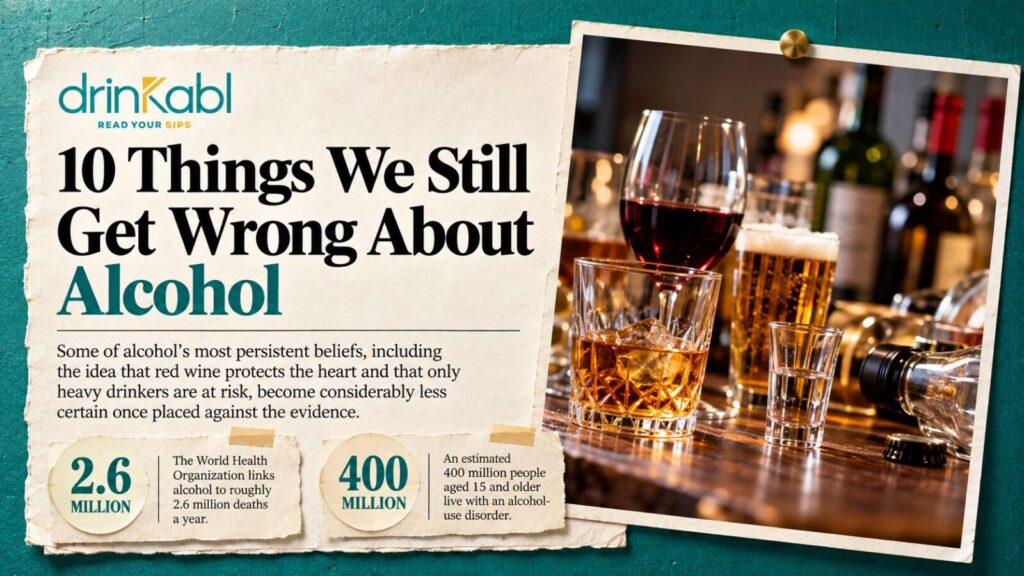
Some of alcohol’s most persistent beliefs, including the idea that red wine protects the heart and that only heavy drinkers are at risk, become considerably less certain once placed against the evidence.
Fast Facts
- The World Health Organization classifies alcohol as carcinogenic and links it to roughly 2.6 million deaths a year.
- An estimated 400 million people aged 15 and older live with an alcohol-use disorder, including 209 million with alcohol dependence.
- Africa’s alcohol-attributable death rate (52.2 per 100,000) is above the global average of 32.3.
- A 2023 review of 4.8 million people found no protective effect from low-volume drinking on all-cause mortality.
Alcohol has spent decades occupying an unusual position in public life. It is a consumer product, a social ritual, a source of tax revenue, an agricultural commodity and a major global industry. It is also a psychoactive substance associated with disease, injury and dependence.
That contradiction has produced a remarkable number of assumptions about what alcohol does to the body. Some are clearly wrong. Others contain a fragment of truth that has been stretched far beyond what the evidence can support. Here are 10 of the most persistent.
1. “A little alcohol is good for your health”
This may be the most famous alcohol claim of all. The idea largely emerged from observational research suggesting that moderate drinkers sometimes had lower rates of cardiovascular disease and mortality than non-drinkers. But the evidence is not straightforward.
A 2023 systematic review of 107 cohort studies involving more than 4.8 million participants found no significant reduction in all-cause mortality among low-volume drinkers, once several methodological biases were accounted for. Yet the debate has not disappeared. The National Academies’ 2025 review found an association, at moderate certainty, between moderate alcohol consumption and lower all-cause mortality compared with never drinking. It also found an association between moderate drinking and higher breast-cancer risk.
Put plainly, the mortality evidence remains contested, and no scientific body has established alcohol as a legitimate health intervention.
2. “Red wine is different”
Red wine became the celebrity of the moderate-drinking argument because of compounds such as resveratrol and its association with Mediterranean-style diets. But the presence of potentially beneficial compounds does not cancel the alcohol.
The IARC has established a causal association between alcohol consumption and cancers including breast, liver, colorectal, oral, pharyngeal, laryngeal and oesophageal cancers. The important distinction is between studying a compound and studying the health consequences of consuming an alcoholic beverage containing ethanol. The bottle may contain more than one biologically interesting substance. That does not make the ethanol disappear.
3. “Beer is safer than spirits”
The colour of the bottle and the category written on the label do not determine the biological risk by themselves. What matters is the amount of ethanol consumed. NIAAA illustrates the point using standard drinks: a 12-ounce beer at 5% ABV contains roughly one US standard drink, while a beer of the same volume at 10% ABV contains about two.
So “I only drink beer” tells us almost nothing without knowing the quantity and strength. The same applies to wine and spirits.
4. “Only alcoholics have an alcohol problem”
This confuses dependence with alcohol-related harm. Alcohol-use disorder is one possible outcome of problematic drinking, but alcohol can cause harm long before someone meets the criteria for dependence. Binge drinking, for example, can increase the risk of crashes, injuries, blackouts and other acute harms even when a person does not have alcohol-use disorder.
WHO estimates that around 400 million people aged 15 and older lived with alcohol-use disorders in 2019, including about 209 million with alcohol dependence. But the population experiencing alcohol-related harm is much broader than those figures. A person does not need to be dependent on alcohol for alcohol to hurt them.
“Absence of obvious intoxication is not evidence of absence of risk.”
5. “If you don’t get drunk, you’re safe”
Intoxication is only one visible manifestation of alcohol exposure. Some risks accumulate over time rather than producing an obvious episode of drunkenness. Alcohol is an established carcinogen, and WHO states that even low levels of consumption can carry health risks.
That does not mean every low-level drinker will develop an alcohol-related disease. It means that absence of obvious intoxication is not evidence of absence of risk. A person can feel perfectly normal and still have consumed alcohol.
6. “Alcohol only harms the person drinking it”
It doesn’t. WHO specifically identifies alcohol-related road traffic injuries among the major forms of harm and notes that alcohol can affect people other than the drinker. The consequences can extend into families, workplaces, roads and communities.
In 2019, WHO estimated approximately 298,000 deaths from alcohol-related road crashes globally, with about 156,000 resulting from someone else’s drinking. That makes alcohol partly a public-safety question, not simply a private lifestyle choice.
7. “If you only drink on weekends, your drinking is automatically moderate”
Frequency alone cannot tell the whole story. Someone drinking twice a week could be consuming relatively little. Someone else could consume a large quantity during those same two occasions.
NIAAA’s definition of binge drinking demonstrates why how quickly alcohol is consumed matters alongside frequency: for a typical adult, approximately five drinks for men or four for women within about two hours meets its binge-drinking threshold. The phrase “weekend drinker” therefore tells us almost nothing without the rest of the story.
8. “The main danger is addiction”
Addiction is an important part of the alcohol story. It is not the entire story. Alcohol is associated with multiple cancers, cardiovascular and digestive diseases, injuries and other health consequences.
WHO estimated that alcohol contributed to approximately 2.6 million deaths globally in 2019, including 1.6 million from non-communicable diseases, 700,000 from injuries and 300,000 from communicable diseases. Focusing exclusively on addiction can obscure a much larger spectrum of alcohol-related harm. Public health has two related but distinct questions to answer: how to prevent harmful consumption, and how to treat people who have developed alcohol-use disorders.
9. “Africa’s alcohol problem is simply that Africans drink too much”
This is another oversimplification. Consumption volume matters, but WHO says alcohol-related harm is influenced by the amount consumed, frequency, drinking pattern, health status, age, sex and context. Social and economic conditions also shape drinking patterns and related harms.
That is particularly important in Africa, where alcohol-related harm has to be understood alongside road safety, healthcare access, informal alcohol markets, infectious diseases and other structural conditions. Nigeria’s own pharmacists have warned regulators to tighten oversight of unregulated alcohol after methanol deaths in Ondo underlined exactly this kind of structural risk.
WHO’s 2019 estimates put alcohol-attributable mortality in the African Region at 52.2 deaths per 100,000 people, compared with a global rate of 32.3. The African question is less about how much alcohol is consumed than about the conditions under which it is consumed, who is drinking it, and what happens afterward.
10. “The science says everyone should stop drinking”
This is perhaps the mirror-image myth. It sounds like a reasonable conclusion from the evidence that alcohol causes harm. But scientific evidence is not normally expressed as a single moral instruction.
The evidence shows that alcohol carries health risks, that those risks increase with consumption, and that heavy drinking produces particularly substantial harm. It also shows that the literature around some outcomes, especially the relationship between moderate consumption and overall mortality, contains genuine disagreement. The National Academies, for example, found associations between moderate consumption and lower cardiovascular and all-cause mortality in some analyses while also finding higher breast-cancer risk. That is not a simple “good” or “bad” result, and it is precisely why readers should be wary of anyone presenting alcohol science as fully settled in one direction.
What We Actually Know
The alcohol debate does not need more slogans. It needs better questions: how much is being consumed, how quickly, how often, at what age, with what health conditions, in what setting, and with what consequences.
Some answers are now very clear: alcohol is a carcinogen, heavy drinking creates substantial health and social risks, alcohol-related harm extends beyond the drinker, and lower consumption generally means lower exposure to that risk. Other questions remain genuinely contested, particularly around the apparent health effects of moderate drinking and the methodological difficulties involved in separating alcohol from the characteristics of the people who choose to drink it.
That distinction matters. The goal is to replace simplistic claims with evidence, not to trade one alcohol myth for another. Alcohol is neither the harmless social lubricant that older narratives sometimes suggested, nor a single, uniform source of harm affecting every drinker in exactly the same way.
The science is more uncomfortable than that. And considerably more useful.