
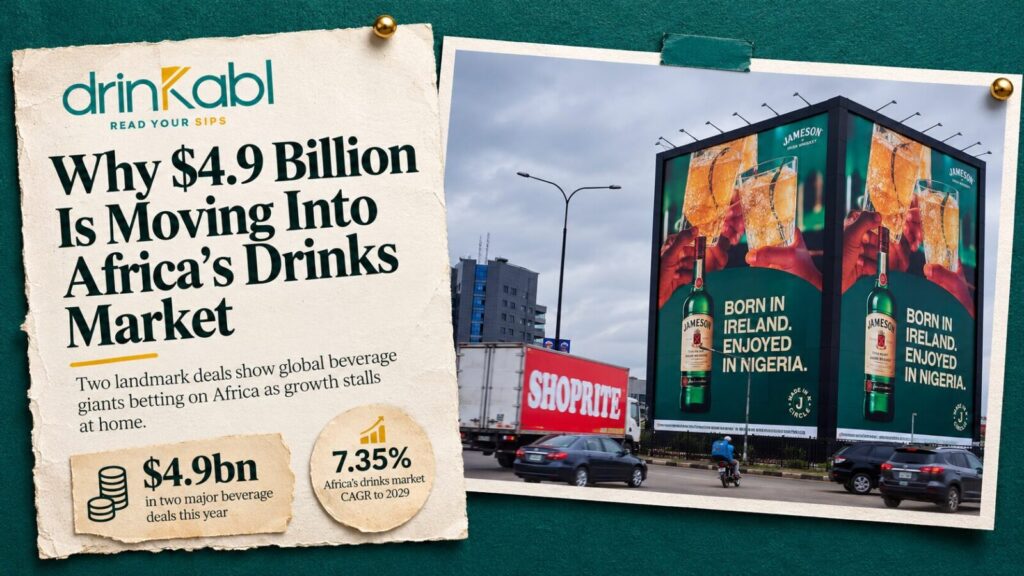
Two landmark deals show global beverage giants betting on Africa as growth stalls at home. Global beverage companies have put $4.9 billion behind a single bet this year: that Africa, not the West, is where growth still lives.
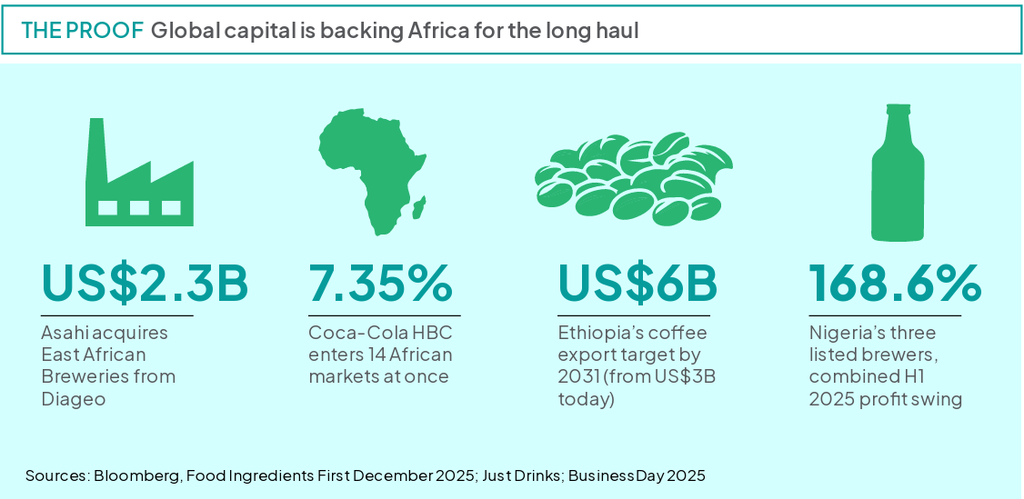
Coca-Cola HBC agreed to acquire a 75% stake in Coca-Cola Beverages Africa for $2.6 billion, a deal that hands it entry into 14 more African markets. Separately, Asahi Group Holdings agreed to buy Diageo’s 65% stake in East African Breweries for $2.3 billion, taking the Japanese brewer into Kenya, Uganda and Tanzania for the first time.
Together, the two transactions are among the clearest signs yet that Africa’s beverage market has moved from a story about potential to a live item on global boardroom agendas.
The growth problem is elsewhere
The capital isn’t moving south in isolation. It’s moving because growth in the traditional beverage heartlands, the US and Western Europe, is getting harder to find.
Global beverage alcohol volumes fell 1% last year, with spirits down 1.3%, wine down 2.4% and beer down 0.2%, according to data compiled in The New Pour Report 2026, a new Drinkabl Africa study. The World Health Organisation has recorded a 12% decline in global alcohol consumption between 2010 and 2022.
The US illustrates the pressure most sharply. Spirits supplier revenue fell 2.2% in 2025 to $36.4 billion, and volumes have kept slipping across several major international drinks companies. Western European beer markets are under similar strain.
When mature markets stop growing, companies run out of easy places to expand. Cost-cutting protects margins. Premiumisation protects value. Neither changes where the world’s drinkers actually live, and increasingly, that answer is Africa.
A different growth equation
Africa’s alcoholic drinks market is projected to reach $130.8 billion by 2029, a 7.35% compound annual growth rate between 2024 and 2029, per the report. Urbanisation, a growing middle class and shifting consumer habits are driving that curve, backed by a population of more than 1.4 billion, one of the youngest on earth.
The opportunity runs wider than alcohol. Africa’s non-alcoholic beverage market is worth $124 billion in 2025. Ethiopia’s coffee exports hit a record $3 billion in 2025/26, and Kenya’s tea earnings reached about $1.44 billion, with volumes up nearly 10%.
For global drinks companies, that mix of alcohol, coffee, tea and soft drinks adds up to more than a bet on population growth. It’s exposure to multiple beverage occasions on a continent still urbanising and fragmenting into new consumer markets.
Source: The New Pour Report, July 2026; data from sources cited in the report.
Two buyers, two strategies
Coca-Cola HBC’s move is about scale. The CCBA deal gives it entry into 14 additional markets, including Ethiopia, Kenya and South Africa, in one transaction. The New Pour Report argues Africa should never be treated as a single market: consumer habits in Lagos differ from Accra, which differ again from Nairobi. Buying distribution and local knowledge across several markets at once, not just buying consumers, is what makes the deal valuable.
Asahi’s bet is narrower but tells a different story. The East African Breweries acquisition is Asahi’s first African investment, and it comes as Diageo exits African beer almost entirely under its Accelerate restructuring programme, which targets $500 million in cost savings after a 27.8% drop in operating profit. What Diageo shed to cut debt, Asahi is buying as a long-term growth vehicle. Same assets, different time horizon.
Heineken’s own numbers back the pattern. In its first-quarter 2026 update, Africa and the Middle East posted robust volume and price-mix growth while Americas volumes fell 2.6%. Its full-year 2025 results showed total volume down 2.1%, even as Nigeria and Ethiopia contributed to revenue growth.
Fifty-four markets, not one
The New Pour Report is blunt about the risk of reading these deals as proof that Africa has become one giant, uniform consumer market. It argues the opposite: Africa is 54 markets, not one. Beer dominates the continent overall, but spirits lead in Nigeria and Kenya, cider is strongest in South Africa, and wine leads in Morocco and Tanzania.
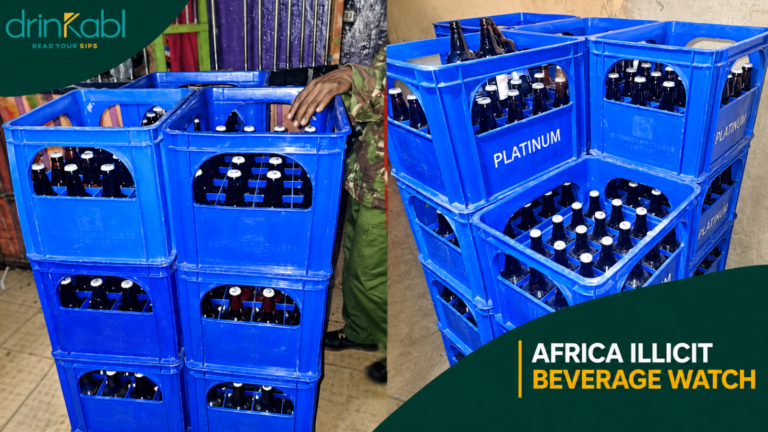
That fragmentation is real friction. Distribution is harder. Regulation differs by country. Informal trade is significant, and illicit alcohol is a structural problem rather than a side issue. In Kenya, the report cites estimates that illicit and fake brands account for 60% of all alcohol consumed, costing the state about $928 million in tax every year. South Africa’s illicit alcohol market is valued at R25.1 billion, 18% of everything sold.
Inflation has also pushed consumers toward cheaper, sometimes unregulated, alternatives in several markets, squeezing formal operators. But recovery has followed contraction: Nigeria’s three listed brewers swung to a combined 131.8 billion naira profit in the first half of 2025, up 168.6% on the year before, and South Africa’s wine harvest rebounded to 1.37 million tonnes in 2026 with a shift toward premium.
What happens next
The $4.9 billion in headline deals doesn’t make Africa an easy market. It makes it a market that rewards patience and local knowledge over speed and scale alone.
The harder question for investors is no longer whether Africa can grow. It’s how to convert that growth into durable returns while managing currency volatility, counterfeit competition and regulation that varies from country to country. That takes local distribution, pricing discipline and a far closer read of the consumer than most global playbooks currently offer.
The companies writing the big cheques are buying entry points. Turning those entry points into lasting market share is the work that starts now.
This article draws on data and reporting from The New Pour Report 2026, published by Drinkabl Africa in July 2026 and built on more than 15 independent market intelligence sources, eight in-depth interviews and five expert perspectives.