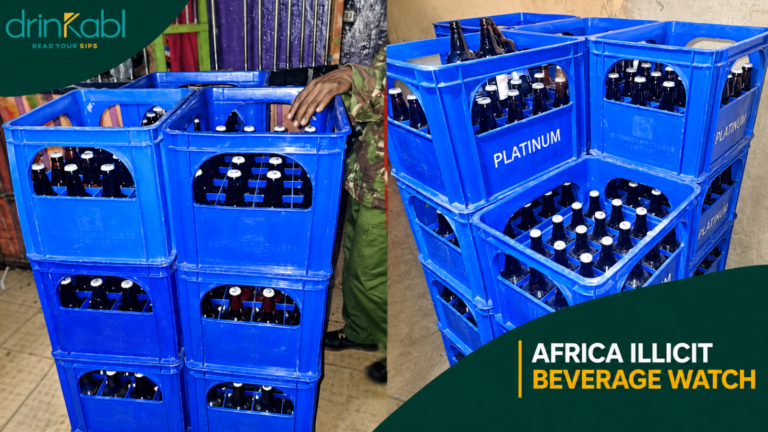

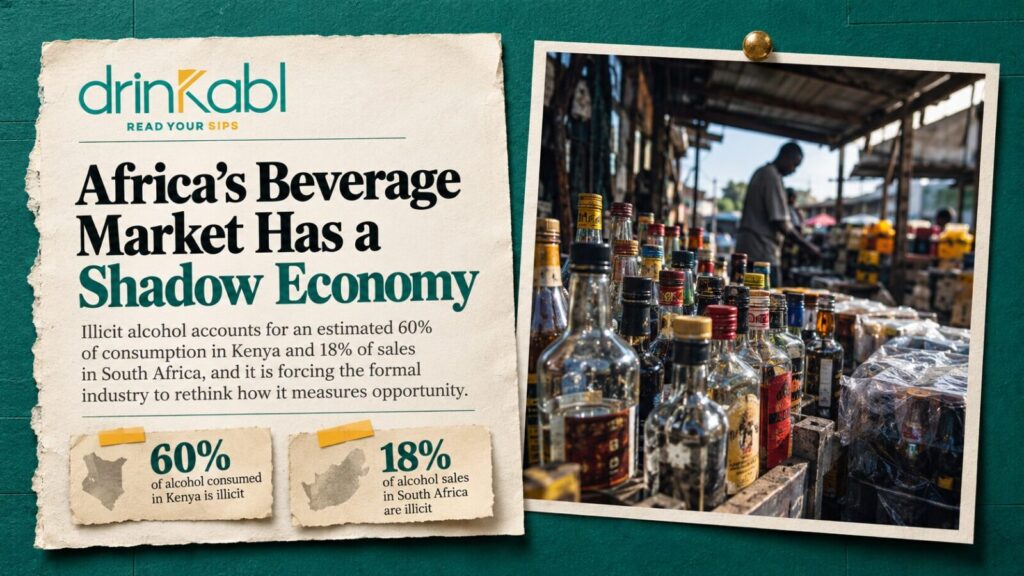
Illicit alcohol accounts for an estimated 60% of consumption in Kenya and 18% of sales in South Africa, and it is forcing the formal industry to rethink how it measures opportunity.
For Africa’s formal beverage industry, the toughest competitor may not be another brewer or distiller. It may be the bottle that never entered the legal market at all.
Counterfeit and illicit alcohol has become a structural feature of several African beverage markets, reshaping competition, government revenue, and consumer access to legal products. In Kenya, illicit and fake brands are estimated to account for 60% of total alcohol consumed, according to data cited in The New Pour Report 2026. In South Africa, the illicit alcohol market is valued at R25.1 billion, or 18% of alcohol sold.
In Kenya alone, the state loses an estimated US$928 million in tax revenue every year to fake and illicit alcohol. These are not marginal losses. They are large enough to change how the industry needs to understand the market it operates in.
The market on paper isn’t the market consumers buy in
Official market figures only tell part of the story. A formal beverage market is straightforward to measure: products move through registered manufacturers, distributors, and retailers, and taxes get collected along the way.
The informal market works differently. Goods move outside licensed channels, taxes go uncollected, and counterfeit products compete for the same consumption occasions as legitimate brands. That creates a measurement problem for anyone trying to size the opportunity.
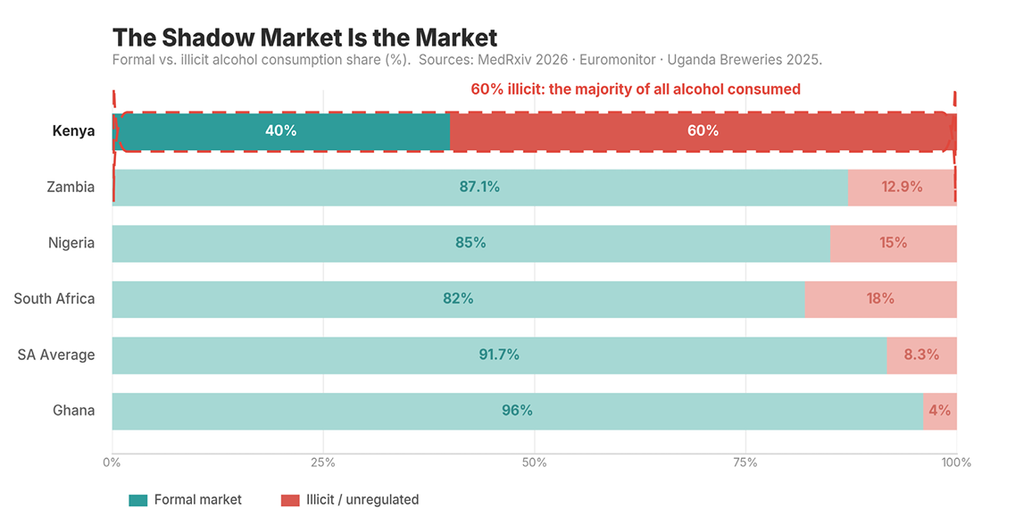
A company measuring only formal sales may underestimate total consumption. One that assumes all unserved demand can simply convert into legal purchases may overestimate what is commercially addressable, a distinction drinkabl.media has previously examined in its coverage of outdated consumer data. The New Pour Report’s Africa Beverage Playbook warns that official figures can overstate addressable opportunity in markets with heavy illicit consumption, and it puts Kenya’s formal market at only about 40% of total alcohol consumption.
The shadow market, in other words, is not separate from the beverage market. It is part of it.
Price is the biggest fault line
The counterfeit problem cannot be separated from affordability. Illicit and counterfeit products are, on average, around 37% cheaper than legitimate alternatives, according to Euromonitor International data cited in the report, with the gap even wider in East Africa.
That price gap creates a straightforward incentive. For consumers facing inflation or shrinking purchasing power, the choice is often not between two similarly priced brands. It can be between an increasingly expensive legal product and an illicit alternative offering the same drinking occasion for far less.
That changes the shape of competition. A formal producer invests in quality, packaging, distribution, and compliance, costs an illicit operator does not carry, leaving legal brands to compete against a fundamentally different cost structure.
Kenya shows how large the problem can get
Kenya’s numbers are the most striking in the report. Illicit alcohol prevalence across 12 African countries averages 8.3%, according to a study published on MedRxiv, reaching 12.9% in Zambia. Kenya sits well outside that range: illicit sales have risen 27% since 2022 and now make up an estimated 60% of total consumption, a figure also reported by the Alcoholic Beverages Association of Kenya.
At that scale, “problem” understates the commercial reality. Most consumers are buying in a market where formal producers, distributors, and regulators have limited control, which makes brand-share figures difficult to read: a formal brand can appear to be losing ground when the real shift is happening between the formal and informal economy.
South Africa’s version looks different
South Africa’s illicit market is a smaller share of total alcohol sales than Kenya’s, but its value, R25.1 billion, remains substantial, with counterfeit white spirits the biggest single component.
There is no single African illicit-market model. In one country, illicit consumption can represent a majority of what is drunk. In another, it is a smaller but still sizeable share of total sales, often for different reasons. That reinforces one of the report’s broader arguments: Africa cannot be treated as one beverage market, and the same is true of its shadow economy.
Nigeria’s tax dilemma
Nigeria illustrates a different problem: regulating harmful or informal consumption while protecting legitimate economic activity. The country’s sachet alcohol ban, backed by health advocates and regulators, has been frozen twice by the federal government over concerns about economic disruption.
Governments want alcohol taxes to raise revenue and support public health. But when the price of legal alcohol climbs too far above unregulated alternatives, consumers have an incentive to switch channels rather than cut back. Uganda Breweries’ 2025 market report found illicit beverage prices running up to 81% lower than equivalent legal products, a gap wide enough that enforcement alone struggles to compete with it.
Nigeria’s beverage sector felt a related strain directly, with counterfeit spirits raids intensifying as manufacturers work more closely with regulators to protect their supply chains.
Every counterfeit bottle costs more than one sale
For formal operators, the obvious loss is a sale. The damage runs deeper: lost excise revenue, thinner distributor and retailer margins, brand damage, consumer-safety risk, and weaker incentive to invest in the formal market at all.
Kenya’s roughly US$928 million annual tax loss reframes the issue. Counterfeiting is no longer only a brand-protection problem for beverage companies. It is a fiscal problem for governments, a distribution problem for legitimate operators, and a consumer-safety problem for regulators.
An affordability trap, and what operators can do
Africa’s beverage industry is premiumising and facing affordability pressure at the same time. Premium spirits are a growth segment even as inflation pushes other consumers toward cheaper options. A portfolio built only around premium price points risks leaving a gap that informal competitors are quick to fill.
The report’s answer is not simply more enforcement. It argues operators should engage proactively with regulators rather than treat compliance as a defensive afterthought, and that means sizing the shadow market before sizing the opportunity: understanding where illicit products are strongest, why consumers choose them, and where distribution gaps let them in.
The market underneath the market
Africa’s beverage market cannot be understood through formal sales figures alone. The official market shows what moves through recognised channels. The shadow market shows what consumers actually buy when price, availability, and regulation collide, and in Kenya, that shadow market has grown extraordinarily large.
The question for beverage companies is no longer simply how big the market is. It is how much of that market is formal, and what is happening underneath it. Until operators and policymakers can answer that with more precision, Africa’s beverage opportunity will keep carrying a significant blind spot.
This story draws on The New Pour Report 2026’s “Shadow Market Problem” and “Regulatory Tightrope” sections, examining illicit alcohol across Kenya, South Africa, and other African markets. Read the full report.