
The packaged food and beverages market in Nigeria had been watching the C.H.I. Limited transaction since Coca-Cola first signalled its intent to exit the asset. When UAC of Nigeria completed the purchase in October 2025, the question for investors was straightforward: how fast could the group absorb the acquisition and translate scale into earnings? The Q1 2026 numbers answered that question with considerable force.
Revenue at UAC nearly tripled the scale of prior-year earnings in the same quarter, as the consolidation of C.H.I. into group accounts reshaped the financial profile of one of Nigeria’s oldest conglomerates. The numbers reflect not just a change in ownership but a structural repositioning of the group within the local consumer goods landscape, where packaged beverages have become the dominant growth engine.
UAC of Nigeria reported profit after tax of N13.64 billion for the three months ended March 31, 2026, compared with N3.32 billion in the same period a year earlier. Group revenue reached N191.22 billion, up from N56.00 billion, with the packaged food and beverages segment contributing N161.09 billion to that total. Gross profit rose to N54.81 billion from N14.26 billion, and operating profit stood at N28.40 billion against N6.83 billion in Q1 2025, with operating margin improving to 14.8 percent from 12.2 percent.
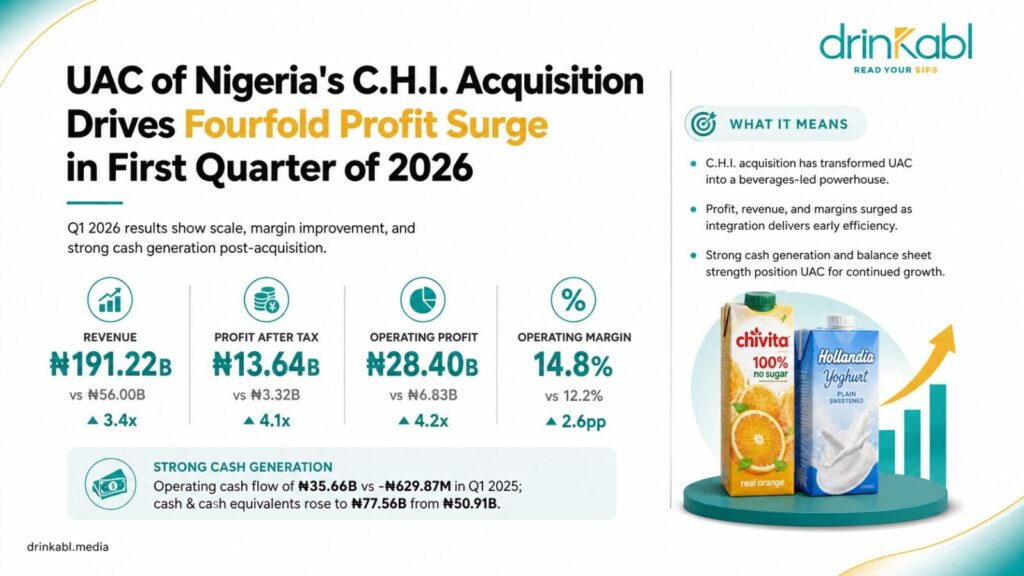
Group Managing Director Fola Aiyesimoju stated in the earnings release: “Our results for Q1 2026 reflect the consolidation of C.H.I.’s performance, continued strong performance at our Packaged Food and Beverages and Paints businesses, and the work we have done to drive improved performance at C.H.I. These contributed to revenue growth of 3.4x to N191 billion and profit before tax increasing 4.5x to N23 billion.”
The C.H.I. acquisition fundamentally repositioned UAC’s portfolio. Before the deal, the group operated across edibles, quick-service restaurants, paints, and a smaller beverages operation. The addition of C.H.I., which produces Chivita fruit drinks and Hollandia dairy products, moved beverages from a supporting segment to the core of the business. That shift is now visible in segment data: packaged food and beverages revenue rose to N161.09 billion from N19.29 billion, while edibles and feed revenue declined to N17.95 billion from N26.15 billion on weaker volumes and price pressure. Quick-service restaurant revenue fell to N576 million from N611 million, partly reflecting store closures. Paints held relatively steady at N11.59 billion, up from N10.09 billion.
The scale of the C.H.I. integration is directly relevant to the broader Nigerian beverage sector, where consolidation among local manufacturers has accelerated as multinationals recalibrate their African footprints. Helios Investment Partners completed a comparable strategic move earlier this year, as covered in our analysis of the Beta Glass acquisition, which similarly reflected private and local capital stepping into assets Coca-Cola and other multinationals were releasing. The C.H.I. deal follows an identical logic: Nigerian groups acquiring category-relevant brands at a moment when consumer demand for packaged and processed beverages remains structurally robust, a trend detailed in our coverage of the forces driving Africa’s beverage sector in 2026.
Finance costs rose to N14.81 billion from N3.29 billion, reflecting higher borrowings tied to the acquisition. Net finance cost widened to N6.49 billion from N2.09 billion, though a N6.8 billion foreign exchange gain and debt refinancing helped offset the pressure. Operating cash generation was strong: UAC produced N35.66 billion from operations in the quarter, reversing a negative cash position of N629.87 million in Q1 2025. Cash and cash equivalents rose to N77.56 billion from N50.91 billion. The ratio of operating expenses to revenue also declined to 14.0 percent from 14.5 percent, suggesting early integration efficiency gains. As reporting from Reuters on peer consumer groups in frontier markets has noted, overhead absorption at this pace following a large acquisition is unusual and typically signals a well-structured transition plan.
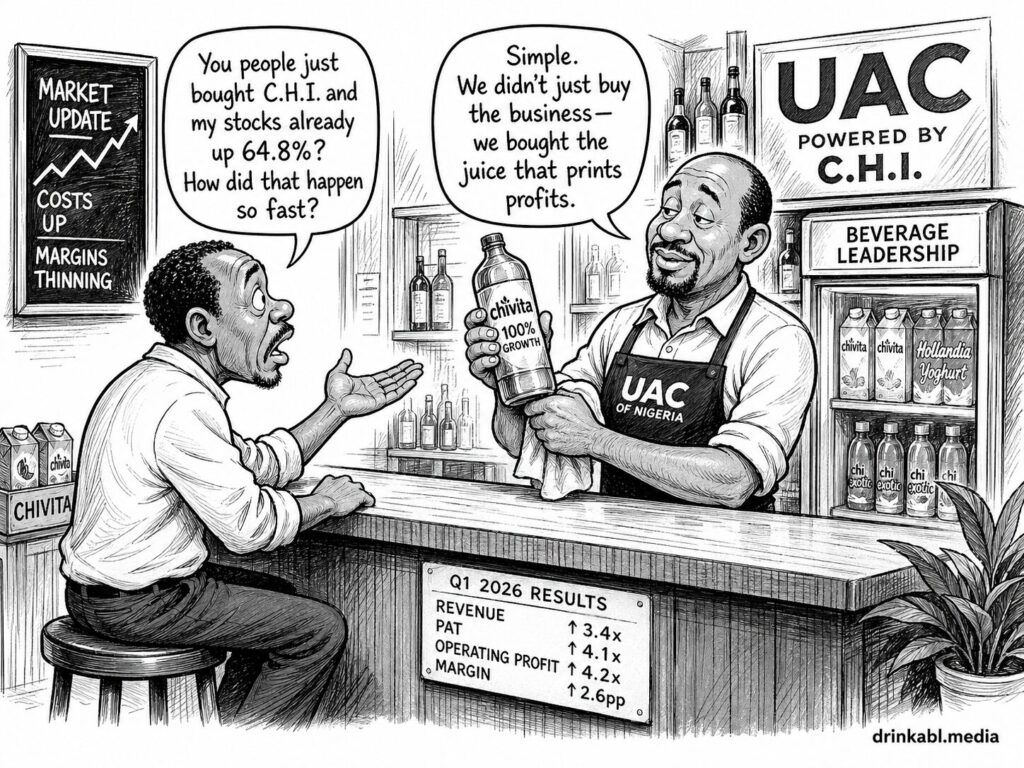
The immediate task for UAC is margin expansion within C.H.I. itself, moving from volume consolidation to operational optimisation. Aiyesimoju signalled as much in the earnings note, framing margin expansion and working capital optimisation as post-acquisition priorities now actively in execution. With total equity at N83.95 billion and retained earnings climbing to N66.52 billion, the balance sheet gives the group room to pursue that agenda without immediate capital pressure. The share price has gained 64.8 percent year-to-date on the Nigerian Exchange, placing UAC among the market’s better performers as investors price in continued integration upside. Whether the group can sustain that trajectory through the remainder of 2026 will depend on its ability to hold C.H.I. volumes while compressing unit costs across the combined beverage operation. The Nigerian consumer backdrop remains competitive, with the same inflationary dynamics reshaping spending patterns across markets globally creating similar pressures at the retail level locally.
Read More:
Goldberg Brings Football Fans Back to Bars With Rewards Campaign Across Nigeria
How Nigeria’s First Craft Brewery Survived a Mass-Market Beer Market to Build a Global Name
Uganda’s Tea Sector Presses Government for Promised Bailout as Price Recovery Remains Fragile