


Nigeria’s Beer Sectoral Group told the Nigeria Customs Service on 11 May that a proposed tax stamp scheme would raise compliance costs in a sector it says is already closely tracked, without meaningfully reducing illicit trade.
The Abuja meeting, held at NCS headquarters in Maitama, brought together Comptroller-General Adewale Adeniyi and senior executives from the group’s member companies, including Guinness Nigeria Plc and Nigerian Breweries. The agenda covered tax administration, trade transparency, and proposed changes to excise enforcement.
Girish Sharma, Chief Executive Officer of Guinness Nigeria Plc, led the industry delegation and questioned the necessity of physical stamps in a sector where the compliance infrastructure already exists. “We fully understand the purpose and importance of tax stamps, particularly in industries where counterfeiting is a major concern,” he said. “However, within the beer sector, counterfeiting is minimal.”
Sharma added that existing monitoring systems already cover the full production and distribution chain. “From an end-to-end compliance perspective, we believe there is already sufficient transparency and oversight,” he said.
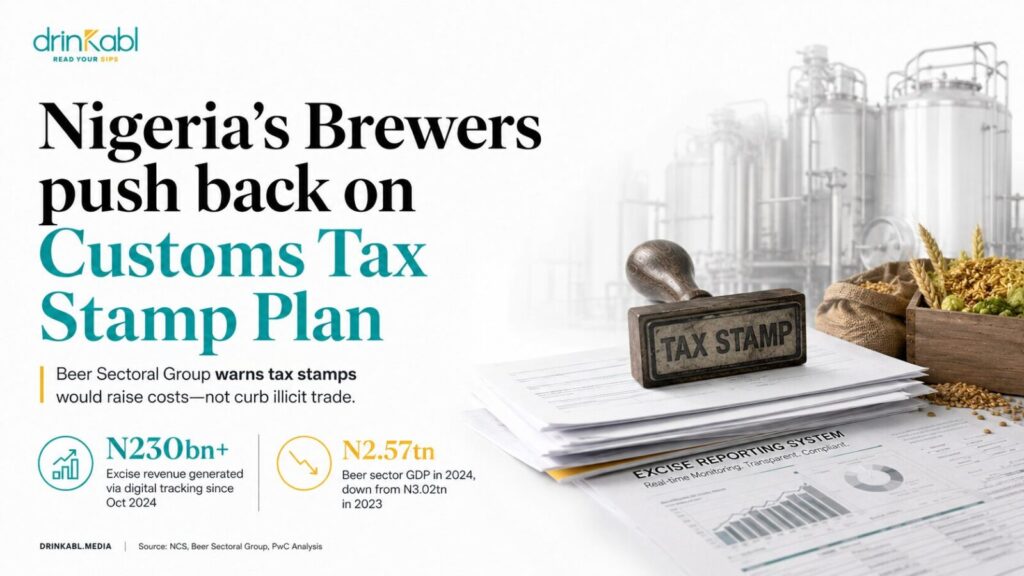
The industry’s case rests partly on the NCS’s own Excise Reporting System, a digital platform launched in October 2024 that tracks production volumes and excise duty payments in real time. Since its rollout, the system has generated more than N230 billion in excise revenue, according to figures the Beer Sectoral Group presented at the meeting.
A PwC analysis presented by the industry delegation showed the beer sector’s GDP contribution more than doubled from N1.47 trillion in 2018 to N3.02 trillion in 2023, before contracting to N2.57 trillion in 2024 as rising interest rates, naira depreciation, and inflation compressed margins.
Adeniyi did not dismiss the industry’s concerns outright but pushed back on some of the data framing. “We need to have a clear understanding of what constitutes illicit trade,” he said. “Some of these products are legitimately manufactured in Nigeria.” He also questioned the reliability of certain estimates circulating in the policy debate.
On the core question of whether tax stamps will be implemented, Adeniyi kept the outcome open. “As far as I am concerned, consultations are still ongoing,” he said. “If this initiative is legitimate and beneficial, then we all have a responsibility to ensure that we are heading in the right direction.”

No final decision has been reached. The sector is already managing rising excise rates under the current 2026 to 2028 fiscal framework, and any cost increase from additional compliance infrastructure will weigh directly on production economics and retail pricing.
Read More: