

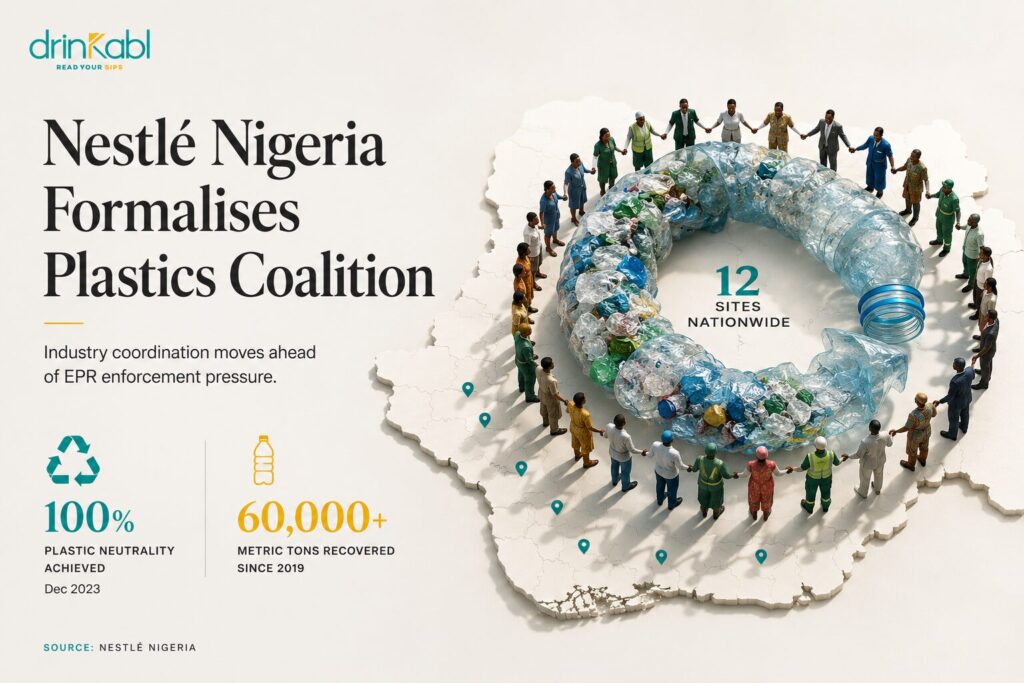
Nestlé Nigeria has launched a multi-stakeholder coalition to accelerate plastic waste recovery across twelve sites nationwide, framing the move as a shift from company-level action to coordinated systems management across the full plastics value chain.
The coalition, announced on June 5 in commemoration of World Environment Day, brings together NESREA, the Federal and Lagos State Ministries of Environment, LAWMA, the Food and Beverage Recycling Alliance (FBRA), and the Recyclers Association of Nigeria, alongside development partners including the Swiss Consulate and the Netherlands.
The timing reflects more than calendar symbolism. Nigeria is finalising enforcement mechanisms for its Extended Producer Responsibility regulations, under which food and beverage producers face mandatory take-back obligations for the packaging they introduce to market. FBRA, Nigeria’s first Producer Responsibility Organisation, has grown from four founding members to 49 organisations since its 2018 launch. Compliance infrastructure that works before enforcement arrives is worth more than one assembled under deadline.
“Waste management outcomes improve when intervention shifts from awareness alone to shared accountability across the value chain.” Victoria Uwadoka, Corporate Communications and Sustainability Lead, Nestlé Nigeria
Nestlé Nigeria’s position in that infrastructure is not marginal. The company achieved 100% plastic neutrality in December 2023, taking back the equivalent of every tonne of plastic it puts into the Nigerian market. It was also the first producer in Nigeria to incorporate 50% recycled PET into Nestlé Pure Life bottles, using recovered material from the same FBRA system through which it now coordinates this coalition. Since 2019, partnerships with Chanja Datti, Wecyclers, and MECOM have recovered more than 60,000 metric tons of plastic waste for processing.
Victoria Uwadoka, Corporate Communications and Sustainability Lead at Nestlé Nigeria, stated: “Waste management outcomes improve when intervention shifts from awareness alone to shared accountability across the value chain. This coalition is designed to connect policy, infrastructure, community action, and market-based recovery systems in a way that can deliver more durable environmental results.”
Packaging is among the highest-visibility compliance costs for food and beverage producers. Drinkabl.media’s coverage of Nigerian Breweries’ internal packaging efficiency work tracked how companies across the sector are treating materials management as an operational lever. Separately, this publication’s reporting on how regulation is reshaping Africa’s beverage market has traced the growing compliance burden building across producer categories.
The coalition’s measurable test comes when the 12-location community programme produces recovery data. FBRA’s collective membership has already diverted more than 100,000 metric tons of plastic from Nigeria’s environment since 2018. How much flows back into rPET-grade production inputs, rather than lower-value processing streams, will determine how much of the circular economy story here is commercially sustainable.
READ MORE