
Before the Uganda Tea Association could push for recovery, the industry had to survive. Years of compounding shocks, rooted in geopolitical disruption and collapsing commodity prices, quietly hollowed out one of East Africa’s most storied agricultural export sectors, forcing a reckoning that is now translating into a landmark government intervention.
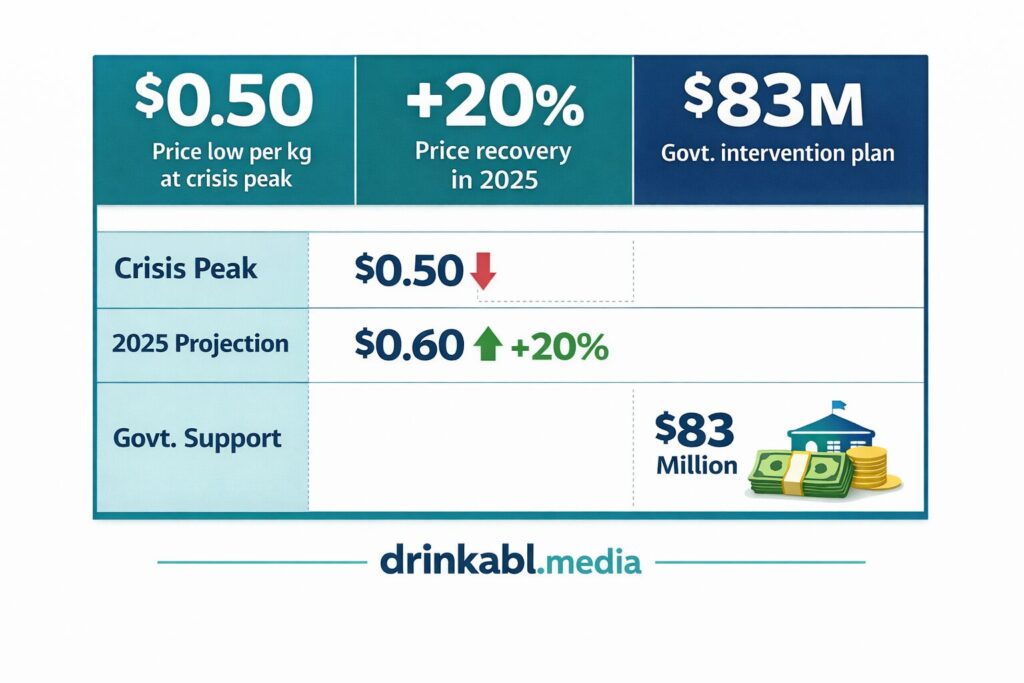
The cascade began with global conflict. As the Russia-Ukraine war and Middle East instability fractured international commodity flows, Uganda’s tea prices fell to as low as US$0.50 per kilogramme, decimating margins across the entire value chain. Factories shuttered or scaled back operations. Annual production slid from over 60 million kilogrammes to roughly 40 million kilogrammes, a contraction that stripped cash flow from growers, processors, and exporters simultaneously.
The Uganda Tea Association (UTA) had spent years escalating its case internally before going public. In 2023, the body formalised its position, presenting the government with a tiered proposal spanning short, medium, and long-term stabilisation measures. Central to the ask was working capital equivalent to 30 percent of industry needs, a figure the UTA calculated as the minimum threshold to allow factories to maintain green leaf purchases from smallholder farmers without interruption.
“The entire system is interconnected. When factories cannot pay farmers, farmers cannot invest in fertilisers or quality inputs, and the entire value chain suffers.”Victoria Ashabaahebwa, Chairperson, Uganda Tea Association
Those negotiations reached the highest level of government. Following sustained engagement, including consultations with the East Africa Tea Trade Association, President Yoweri Museveni pledged UGX152 billion (US$40.71M) in working capital support, alongside fertiliser subsidies for farmers. The UTA is now pressing for immediate disbursement, warning that delayed release of funds risks undermining the tentative recovery already underway.
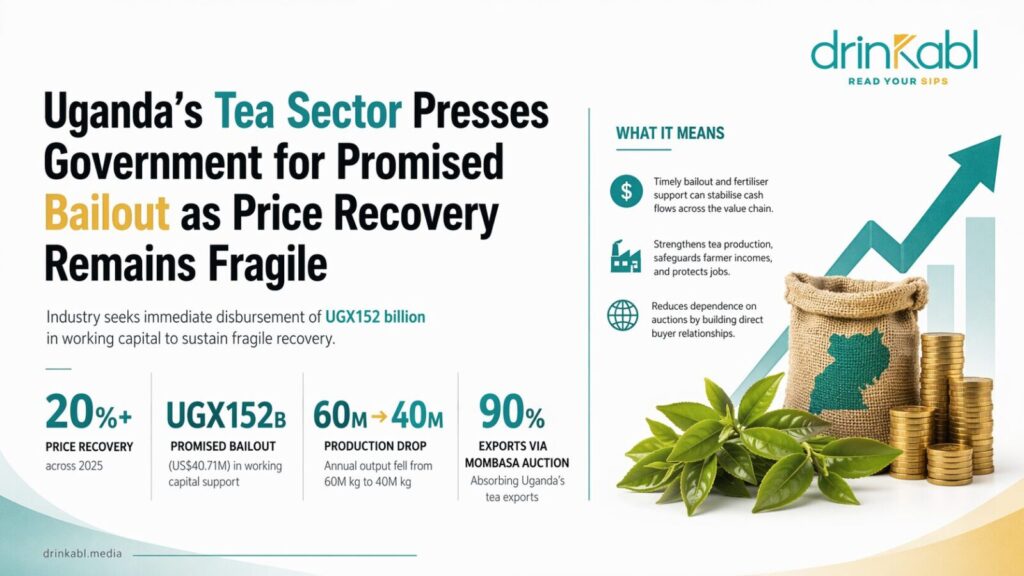
Prices improved more than 20 percent across 2025, supported by strong demand at the Mombasa auction, which absorbed around 90 percent of Uganda’s exported tea. But the UTA has made clear that price gains alone are insufficient. The industry still contends with high production costs, persistent labour shortages, deteriorating rural infrastructure, and a near-total absence of affordable credit for smallholder farmers and mid-scale processors alike.
“Both the fertiliser support and the UGX152 billion bailout must be provided simultaneously.”Grace Kyomugisha, Chairperson, Kayonza Growers Tea Factory
To address financing gaps structurally, the UTA has partnered with Diamond Trust Bank, which brings direct experience financing Kenya’s tea sector. The partnership is designed to unlock asset financing and working capital instruments tailored to Uganda’s production and export cycle, a model Kaziro Kyambadde, the bank’s head of corporate and institutional banking, says has already delivered measurable results in Kenya.
The UTA is also developing a five-year strategic plan covering financing, logistics, market access, and value addition. A central objective is reducing Uganda’s structural dependence on auction, a vulnerability exposed by the price collapse, through direct buyer relationships in key international markets.
State Minister for Agriculture Bwino Fred Kyakulaga signalled that the government has elevated tea to the level of strategic commodity, confirming a UGX310 billion (US$83.04M) intervention plan is in development. Whether that political commitment converts to disbursed capital, and on what timeline, remains the defining question for a sector that has been waiting longer than the price charts suggest.