
While a heritage tree planting ceremony in Cape Town last week drew attention to the anniversary of South Africa’s apple industry, the more consequential story for beverage manufacturers had been building for years, one rooted in counter-seasonal positioning, concentrate supply resilience, and an export infrastructure that now feeds juice and cider production lines across more than 100 countries.
South Africa’s largely temperate climate and fertile river valleys have enabled it to become a major producer of fruits that meet counter-seasonal demand in the Northern Hemisphere, with the country long functioning as Europe’s out-of-season fruit bowl. For beverage sourcing teams, that structural advantage is not symbolic, it is operational. The South African apple season runs counter to the Northern Hemisphere, meaning South Africa supplies markets precisely when domestic harvests fall short.
That supply dynamic underpins a market that is growing in both volume and value. The global apple juice market reached USD 19.56 billion in 2025 and is forecast to attain USD 28.32 billion by 2031, advancing at a CAGR of 6.39%. Within that, the concentrate segment, where South Africa plays most directly, is itself on an independent growth trajectory, with the apple juice concentrate market valued at USD 5.4 billion in 2026 and projected to reach USD 8.24 billion by 2035 at a CAGR of 4.81%.
Against that backdrop, the scale of South Africa’s production base commands attention. Tru-Cape Fruit Marketing, which hosted the 364th anniversary ceremony on 17 April at Jan van Riebeeck High School in Cape Town, operates within an industry that now hosts approximately 45 million apple trees and produces 1.3 million tonnes annually.
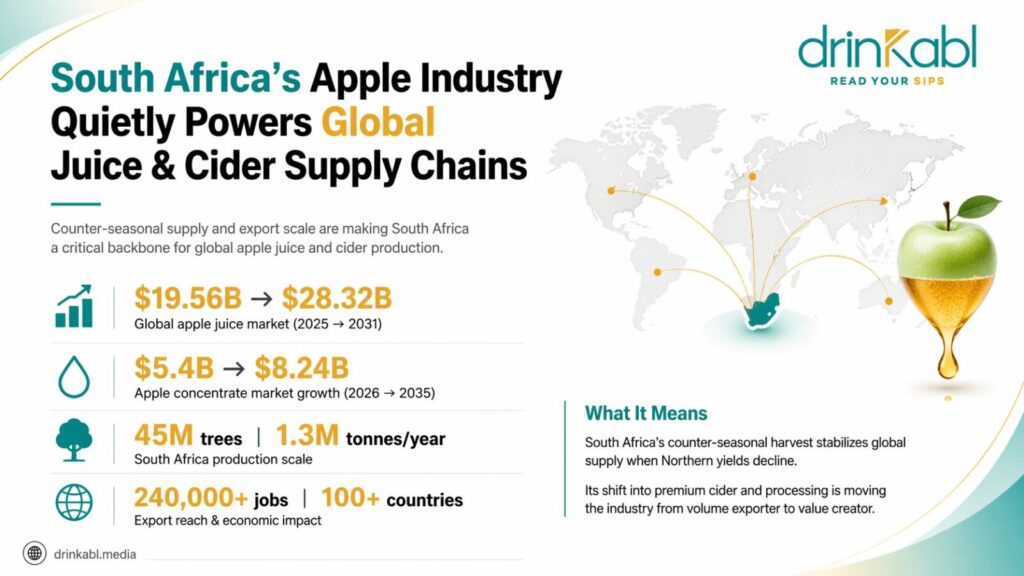
“Today, South Africa is home to approximately 45 million apple trees and produces 1.3 million tonnes of apples annually, making us the largest apple exporter in the Southern Hemisphere,” said Jeanne Fourie at the ceremony.
That export volume supports over 240,000 jobs and feeds directly into both fresh supply chains and processed beverage ingredient markets, with apple juice concentrate traded internationally in bulk for reconstitution and blending, with major export availability from Southern Hemisphere suppliers complementing Northern Hemisphere production cycles.
On the cider side, South Africa has moved beyond pure ingredient supply. Premium cideries established in the Western Cape are producing orchard-to-bottle product from the Ceres Valley, blending apple cultivars for the commercial market. That premium positioning mirrors a broader shift in how Southern Hemisphere producers are attempting to capture more value from raw fruit volumes, rather than exporting commodity concentrate alone.
The ceremony itself, which involved planting only the fourth known Witte Wijnappel tree in South Africa, an heirloom cultivar traced by Tru-Cape’s quality assurance manager Henk Griessel to two surviving trees in the Netherlands, was as much a signal of long-term institutional confidence as a heritage gesture. Roelf Pienaar, Managing Director of Tru-Cape, framed it in explicitly competitive terms.
“The South African apple industry stands as a remarkable example of resilience, innovation, and global competitiveness. From a single tree to a world-leading export industry, it is a story we can all be proud of,” Pienaar said.
For beverage manufacturers reassessing fruit ingredient sourcing amid climate volatility and Northern Hemisphere yield uncertainty, South Africa’s combination of scale, counter-seasonal timing, and an increasingly sophisticated domestic processing industry makes it a supply chain asset that extends well beyond its anniversary headlines.
Read More
Heineken Exits DRC as Africa’s Asset-Light Brewery Reset Accelerates
Guinness Nigeria’s Q1 Profit Surge Seals Tolaram’s Turnaround Thesis
How the Iran-U.S. War, Strait of Hormuz Closure Is Shaking the Global Beverage Industry