
For years, the pressure had been building quietly. Civil society groups, regulatory bodies across Europe, and independent researchers were compiling an increasingly damaging body of evidence that Nestlé’s sustainability commitments in coffee sourcing were falling well short of their stated intent. In Brazil and Mexico, farmers participating in the Nescafé Plan were earning incomes below subsistence level. In Germany, NGOs filed formal complaints under the Supply Chain Act, naming Nestlé among companies allegedly sourcing from suppliers who violated human rights. In Mexico, a ProDESC report documented opaque purchasing practices and worker exploitation tied directly to Nestlé supply chains. The company’s flagship coffee brand faced a credibility problem it could no longer manage through communications alone.
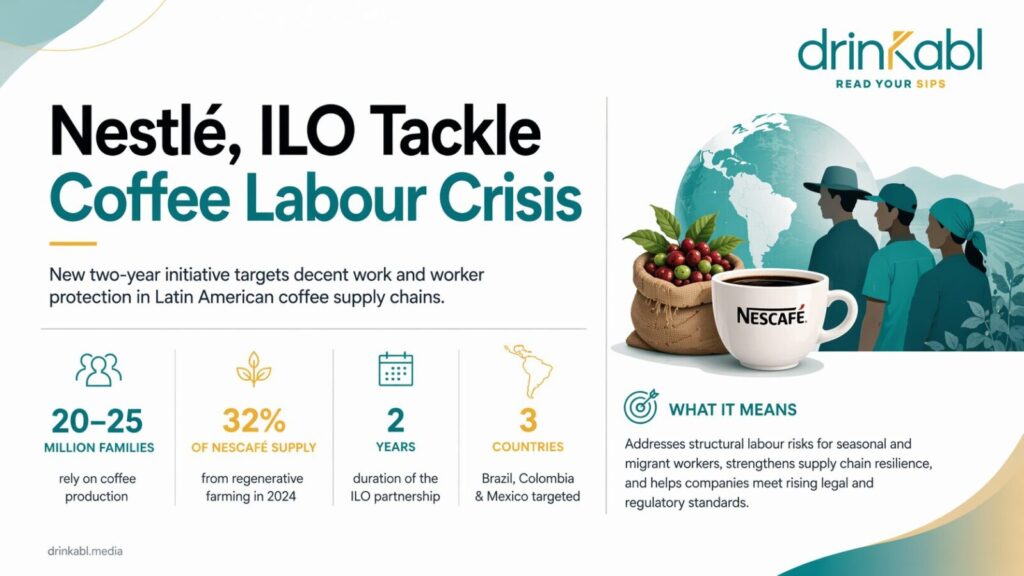
That accumulation of pressure helps explain the strategic logic behind Nestlé’s expanded partnership with the International Labour Organization, formalised this month through a new two-year initiative titled “From fair recruitment to worker protection in coffee supply chains.” The programme targets Brazil, Colombia and Mexico, precisely the markets where scrutiny of Nestlé’s sourcing had been most acute.
The timing is not incidental. Nestlé updated its Nescafé Plan in 2022 with a commitment exceeding $1 billion and a promise to source responsibly at full scale by 2025. That deadline has now passed, and the company’s own reported figures show that only 32% of Nescafé’s supply came from farmers using regenerative agriculture practices in 2024. The gap between ambition and delivery is where the ILO partnership enters the frame.
Under the arrangement, the ILO will convene social dialogue among governments, employers’ organisations and workers’ groups to map the structural causes of labour deficits across coffee supply chains, with particular attention to seasonal and migrant workers, the segment most consistently documented as carrying the highest risk of exploitation. Country-level interventions will follow, feeding into broader knowledge-sharing across the global sector.
Dan Rees, Director of the ILO Priority Action Programme on Decent Work in Supply Chains, addressed the scale of the challenge directly.
“Coffee production sustains the livelihoods of approximately 20 to 25 million families worldwide, generating vital income and employment. However, decent work deficits in coffee supply chains persist, particularly among seasonal and migrant workers. Through this project, we aim to advance labour rights and promote decent work and contribute to more sustainable supply chains.”
For Nestlé, the partnership is also a supply chain resilience argument, not merely a social one. The company’s exposure to three Latin American markets for Nescafé sourcing creates structural vulnerability; workforce instability, poor recruitment practices and inadequate safety conditions all represent operational risks at scale. Drinkabl.media has previously reported on Nestlé’s accelerating investment in the premium coffee segment, including the launch of Starbucks Coffee Craft concentrates across Asian and European markets, moves that raise the brand stakes considerably for the Nescafé platform that underpins them.
Antje Shaw, Head of Sustainability for Coffee at Nestlé, framed the partnership in terms of both rights and commercial strategy.
“Our partnership with the ILO represents a significant step to advancing and promoting human rights in coffee supply chains. By working together, we can progress faster in creating more resilient and inclusive coffee value chains, where workers are treated with dignity.”
The programme will operate within the ILO’s Fair Recruitment Initiative and its Safety and Health for All flagship programme, including the Vision Zero Fund, which targets safe working environments across global supply chains. Nestlé is already a founding member of the ILO-convened Child Labour Platform, a relationship that provided the institutional foundation for this more expansive arrangement.
The beverage sector is watching. Labour standards in agricultural supply chains have moved from a reputational consideration to a legal and commercial one, driven by mandatory due diligence legislation in the EU and analogous frameworks in Germany. As the regulatory environment tightens across beverage markets globally, companies that cannot demonstrate verifiable labour practices in sourcing will face escalating risk. The Nestlé-ILO initiative, whatever its eventual outcomes, represents the most operationally structured response to that pressure that a major coffee group has yet attempted. Whether it translates into measurable change for the 20 to 25 million families whose livelihoods depend on the industry will be the measure against which both partners are ultimately judged.
Read More
Guinness Nigeria’s Q1 Profit Surge Seals Tolaram’s Turnaround Thesis
Uganda’s Tea Sector Presses Government for Promised Bailout as Price Recovery Remains Fragile
Alani Nu Faces Lawsuit After Teen’s Death Linked to Caffeine Overconsumption