
After years of mounting losses under a weakened naira and shifting ownership, Nigeria’s most iconic brewer enters 2026 not just in recovery, but in command.
Long before Guinness Nigeria Plc filed its Q1 2026 numbers with the Nigerian Exchange, the shape of this result had been telegraphed by a series of deliberate, high-stakes moves. The Tolaram Group’s completion of its acquisition of Diageo’s majority stake, finalised in late 2024, ushered in new leadership, a restructured cost framework, and a clear mandate: return the brewer to consistent profitability in a market that had punished it for years. That mandate, it now appears, is being delivered ahead of schedule.
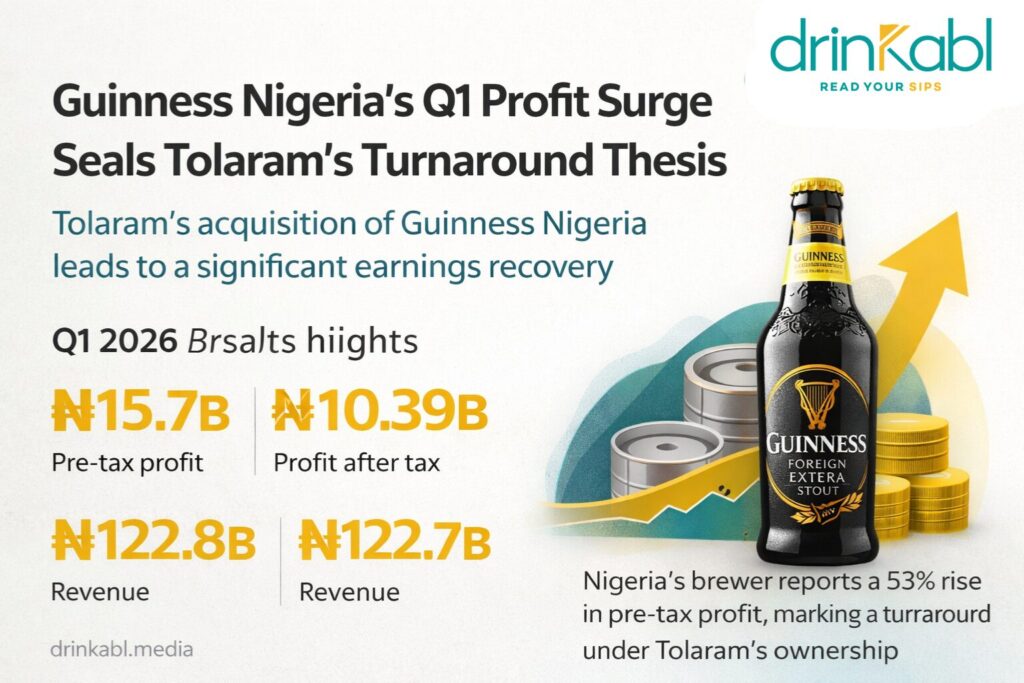
For the quarter ended 31 March 2026, Guinness Nigeria reported a pre-tax profit of ₦15.7 billion, a 53.19% year-on-year climb from ₦10.2 billion in the same quarter of 2025. Profit after tax reached ₦10.39 billion, up 48% on the prior year period, while revenue expanded to ₦122.77 billion from ₦118.3 billion. Brewed products accounted for 98.47% of that topline, with exports making up the balance.
The numbers carry deeper significance when read against the brewer’s recent history. Just two years ago, Guinness Nigeria was bleeding red, posting a ₦54.7 billion loss for the financial year ended June 2024, a casualty of naira devaluation, surging input costs, and a consumer base squeezed by inflation. The 18-month audited period ending December 2025, Guinness Nigeria’s first full cycle under Tolaram, produced a ₦41.2 billion net profit and revenue growth of 144% to ₦730.8 billion, a landmark recovery that reordered the narrative around the company entirely.
What the Q1 2026 results confirm is that the rebound was structural, not statistical. Net finance costs declined significantly, pointing to tighter capital management. Earnings per share improved, and the board moved with conviction, approving an interim dividend of ₦2.00 per share, totalling ₦4.38 billion, with a qualification date of 20 April 2026. For a company that had not rewarded shareholders in years, the gesture carries strategic weight.
“We are pleased to report Guinness Nigeria PLC’s eighteen-month results, which demonstrate resilience and unwavering focus, resulting in stellar financial performance despite the intense competitive landscape,” the company stated in its full-year filing, a tone it has now carried into its quarterly disclosures.
The result lands in a market still navigating significant headwinds. Nigeria’s beer volumes declined by mid-teens across 2025, according to industry data, and the sector remains locked in a high-stakes standoff with regulators over the proposed 2026, to 2028 excise duty framework. Guinness Nigeria sits at that table alongside Nigerian Breweries and International Breweries, all three pressing the Beer Sectoral Group’s case for a fiscal environment that does not strangle recovering producers. NAFDAC’s ongoing sachet alcohol ban adds a further layer of operational complexity, particularly at the lower end of the market where volume is made.
Yet Guinness Nigeria’s Q1 performance suggests its portfolio is holding its own. The brand’s pivot under Tolaram, emphasising commercial execution, portfolio discipline, and distribution efficiency across its Ogba, Benin, and Aba facilities, appears to be generating margin resilience even as the broader Nigerian beer market softens. Cost of sales rose to ₦79.2 billion from ₦73.8 billion, an expected function of volume growth, but was absorbed without eroding the profitability trajectory.
For the industry at large, Guinness Nigeria’s Q1 numbers represent something more than a single quarterly beat. They signal that a post-Diageo, Tolaram-led Guinness is competitive, dividend-paying, and reclaiming ground in Africa’s second-largest beer market. The question now is whether that momentum can hold as excise pressures, currency volatility, and volume softness test every brewer operating in Nigeria through the remainder of 2026.
Read More