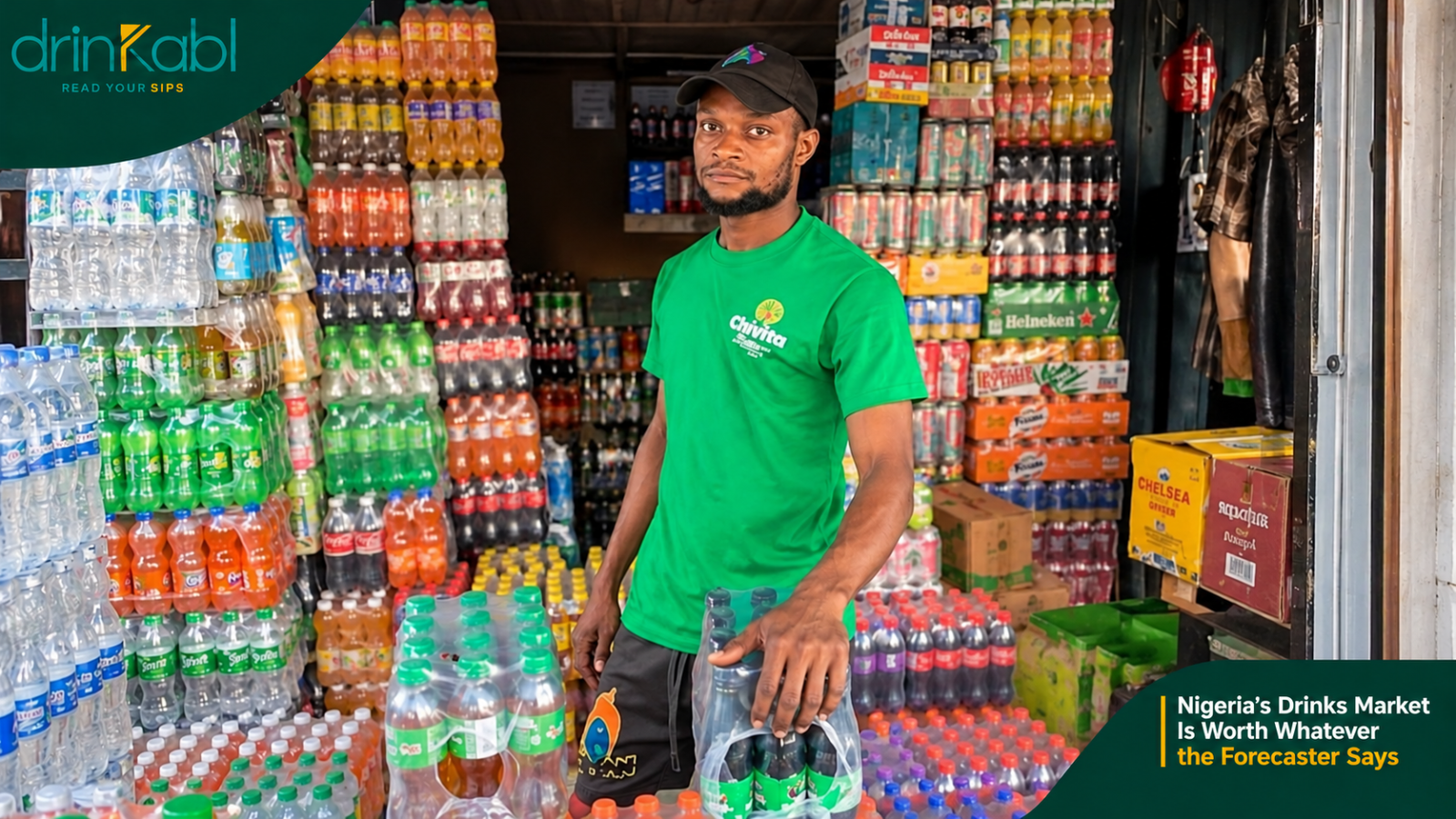

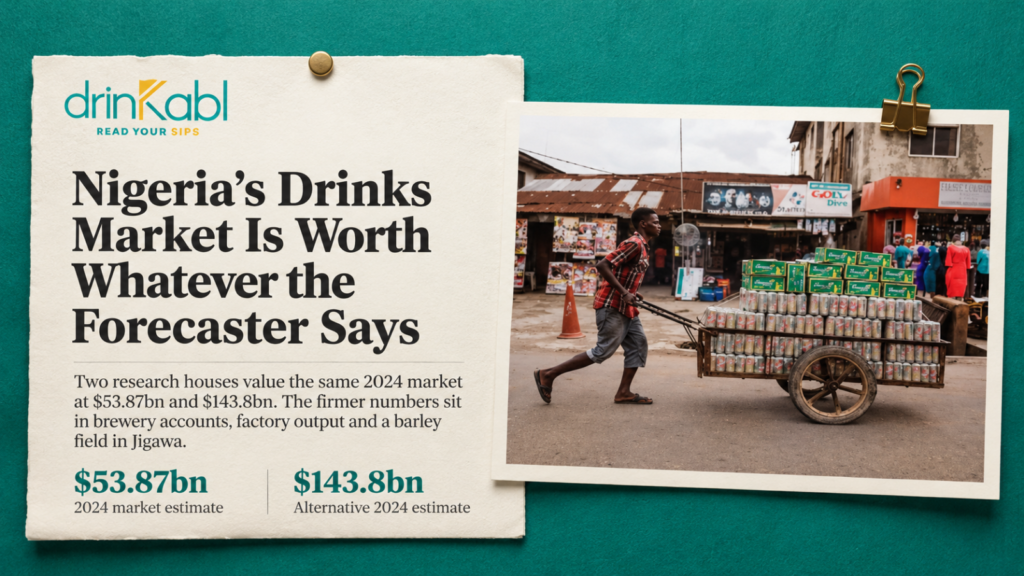
Two research houses value the same 2024 market at $53.87bn and $143.8bn. The firmer numbers sit in brewery accounts, factory output and a barley field in Jigawa.
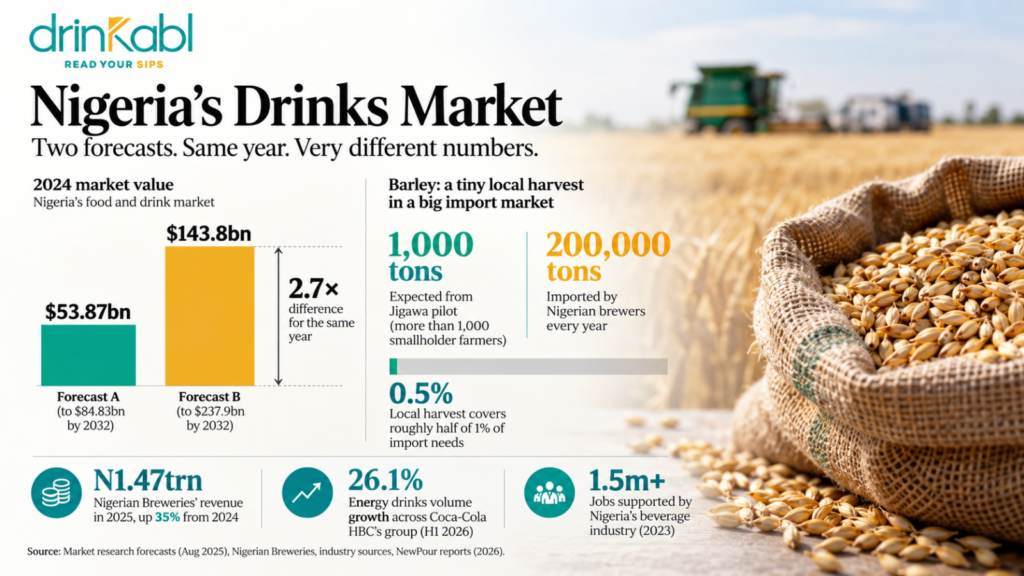
Earlier this year, at a barley field day in Ringim, Jigawa State, Nigerian Breweries said more than 1,000 smallholder farmers had grown the crop under its pilot programme and expected just over 1,000 tons. Nigeria’s brewers import about 200,000 tons of malted barley every year, which the company says sends more than $150 million abroad. The local harvest therefore covers roughly half of one per cent of that appetite. The brewer says the pilot shows barley can grow commercially in the north.
That gap between what a market spends and what stays in the country is the question behind a forecast published in August 2025. It projects Nigeria’s food and drink market reaching $84.83 billion by 2032, up from $53.87 billion in 2024, yet it does not publish the beverage share. This piece asks how large the beverage slice really is, and who keeps the money when spending rises.
Forecasts that disagree by a factor of 2.7
A rival forecast for the same market puts the 2024 base at $143.8 billion, rising to $237.9 billion by 2032. That is about 2.7 times the first figure for the same year, and the gap almost certainly reflects different definitions, such as retail value against producers’ revenue. The first forecast expects food to dominate the combined total, so beverages are the smaller slice, though its size is not disclosed. Its contents page also still carries chapter headings for 2015 to 2020 and for the COVID-19 period, which does not show the numbers are old but leaves a buyer unable to tell which parts are new.
Narrower measures are easier to pin down. One estimate values Nigeria’s 2024 market for non-sugary, non-alcoholic drinks, leaving out juices and milky drinks, at $3.6 billion, the largest in Africa for that category. It counts what producers and importers earn before retailers’ margins, and Nigeria imported only 33 million litres of it against 4.2 billion litres consumed, so the drinks are made at home. An industry-side estimate puts beverage gross value added, the value a sector creates after subtracting what it buys in, at N14.3 trillion for 2023, with more than 1.5 million jobs. It surfaced in the manufacturers’ case against a tax rise, so it should be read as an advocate’s number.
Brewers grew revenue while beer volumes fell
Nigerian Breweries lifted revenue 35 per cent in 2025 to N1.47 trillion from N1.08 trillion, and credited premiumisation, which means selling dearer versions of a product, along with pricing. Its chief executive, Thibaut Boidin, told Lagos journalists in April that “The overall beer market declined in the last year,” mostly because of pressure on purchasing power. Pricing explains much of the gap, since the company notified distributors of another increase on selected products in March 2026. Revenue in naira therefore records what shoppers were charged as well as what they bought, which makes it a poor stand-in for market size.
The strongest argument that demand is healthy comes from the soft-drinks side. Coca-Cola HBC, whose Nigerian bottling arm serves the market, reported strong first-half volume gains there in 2026, and energy drinks grew 26.1 per cent across its group. Those are volumes rather than prices, and they cover sparkling and energy drinks where Nigerian Breweries is describing beer. The two accounts can both be right. Drinkers appear to be moving between categories and price tiers rather than leaving the shelf, which a single market-size figure would hide.
The costs behind the shelf price
Food, beverage and tobacco is the largest group inside Nigerian manufacturing, with a 36.58 per cent share of real manufacturing output, and it grew only 2.79 per cent in the second quarter of 2026. Weak purchasing power and persistent food inflation were the explanation offered, and food inflation still stood at 19.57 per cent in August against headline inflation of 15.39 per cent. On the cost side, the average retail price of diesel, which factories burn to make their own power, rose 86.4 per cent in a year to N3,277.47 per litre in May. Tax expense at Nigerian Breweries, Guinness Nigeria and International Breweries reached N112.87 billion in the first half of 2026, up from N71.39 billion a year earlier.
A sugar tax with no rate yet
The Senate passed a bill on 4 June 2026 that would replace the N10-per-litre excise duty, a tax charged on production or import, on sugar-sweetened drinks with a levy tied to retail price, at a rate the finance minister would set. As of late September it had not been enacted, since the House of Representatives must still agree. The Senate committee argued that inflation has eroded the duty until it neither discourages consumption nor raises useful revenue, although it still collected more than N108.6 billion between 2022 and September 2025. These drinks typically retail at between N350 and N450, which is why a flat N10 now looks small.
Segun Ajayi-Kadir, director general of the Manufacturers Association of Nigeria, argues the opposite, warning that “Higher taxes reduce demand” and cut factory output, with effects running through sugarcane growers, hauliers and small retailers. The association cites a projection that the rise could remove N2.8 trillion from beverage gross value added by 2030, and it says there is no conclusive evidence that sweetened drinks are the main driver of chronic disease in Nigeria. Health groups have pushed for rates of up to N130 per litre or 20 per cent of retail price, and the Senate committee pointed to cuts in consumption in South Africa, Mexico and the United Kingdom. The projection comes from the side that would pay the tax, and the health benefit is a forecast too, since no Nigerian rate of that size has yet applied.
Where the barley comes from
Value capture is easier to see in an input list than in a forecast. Nigerian Breweries relies on imports for about 40 per cent of its input costs, which left its 2024 accounts exposed to a steep foreign exchange loss. A separate land study found more than 400,000 hectares in northern Nigeria suitable for barley, and the brewer wants about 20,000 farmers growing it by 2030. Scaling that depends, the company says, on stable policy, access to financing and continued import allowances while local capacity builds.
The 1,000 tons expected from Ringim is small beside national demand, and it still arrives with a denominator, the 200,000 tons the industry buys abroad. The headline forecast offers no such pair for beverages. Its authors put an $84.83 billion total on 2032 without saying how much of it will be poured, or how much of the pouring will begin in a Nigerian field.
Read more
Nigeria’s Brewers Return to Profit as Beer Volumes Fall