

Nigerian Breweries CEO Speaks Plainly on Nigeria’s Brewing Crisis
Before Thibaut Boidin stood before Lagos journalists on Thursday to lay out the pressures grinding at Nigeria’s largest brewer, the numbers had already told a significant part of the story. The Nigerian beer market had contracted in volume terms through 2025, squeezed by an inflation shock that stripped ordinary consumers of the purchasing power to sustain even mainstream lager habits. The sector had only clawed its way back to collective profitability in Q4 2024, and then barely. What Boidin said at the pre-80th AGM media parley in Lagos was not so much a warning as a reckoning.
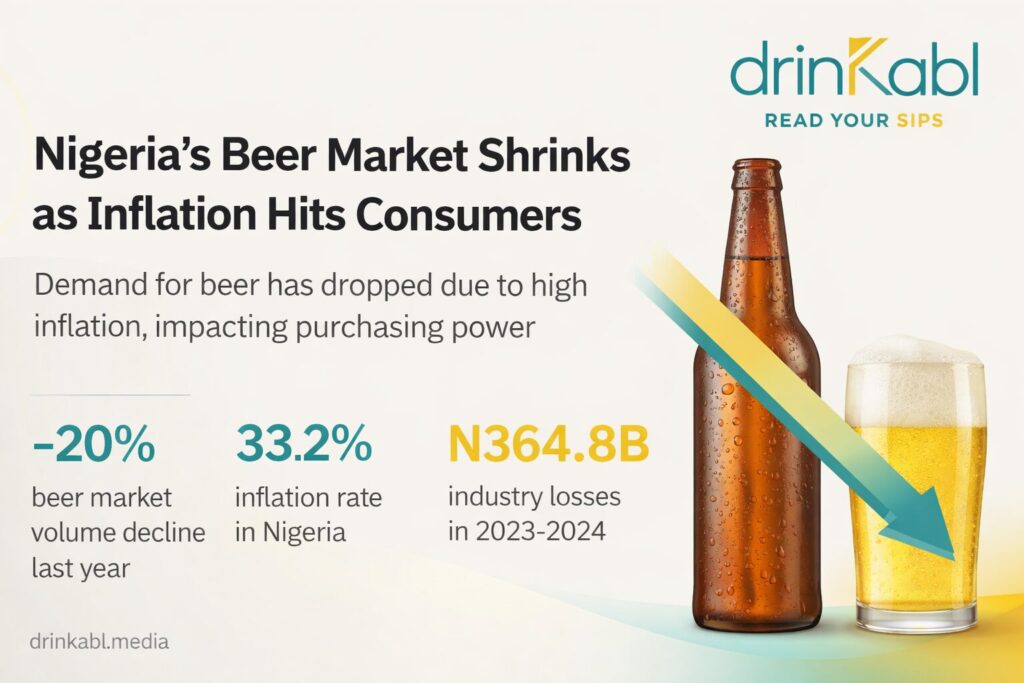
“We are operating in a very volatile environment,” the managing director and chief executive of Nigerian Breweries Plc said, mapping out a landscape defined by tight monetary policy, elevated borrowing costs, persistent inflationary pressure, and a series of fiscal reforms that have reshaped cost structures across the FMCG sector. These were not isolated shocks. They were the accumulated weight of years of policy turbulence, landing simultaneously on an industry still nursing wounds from a combined ₦364.8 billion in sector losses across 2023 and 2024.
The monetary policy dimension has been particularly punishing. The Central Bank of Nigeria’s rate-tightening cycle pushed financing costs sharply higher, eroding the margins of capital-intensive businesses like brewing. Nigerian Breweries, whose revenue trajectory had returned impressive nominal gains, was simultaneously absorbing higher interest charges on operational borrowing even as it worked to eliminate its foreign-currency debt exposure through the landmark ₦550 billion rights issue completed in 2024.
On the fiscal side, Boidin pointed directly to foreign exchange harmonisation, petrol subsidy removal, and ongoing tax reforms as catalysts of short-term market volatility. The FX rate, while more stable than at its most turbulent, remains at historically elevated levels, driving up the cost of imported inputs, packaging materials, and equipment. Energy and logistics costs, compounded by unreliable grid power and elevated diesel prices, continue to inflate the company’s operating expense base.
Consumer purchasing power, Boidin argued, sits at the heart of all of it. “The overall beer market declined in the last year. It’s mostly because of the pressure on purchasing power,” he said, adding that both official inflation readings and the lived perception of rising prices are shaping how consumers spend, what they buy, and how frequently they engage with the category. The demand shift has not been subtle. As Drinkabl.media reported in its 2026 industry outlook, the brewer is navigating a market where consumers have consistently traded down, stretching their budgets by reaching for economy brands over premium or mainstream products.
“This level of inflation, the official rate of inflation, but also the perceived level of inflation, is putting a lot of pressure on all consumers, and this is a concern for us,” Boidin stated. He also cited the Middle East crisis as a fresh geopolitical variable, one that has pushed crude oil prices above $100 per barrel in early 2026, creating a new wave of energy cost pressure for Nigerian manufacturers just as the macroeconomic environment had appeared to be stabilising.
Still, Boidin was deliberate in positioning Nigerian Breweries as a committed long-term player. When competitors were exiting Nigeria during the peak of the reform-induced disruption, the company stayed. Its portfolio strategy, centred on premiumisation and product diversification including its completed acquisition of Distell Wines and Spirits Nigeria, reflects management’s bet on eventual demand recovery rather than a retreat from the market.
The path forward remains contested. The proposed 2026 to 2028 excise duty framework, which the Beer Sectoral Group warns could put ₦425 billion in industry value at risk, is an additional policy overhang that has not yet been resolved. For now, the brewer’s message is calibrated: frank on the headwinds, committed to the long game.
READ MORE
Global Alcohol Producers Face Historic Inventory Crisis as Premium Spirits Demand Drops