
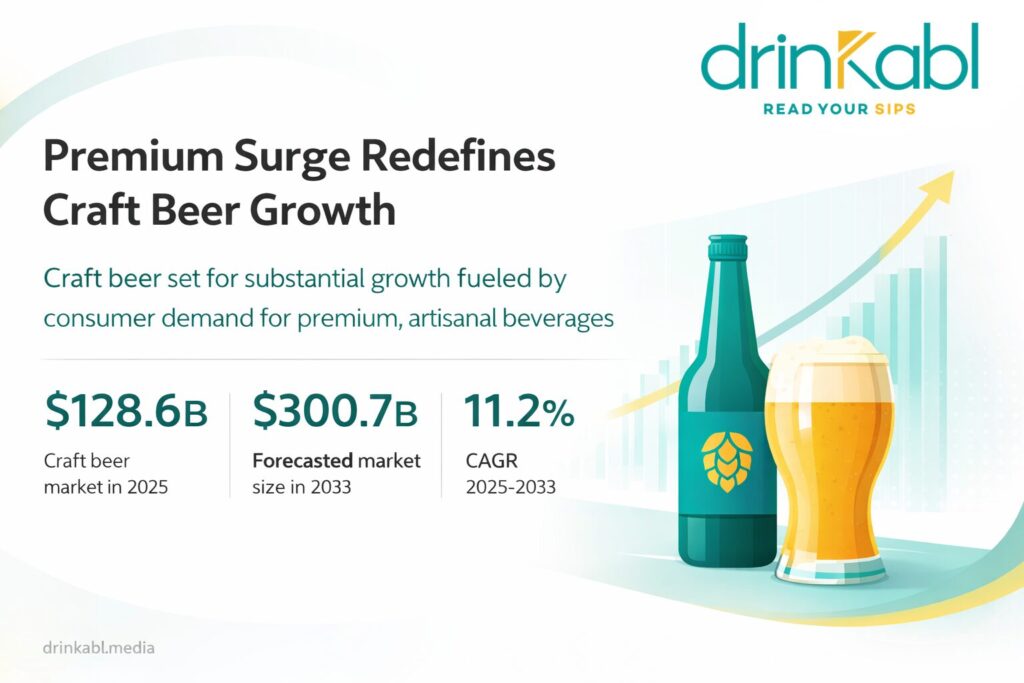
A steady escalation in consumer appetite for artisanal, flavour-forward beverages has now culminated in one of the most consequential growth projections the global beer industry has seen in a generation. The craft beer market, valued at USD 128.6 billion in 2025, is forecast to reach USD 300.66 billion by 2033, advancing at a compound annual growth rate of 11.2%, according to projections from SkyQuest Technology Group.
That headline figure, however, only captures the endpoint of a longer, more layered story. What had been quietly taking shape across the global beverage landscape for several years was a fundamental recalibration of how consumers, particularly millennials and Gen Z drinkers, relate to alcohol. Not as a commodity, but as a cultural statement.
The convergence was not accidental. Signals emerging from urban markets across Asia-Pacific, North America, and Europe began to align in a familiar pattern, rising disposable incomes, a rejection of mass-produced lagers, and an appetite for provenance and process. Independent breweries responded by expanding their footprint, experimenting with fruited sours, cold IPAs, spiced ales, and barrel-aged variants that could command premium shelf positioning. The market did not shift overnight. It was the cumulative result of thousands of micro-decisions made at the brewery, the bar, and the bottle shop.
Asia-Pacific now leads global volume, driven by rapid urbanisation in China and India. India, in particular, has emerged as a structurally important growth market, where the intersection of a young population, expanding middle class, and proliferating urban taproom culture is beginning to mirror the trajectory that defined North America’s craft boom a decade earlier. Heineken’s recent strategic repositioning in Africa, covered by Drinkabl.media, reflects precisely this kind of asset-light market recalibration major brewers are executing globally to chase premium category growth.
The competitive dynamics are becoming increasingly sophisticated. Established players such as The Boston Beer Company, Sierra Nevada, and Brooklyn Brewery are no longer simply competing on liquid, they are competing on narrative, community, and experience. Taprooms, brewpubs, and destination breweries have become strategic anchors, not lifestyle add-ons. As Drinkabl.media reported in its analysis of how Nigeria’s beer wars forged one of the industry’s most refined market intelligence operations, the breweries that endure are those that invest as heavily in understanding their consumer as in perfecting their product.
Health consciousness is adding a structural layer to growth that did not exist five years ago. Low-alcohol and non-alcoholic craft variants are no longer niche experiments. They are portfolio imperatives, a trend explored in Drinkabl.media’s coverage of how boundary-pushing innovation is triggering industry-wide scrutiny and, in some cases, entirely new product categories. Brands that have embedded wellness positioning into their identity early are gaining durable shelf and tap list advantages.
Distribution, too, is undergoing structural change. E-commerce and direct-to-consumer channels are compressing the traditional route to market, allowing smaller independents to scale without the distribution relationships that once made or broke a craft brand. The implications for off-trade dominance, long held by the major players, are significant.
The risks are real. Regulatory restrictions across multiple markets, the persistent threat of counterfeit products, and intensifying competition from ready-to-drink cocktails and hard seltzers continue to apply pressure. As Drinkabl.media’s analysis of Guinness Nigeria’s Q1 profit recovery illustrated, even legacy brewery brands must reinvent their value proposition to stay relevant in a market that no longer rewards inertia.
“While it’s probably premature to say the industry has settled into a ‘new normal,’ there are many indications that we are moving in that direction,” said Matt Gacioch, staff economist at the Brewers Association.
The road to USD 300 billion will not be linear. But the underlying architecture, shifting consumer identity, premiumisation momentum, and category innovation, is more durable than any single market cycle. The craft beer industry is not merely growing. It is maturing into something the global beverage trade has rarely seen: a category with both mass appeal and artisanal credibility intact.
Read More
, Artois Bets the Bar on World Cup Glory, With Beckham as Ace
, Kenyan Court Clears Way for Asahi’s $2.3 Billion EABL Takeover