
Long before a pint of homebrewed wheat beer made international headlines, Chris Buck had spent years building the scientific foundation that would make that moment possible, and controversial.
Buck, a virologist at the National Cancer Institute in Maryland, had quietly accumulated over a decade of polyomavirus research, identifying four of the 13 known human strains. His lab work showed that engineered brewer’s yeast could produce harmless viral proteins capable of triggering a genuine antibody response, mimicking how a conventional vaccine primes the immune system, but through the gut rather than a needle.
When mouse trials validated the oral delivery concept, Buck did not wait for institutional backing. He applied to the NIH for formal human trial approval. The review board rejected his application before it could be considered. Rather than abandon the work, he restructured it entirely, establishing the Gusteau Research Corporation, a one-man nonprofit, and brewed the vaccine at home using a Flash Hefeweizen kit.
For five consecutive days, he consumed one to two pints of the engineered beer, followed by two booster rounds spaced weeks apart. Blood tests confirmed antibody production against two strains of BK polyomavirus, variants linked to bladder and kidney cancers.
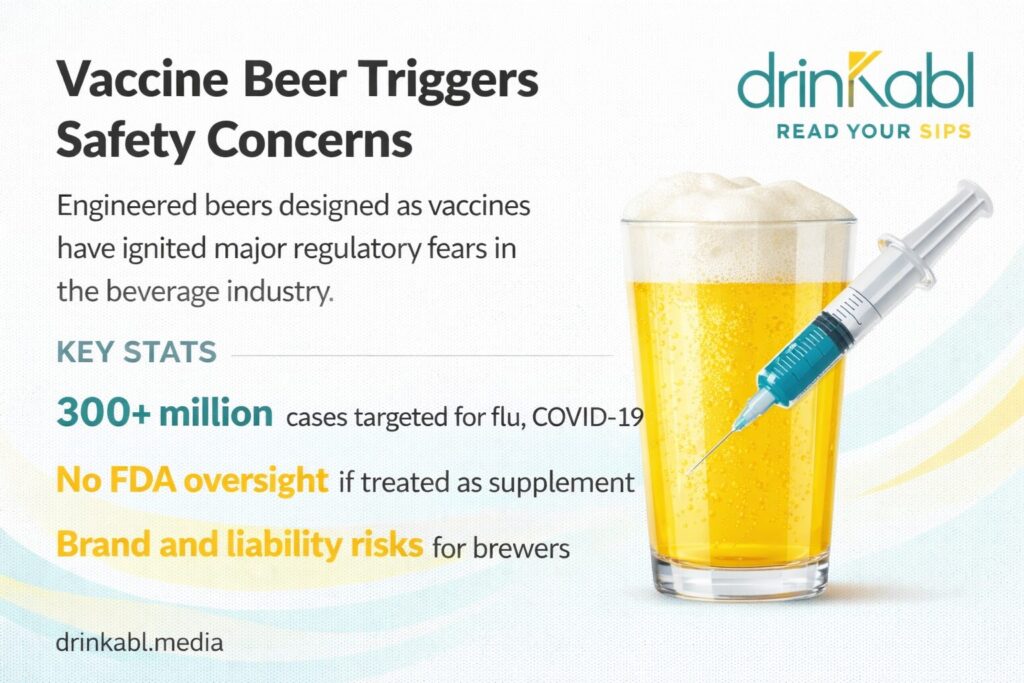
“The idea really is to just take living yeast, which are what makes beer, and put a vaccine inside the living yeast. And by doing that, you can actually get the yeast to cause an immune response,” Buck said.
The regulatory fault line is where the story becomes most consequential for the beverage industry. Buck argues the product straddles two categories simultaneously. Because the yeast is already present in the food supply and raises no known safety concerns, he contends it qualifies under the FDA’s “generally recognised as safe” standard. As a dietary supplement, it would face no obligation to complete the multi-stage clinical trials required for drugs.
“Vaccines are drugs. We all know this. But just because something is a drug does not mean it can’t also be a food,” he said.
That framing has drawn pointed criticism. Arthur Caplan, a medical ethicist at the NYU Grossman School of Medicine, warned the concept could erode rather than rebuild vaccine trust. “This is not the place for do-it-yourself,” he said. Regulators have not been persuaded either, insisting that any legitimate immunological claim requires formal clinical oversight.
QPS, the contract research organisation, framed the situation with precision: vaccine beer sits at the intersection of immunology and regulation, and “the path forward will depend not only on scientific replication but also on navigating the delicate balance between innovation, oversight and public trust.”
For beverage companies, the implications compound quickly. A brewer producing vaccine yeast, even under a dietary supplement classification, faces brand exposure, liability risk, and the possibility of being drawn into a public health debate they did not initiate. The functional beverage sector has spent years carefully navigating health claims without triggering FDA scrutiny. A product with explicit immunological positioning, even one sold as food, represents an entirely different risk calculus.
Buck has signalled that beer may not be the endpoint. The same yeast-based delivery system could in principle be incorporated into yogurt, nutritional supplements, or non-alcoholic beverages. He has described flu, Covid, and common cold viruses as future targets.
The science, QPS confirmed, is “tangible and testable.” Whether it moves through regulated clinical systems or remains a provocative proof of concept depends on decisions that are as much commercial and political as they are scientific. A U.S. administration hostile to vaccine infrastructure, combined with a beverage sector increasingly attentive to functional differentiation, makes that outcome genuinely uncertain.
Read More