
Long before PepsiCo’s Q1 CY2026 numbers landed on Wall Street’s desk, the blueprint was already in motion. Months of internal restructuring, targeted brand restages, and a calculated repositioning of its beverage portfolio around functional, permissible, and smaller-format products had quietly set the stage for a quarter that analysts are now calling a broad-based recovery.
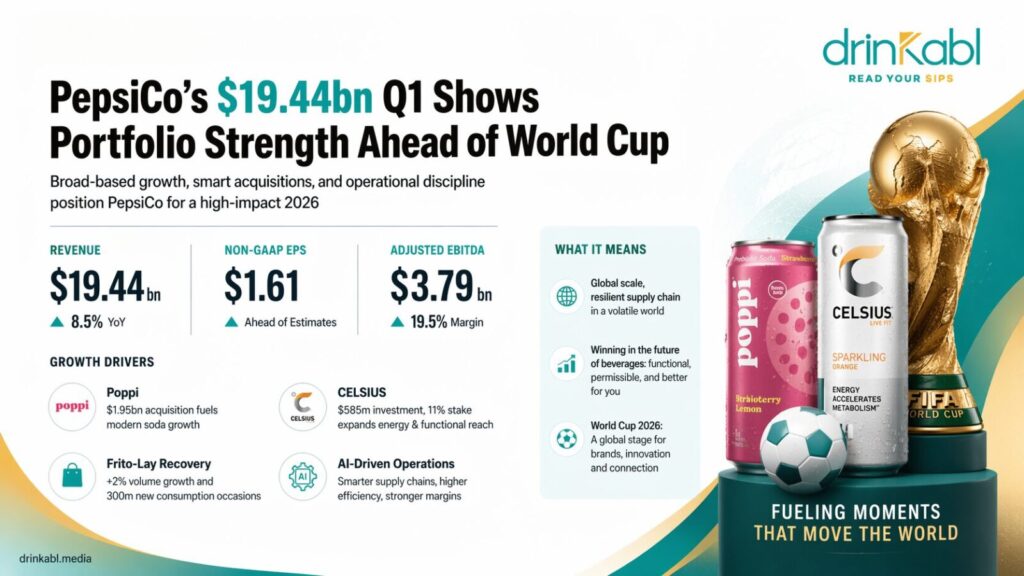
The result: $19.44 billion in revenue, up 8.5% year on year, beating consensus estimates by nearly 3%. Non-GAAP earnings per share came in at $1.61, ahead of forecasts, while adjusted EBITDA reached $3.79 billion at a 19.5% margin, a result that surprised even bullish observers.
But the story is not the number. It is what led there.
PepsiCo entered 2025 under significant pressure. North America Beverages had posted a 3% volume decline in full-year 2024, and Frito-Lay was navigating a period of consumer resistance driven by affordability concerns and shifting pantry behaviour. The company initiated a sweeping productivity programme that included headcount reductions, plant closures, and SKU rationalisation. Cost discipline was not an emergency lever, it was the foundation for what came next.
By early 2026, those decisions had compounded into structural advantage. CFO Steve Schmitt, on the Q1 earnings call, was direct: productivity gains from plant closures and SKU reductions, combined with AI-driven supply chain upgrades, were actively translating into margin expansion and operational flexibility. The conversation Pepsi had been having internally for over a year was now showing up in the financials.
The beverage segment, specifically, tells a compelling story for the drinks industry. Organic revenue growth of 2.6% in beverages was powered not by legacy carbonates, but by new platforms brought into PepsiCo’s distribution ecosystem, most notably poppi and CELSIUS. The addition of poppi, a prebiotic soda brand PepsiCo acquired for $1.95 billion in 2025, marks a decisive entry into the modern soda segment, a category that has since gained formal retail classification at major US chains. CELSIUS, with which PepsiCo deepened its partnership through a $585 million investment that secured an 11% stake and a board seat, has been equally transformative, bringing a health-conscious energy platform to PepsiCo’s already-vast retail footprint of 18,000 outlets.
CEO Ramon Laguarta was unambiguous about the direction of travel. “We’re executing very strong commercial programs for the summer, and the World Cup is a big driver of execution and innovation,” he said on the call. PepsiCo’s Frito-Lay brands have been locked in as a global FIFA 2026 sponsor, covering brands such as Doritos, Cheetos, and Lay’s, and the company has restructured its sports and entertainment cooperation team to mount what Laguarta described as “a very holistic activation across the world.” The implications for beverage distribution, in-stadium, and retail activation are substantial.
The North America Foods recovery, driven by a full restage of Lay’s and Tostitos and a pivot toward multipack and permissible formats, added 300 million new consumption occasions and posted 2% volume growth, reversing a prolonged negative trend. For the drinks industry, the adjacent signal is equally significant: consumers who re-engage with Frito-Lay are re-engaging with the full PepsiCo occasion, extending basket size across snack and beverage pairings at retail.
Internationally, the picture is strong. PepsiCo’s global supply chain showed no material disruption from geopolitical instability, with management crediting multiple sourcing options and hedging programmes that insulated operations from the Iran conflict and broader commodity volatility. This resilience stands in contrast to smaller players across emerging markets who face direct inflationary and regulatory exposure. PepsiCo’s scale, as has been a consistent theme across 2025 and into 2026, is its most durable competitive moat.
Digital transformation runs through the quarter as a secondary, but increasingly important, thread. Schmitt pointed to AI-driven ordering systems and supply chain optimisation as delivering measurable improvements in cases per hour and operating efficiency. It is a trend now shaping operations across the global beverage sector, and PepsiCo’s scale means its AI investments yield disproportionate returns relative to peers.
Risks remain, and management acknowledged them without evasion. SNAP benefit restrictions could tighten household budgets for core snack and beverage buyers in the US. Inflationary cost pressures persist. And competitive intensity across US beverages, particularly in energy and functional hydration, continues to intensify as brands like Alani Nu, now part of the Celsius portfolio, battle for shelf space and consumer mindshare. PepsiCo is responding with price-pack architecture adjustments and expanded promotional investment, but the category war is far from settled.
For now, the Q1 scorecard reflects a company that did the hard internal work early, and is now positioned to harvest returns through one of the biggest commercial events in beverage history. The World Cup kicks off in June. PepsiCo’s commercial machine is already running.
Read More
Further reading from Drinkabl.media:
, Heineken Exits DRC as Africa’s Asset-Light Brewery Reset Accelerates
, Non-Alcoholics Pushes Back on FG’s ‘Job-Killing’ N10 Per Litre Levy