

Before the shelf audits. Before the brand trackers. Before the monthly Nielsen reports landed on boardroom tables, one beverage company in Nigeria had already seen everything, and it was seeing it in real time.
At the peak of Nigeria’s fiercely contested beer market, popularly known as the Beer Wars, a quiet but deliberate restructuring was underway inside at least one major brewer. The ambition: convert a workforce of over 1,000 employees into an active, always-on market intelligence network. Finance officers. HR managers. Quality control engineers. All of them mobilised as frontline market observers, with “Bar Calls” embedded directly into their KPIs.
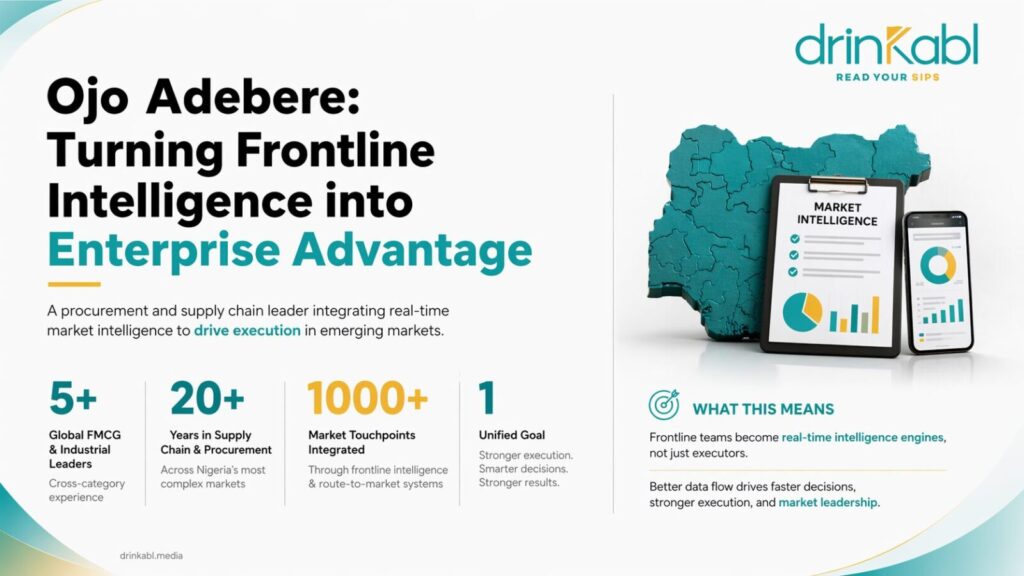
An experienced procurement and supply chain veteran, Ojo Adebere, who had a front-row seat duringg the Beer Wars, has now detailed the mechanics of that model in a widely shared Linkedin post. The account is more than a nostalgic case study. It is a blueprint that speaks directly to one of the most persistent blind spots in beverage strategy: the gap between what the sales team reports and what is actually happening on the ground.
“Data is only as good as its source,” Adebere writes. “When only Sales reports back, you get a biased view.”
The model he describes operated in four deliberate phases. First, market audits were decentralised, stripping the monopoly on field intelligence away from the commercial team alone. Non-sales staff were required to conduct periodic visits to outlets, logging observations on product chilling, visibility, and competitor activity without the filter of quota pressure or commercial incentive.
Second, the organisation introduced what Adebere calls the “Bar Adoption” model, assigning each employee a vendor or outlet close to their residence. The logic was precise: when a local brewery rep becomes a recognised regular at a specific outlet, the vendor feels a direct connection to the organisation’s leadership, and the employee, embedded in the outlet’s daily rhythm, is positioned to spot a competitor’s new promotional campaign before it surfaces in any formal report. This kind of ground-level positioning is precisely what the broader Nigerian market has often lacked, particularly during periods of intense rivalry between the country’s major brewers.
Third, the company maintained a live, localised database of every outlet across Nigeria, each mapped to a specific territory sales manager. Any employee travelling in-country could instantly access local contacts, turning a solo business trip into a potential audit exercise. The result was a distributed, always-active network that no market research firm could replicate in real time.
Fourth, and most critically, the organisation built a culture where informal intelligence was not only tolerated but expected. A quality control engineer who spotted a warm bottle on a shelf, or an accountant who noticed a competitor’s torn promotional poster being replaced with fresh materials, was empowered to route that observation directly to the commercial team. Formal reports, as Adebere notes, are slow. Informal systems are real-time.
The timing of Adebere’s disclosure matters. Nigeria’s beer market today remains one of Africa’s most competitive and most pressured. Brewers are navigating proposed excise duty hikes, naira volatility, and a consumer base still adjusting to elevated prices. As Drinkabl.media has reported, the non-alcoholic sector is already pushing back against fiscal measures it describes as market-damaging, and the stakes for commercial execution across all beverage categories have never been higher.
In that environment, the question Adebere poses is not rhetorical. “If your team isn’t relating real-time feedback to the centre, you are missing 90% of your market reality.” For beverage brands competing across Nigeria’s fragmented, geography-dense distribution networks, that missing 90% is not an abstraction. It is the difference between catching a competitor’s promo launch on the street and reading about it in a quarterly tracker three months later.
The Beer Wars model offers a competitive intelligence framework that is low-cost, scalable, and deeply local, precisely the kind of structural advantage that determines market share in beverage markets where the last-metre distribution battle is won or lost daily.
Ojo Adebere is a result-driven business leader specialising in operational excellence and strategic growth. With a 360-degree perspective on process engineering and supplier relations, they have a proven track record of driving efficiency and measurable value within top-tier organisations.
Read More
Coca-Cola Nigeria Bets Big on Consumer Rewards as Economy Shows Signs of Recovery
Much Ado About Sapele Water
Cameroon’s Cocoa Queen Bets $28.3 Million on Beverages as Market Consolidation Looms