
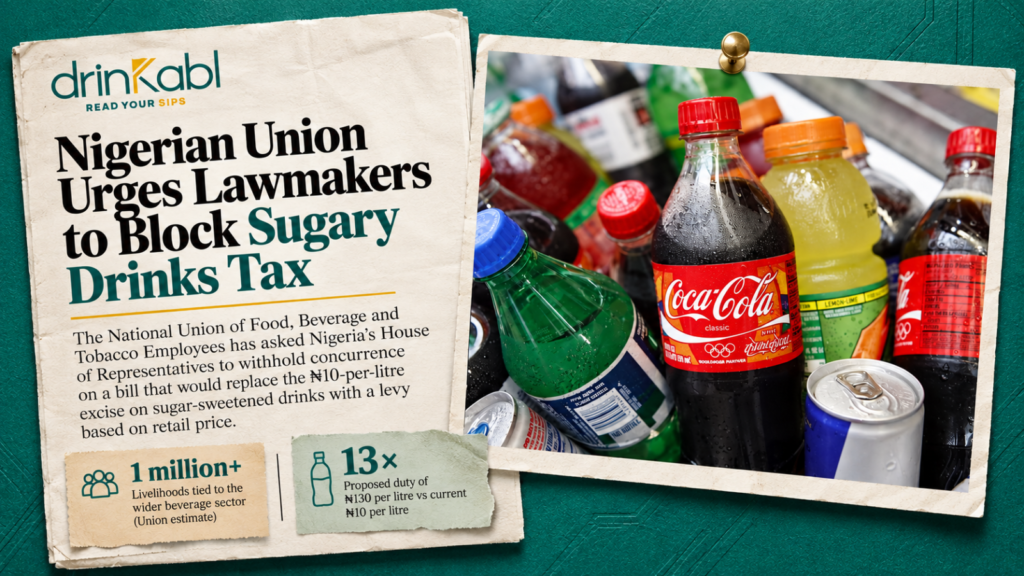
The National Union of Food, Beverage and Tobacco Employees has asked Nigeria’s House of Representatives to withhold concurrence on a bill that would replace the N10-per-litre excise on sugar-sweetened drinks with a levy based on retail price. The Senate passed the bill on 4 June 2026, and it cannot reach the president until the House agrees.
The open letter to Speaker Abbas Tajudeen, signed by union president Garba Dankama, asks lawmakers to weigh the effect on workers and manufacturers first. The bill amends the Customs, Excise Tariff, etc. (Consolidation) Act and is sponsored by Senator Ipalibo Harry-Banigo. The percentage has not been confirmed, but an earlier version put to a Senate hearing in November 2025 proposed N130 per litre, thirteen times the current duty.
Union warns of job losses
Dankama says capacity utilisation has fallen as manufacturers face high borrowing, energy, logistics and foreign-exchange costs and weaker demand. He warns that a heavier tax could bring production cuts, factory closures and retrenchments across farming, distribution, haulage and retail. The union puts the livelihoods tied to the wider sector at more than one million, a figure that has not been independently confirmed.
The Manufacturers Association of Nigeria opposed the amendment at that hearing. The Centre for the Promotion of Private Enterprise has also urged the House to reject it, and argues that the 2026 fiscal policy framework already sets N10 per litre on non-alcoholic beverages.
The public health case
The Senate’s joint committee concluded that inflation has eroded the N10 duty until it no longer deters consumption or raises useful revenue. The bill directs part of the proceeds to health promotion, disease prevention, primary healthcare and health insurance cover for poorer Nigerians.
The Nigerian Cancer Society and the Diabetes Association of Nigeria backed the proposal at the hearing, where one speaker argued it could reduce obesity, diabetes, heart disease and cancer. That benefit is a projection, because no Nigerian rate of this kind has yet been in force.
Who pays if prices rise
Soft drinks sit at the end of a chain of sugar suppliers, packaging makers, hauliers, wholesalers and retailers, so a higher excise would reach each of them. Manufacturers could absorb the cost and lose margin, or pass it to shoppers and risk lower volumes. The union also warns that dearer legitimate drinks could push buyers towards cheaper unregulated ones. How far prices move depends on a rate that has not been confirmed.
What happens next
The bill is not law, and it needs House concurrence and then presidential assent before it takes effect. The union wants lawmakers to assess its effect on workers and manufacturers first. The figure to watch is the percentage written into the text, because it decides whether the duty rises modestly or many times over from N10 a litre.