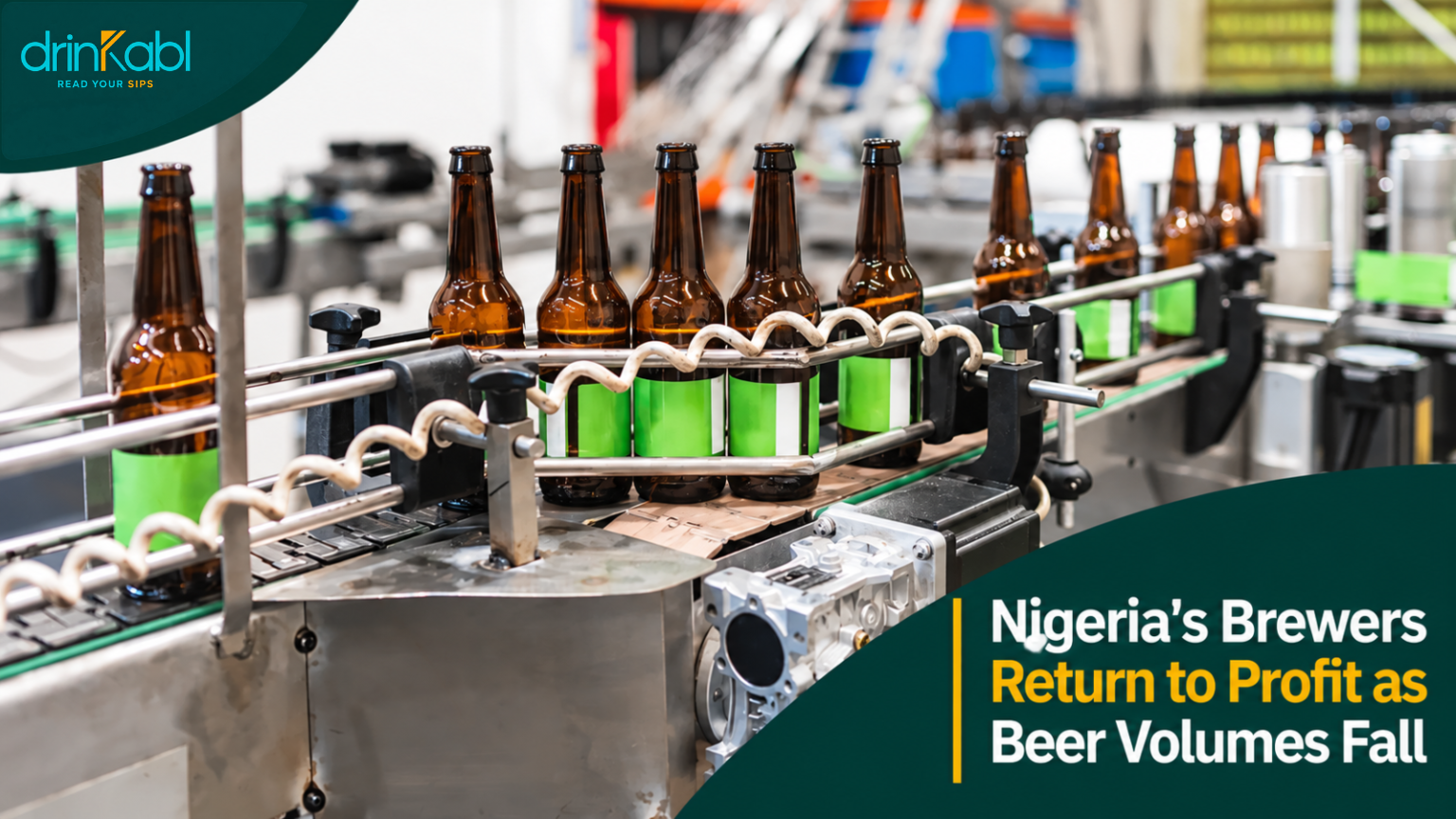

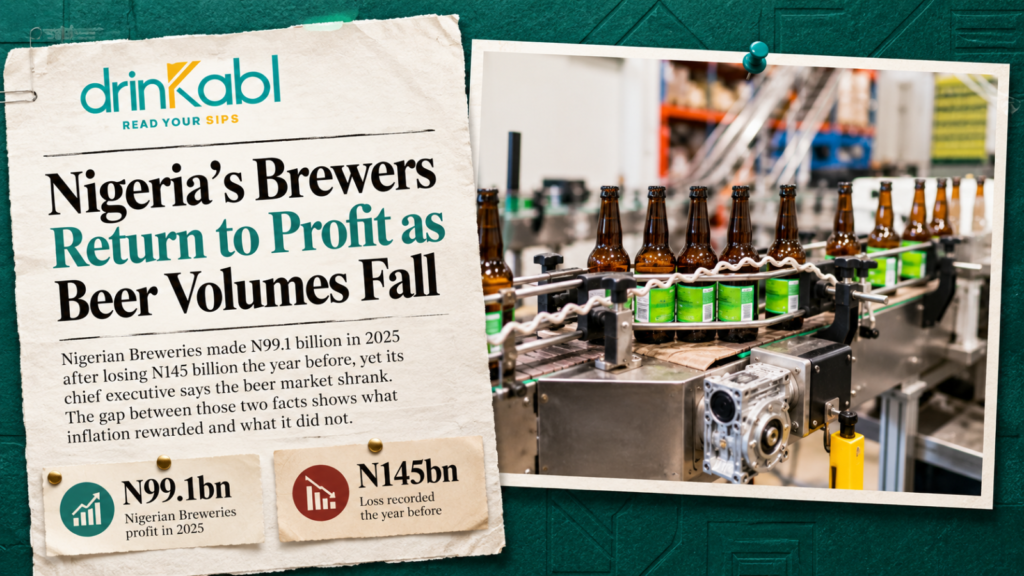
Nigerian Breweries made N99.1 billion in 2025 after losing N145 billion the year before, yet its chief executive says the beer market shrank. The gap between those two facts shows what inflation rewarded and what it did not.
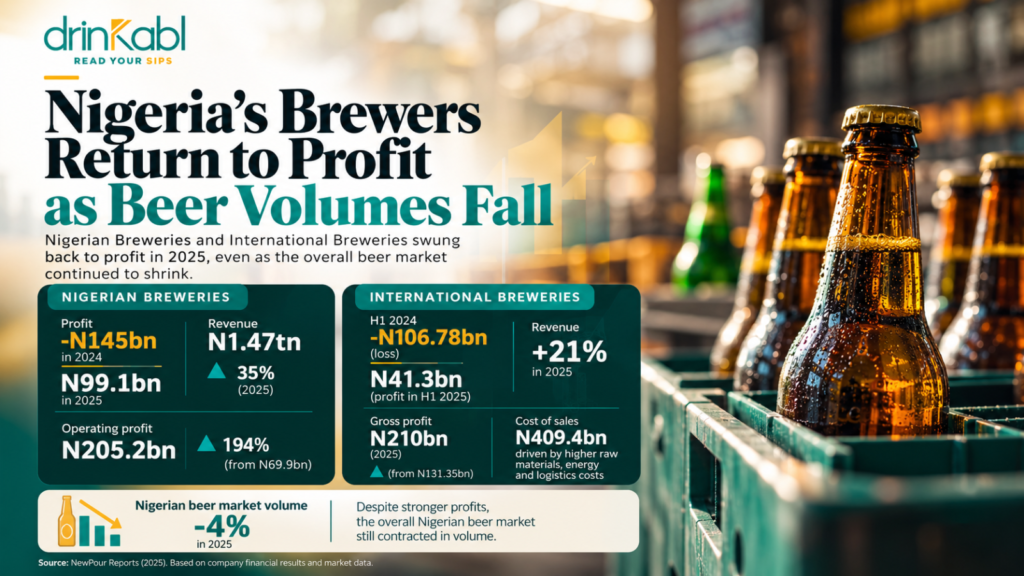
In the first half of 2024, International Breweries lost N106.78 billion. In the same months of 2025 it made a profit of N41.3 billion. Over the full year, Nigerian Breweries swung from a N145 billion loss to a N99.1 billion profit, and International Breweries posted its first annual profit in seven years. Both had spent the stretch before in the red, which makes the turn easy to read as demand coming back.
This feature follows the numbers through two of Nigeria’s largest brewers to see what carried them out of losses. The evidence points to pricing, tighter costs and a steadier currency, and away from a recovery in beer demand, which was still falling as the accounts improved. That matters because pricing and cost control can be copied, a currency cannot be ordered, and the same squeeze that hurt brewers also sent some drinkers to illicit alternatives.
What the accounts show
Nigerian Breweries grew revenue 35 per cent in 2025 to N1.47 trillion, and its operating profit, the money left after running costs but before interest and tax, rose 194 per cent to N205.2 billion from N69.9 billion. Its company secretary, Uaboi Agbebaku, credited innovation, premiumisation, pricing and commercial execution. Premiumisation means selling dearer versions of a product, which only works when enough customers will pay for them.
International Breweries tells a similar story with a harder edge. Its revenue rose 21 per cent in 2025 and gross profit climbed to N210 billion from N131.35 billion. Even so, its cost of sales reached N409.4 billion, pushed up by raw materials, energy and logistics, so the profit arrived with input costs still heavy. A brewer in that position comes out ahead only if it can charge more per bottle than it did a year earlier.
How a price ladder works
A shelf with one price is a single step, and a shopper whose budget shrinks simply steps off it. A brand with a premium line and an accessible line is a ladder, so the same shopper moves down a rung and stays inside the brand. The case for the ladder is that operators selling at several price tiers held up best through the squeeze, and Nigerian Breweries describes its own strategy as premiumisation plus diversification, including its purchase of Distell Wines and Spirits Nigeria.
The case is plausible and hard to prove from outside. Headline results do not split sales by price tier, so a brewer with five brands at five prices and a brewer with one brand at one price both show up as a single revenue line. Testing the idea needs brand-level volumes and prices, which none of the figures above contain.
The shadow market
When legal drinks get dearer, some of the demand moves instead of disappearing. In Kenya, illicit drinks made up 60 per cent of alcohol consumed by volume in 2024, and illicit volumes had risen 27 per cent since 2022. About two thirds of that volume is artisanal brew such as chang’aa and busaa, and the shift has been tied to high taxes on legal alcohol, easy access to homebrew and a growing counterfeit and smuggling trade. Price is one cause among several.
South Africa shows the pattern with an older start. Illicit alcohol there reached 773,000 hectolitres in 2024, up 55 per cent since 2017, and it now makes up 18 per cent of sales. It is a R25.1 billion market in which counterfeit white spirits account for most of the tax losses. A trend that began six years before the 2023 inflation shock cannot be blamed on it alone. Inflation arrived in a market where the problem was already growing.
The case against a tidy story
Thibaut Boidin, Nigerian Breweries’ chief executive, put the difficulty plainly in April. He described a very volatile environment and said the overall beer market had declined over the past year, mostly because consumers had less purchasing power. The currency is steadier than at its worst but still dear enough to raise the cost of imported inputs and packaging. A company can return to profit in that market without the market it sells into recovering.
Part of the swing also came from the balance sheet. Nigerian Breweries slashed its finance costs, the interest it pays on debt, after retiring its foreign-currency borrowing, and International Breweries’ results show smaller foreign-exchange losses in a year when the naira largely held steady. Neither gain comes from how a brewer prices a crate of beer. They come from how it financed itself while the currency stopped lurching.
South Africa’s wine harvest looks like a recovery on paper. It came in at 1.37 million tonnes against 1.24 million the year before, after a season that swung between drought and heavy rain. Weather decided most of that. Rico Basson, chief executive of South Africa Wine, says the harder task now is protecting value in a market oversupplied with wine, which is a pricing problem and not a sign of drinkers returning.
Nigerian Breweries said its retained earnings, the running total of profits kept in the business, stayed negative at the end of 2025 because of heavy losses in the two years before. International Breweries still carries retained losses of N191.03 billion, down from N241.9 billion a year earlier. The N51 billion it earned over the full year covers just over a quarter of that hole.
Read more