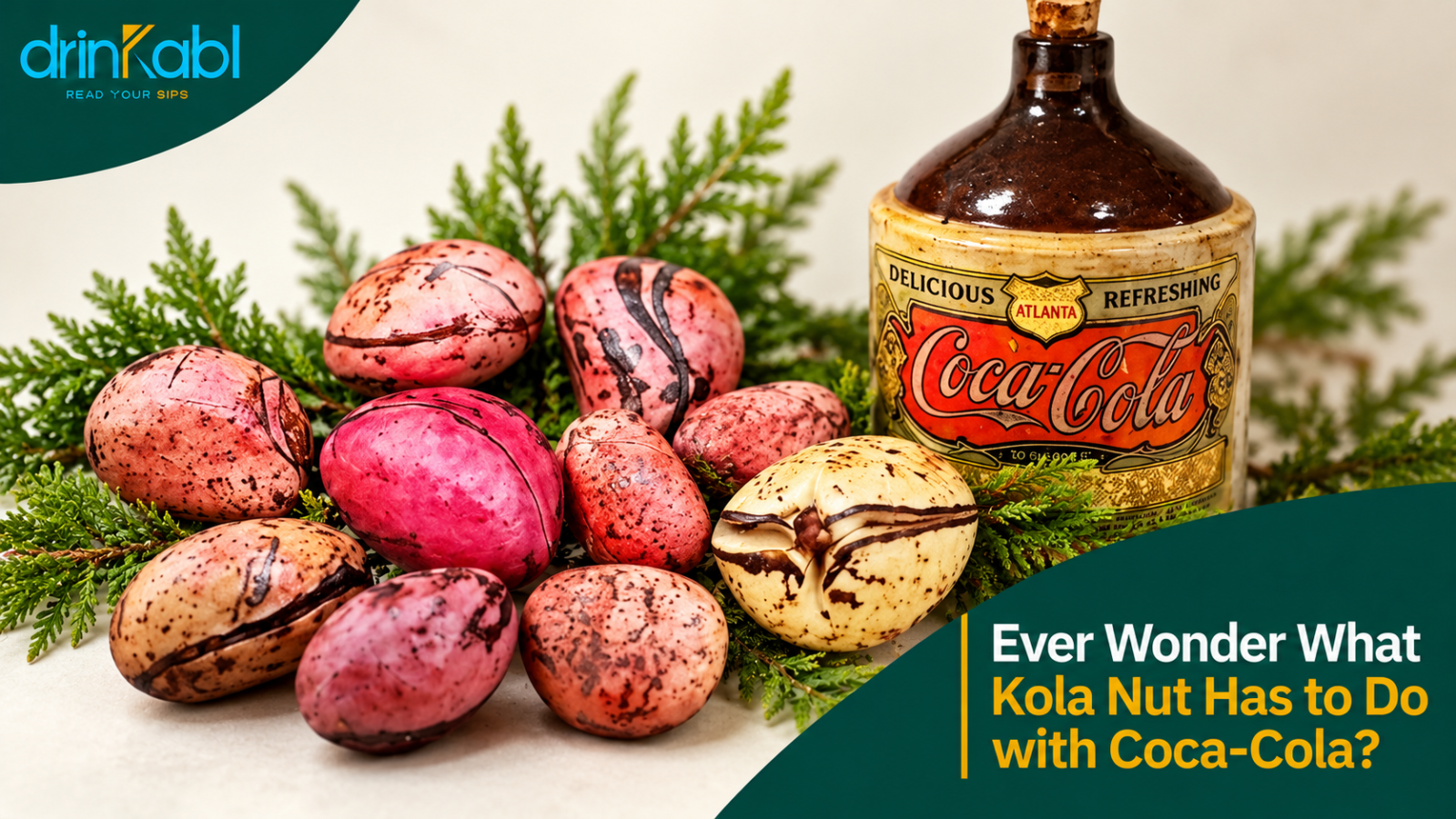

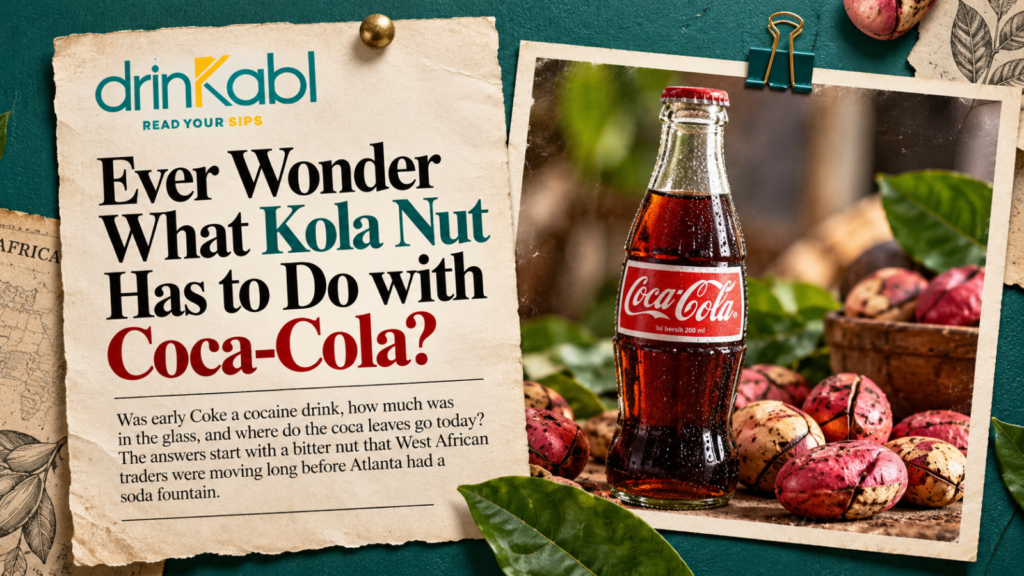
Was early Coke a cocaine drink, how much was in the glass, and where do the coca leaves go today? The answers start with a bitter nut that West African traders were moving long before Atlanta had a soda fountain.
In a layer of earth at Togu Missiri, near Ségou in Mali, archaeologists found the remains of a kola nut. The layer dates from between the eleventh and fourteenth centuries. The nut grew in the West African forest zone, so someone carried it there, and the team that published the find in 2021 reads it as evidence that trade between forest and savannah was well established by the end of the first millennium.
That same nut gave its name to half of Coca-Cola. The drink is built on two plants, coca and kola, and each has attracted a story that gets told badly. The coca half raises the question people ask first, whether early Coke was a cocaine drink, and the answer depends on records the company kept secret for most of a century. The kola half is usually a footnote. What follows sets out what the record shows for both, and why the company that owns the name has long said so little about its formula.
A trade route before there was a drink
Kola is a bitter, caffeine-rich nut native to the forest zones of West Africa. Historian Shantel George’s Oxford encyclopedia entry describes it as a primary commodity in long-distance commerce between the Sierra Leone and Guinea forests and the savannah from at least the eleventh century. Asante became the world’s leading producer in the late nineteenth and early twentieth centuries, selling to the savannah and later to Lagos, Brazil and Europe. By the 1930s, kola grown in southern Nigeria had overtaken other parts of West Africa.
The nut carried social weight too. West African cultures use it in ceremonies and offer it to guests. By the time an American pharmacist wrote kola into a recipe, it already had markets and routes, and a meaning that had nothing to do with soda.
A wine tonic loses its wine
John Pemberton, an Atlanta pharmacist, was already selling French Wine Coca. In 1885 he told a reporter that it combined an extract of Peruvian coca leaf, wine and kola nut. Then Atlanta introduced prohibition in 1886, which ruled out the wine. Pemberton swapped it for sugar syrup and kept the plants.
The new drink was first served at Jacobs’ Pharmacy in Atlanta on 8 May 1886, and sales that first year averaged nine drinks a day. In the company’s account, Pemberton’s partner and bookkeeper, Frank Robinson, suggested the name because the two Cs would look well in advertising, then wrote it out in Spencerian script. Writer Th. Metzger notes that the company later called the name “meaningless but fanciful”. Pemberton’s own description of his earlier tonic suggests the name was less fanciful than that.
What the cocaine record shows
The popular version says Coke began as a cocaine drink. The corporate version has long implied that nothing of the kind happened. Snopes, working from the standard histories, lands between the two. Early Coca-Cola did contain some cocaine, in an amount that is hard to reconstruct, and by 1891 its makers had cut the coca extract to a “mere trace” as attitudes to the drug began to turn. By 1902 the figure was as little as 1/400 of a grain per ounce of syrup. The last of it went only in 1929, when extraction of ecgonine, the leaf alkaloid cocaine can be made from, was perfected.
The company could not simply drop the plants. Asa Candler, who took control of the business, had no patent on the syrup, only the name. According to the same account, he believed a name had to be descriptive, which meant keeping some coca by-product and some kola in the formula to protect the trademark. The name was doing legal work, and it kept both plants in the recipe long after the original reasons for them had changed.
How much was in the glass
Nobody outside the company can say. The formula became a secret in 1891, and the estimates differ. Snopes concludes that whatever cocaine Coke carried was small and not necessarily in a form that gave much of a buzz. Metzger reads it the other way. He points to a formula in the handwriting of Candler’s chief assistant that called for a quarter pound of coca leaves per gallon of syrup, puts that at roughly eight and a half milligrams of cocaine per drink, and argues that the caffeine in the same glass made the effect considerable. Neither can be checked against a published Candler-era formula, since the company maintains that its recipe remains secret.
Where the leaf goes now
Coca leaf with its cocaine removed is called decocainised leaf. In the United States it is handled by Stepan, which runs a plant in Maywood, New Jersey. A 1988 report in The New York Times identified Stepan as the country’s only legal commercial importer of coca leaf, bought mainly in Peru and to a lesser extent Bolivia. Stepan sold the extracted cocaine to Mallinckrodt and the coca flavouring agent to Coca-Cola.
BBC Mundo reported in 2018 that the US Drug Enforcement Administration says Mallinckrodt turns the extract into pharmaceutical cocaine for surgery, and that Stepan sells the leaves left over to Coca-Cola. Peru’s state coca company, Enaco, told the broadcaster it sells about 120 tonnes a year to Stepan. The arrangement resembles decaffeination, with the valuable alkaloid and the flavoursome residue going to different buyers. Coca-Cola has historically avoided confirming the details, and an executive told the Times in 1988 only that coca-leaf ingredients are used, that they contain no cocaine and that regulators oversee the process.
What is left of the kola
In Ireland, the ingredients for Coca-Cola Original Taste read carbonated water, sugar, caramel colour, phosphoric acid and natural flavourings including caffeine. A 2011 study in the Journal of Proteome Research tested cola drinks for proteins from kola nut. It found plant proteins in a premium cola that advertises kola extract and none in Coca-Cola products, which make no such claim. That result covers proteins only, so it cannot say what the company’s secret extracts contain.
What the drink delivers instead is mostly sugar. Coca-Cola’s own figures are 42 kcal and 10.6 g of sugars per 100 ml, which puts a 500 ml bottle near 53 g. The World Health Organization’s 2015 guideline sets a ceiling for free sugars, meaning those added to food and drink, of under 10% of energy intake, and says going below 5%, roughly 25 g a day, brings added benefit. One 500 ml bottle holds about twice that lower figure.
The ingredient list names neither plant. The name on the front of the bottle still carries both.
Read more