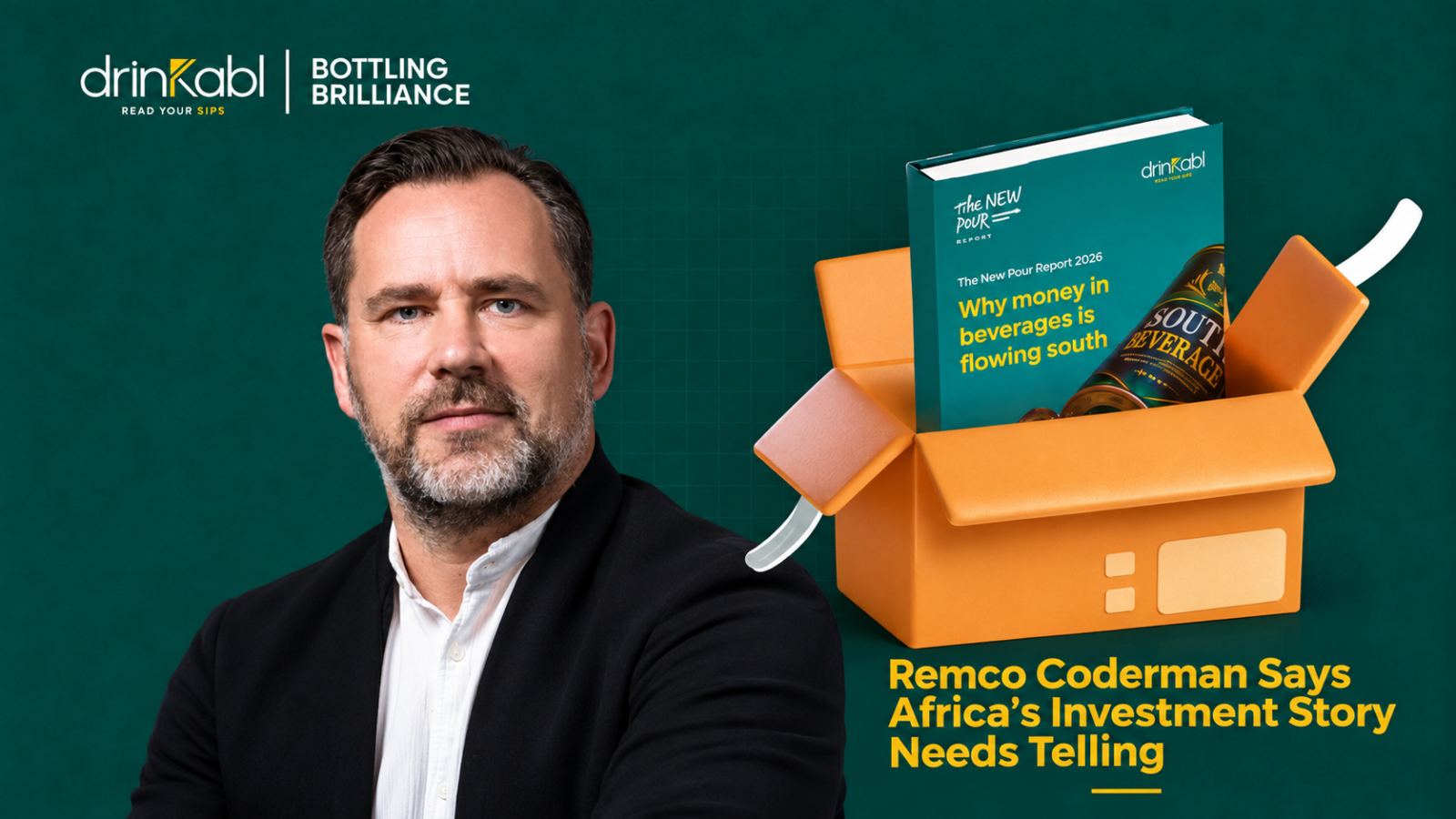

The Epic Edges Capital strategist explains why African beverage businesses must sell their stories as well as their numbers, what makes a company worth backing, and why logistics, local production and credible valuations matter to investors.
When Remco Coderman talks about investment in Africa, he does not begin with a spreadsheet. He begins with a story. For the founder and Chief Capital Strategist of Epic Edges Capital, the decision to back a business often starts with understanding the person behind it, the reason the business exists and whether its proposition can hold an investor’s attention. The numbers come later, although they matter just as much.
Speaking to Tosin Balogun, founder of Drinkabl Africa, on Bottling Brilliance, Drinkabl Africa’s weekly webinar, Coderman offered a perspective shaped by years of entrepreneurship, financial advisory work and investments across different sectors. Now dividing his time between Addis Ababa and Dubai, he sees opportunities in African beverage businesses, agriculture, food production and logistics. His argument is that the continent has plenty worth investing in, but businesses must become better at communicating their value and demonstrating that they can deliver.
The African opportunity is already here
Coderman’s perspective is partly shaped by his own decision to leave Europe. Originally from the Netherlands, he studied economics and accountancy before working as an accountant. He eventually moved into entrepreneurship, establishing and selling businesses across sectors including transport, medical transport, gold trading and finance. He also worked with the Dutch government before relocating to Dubai with his wife, Kanessa Muluneh, and subsequently spending more time in Ethiopia.
His move towards investment advisory work grew out of a longstanding interest in identifying opportunities beyond conventional markets. He had advised family offices on investment decisions, helping wealthy individuals consider ways to protect and deploy their capital outside Europe. His experience has made him particularly interested in businesses and markets that investors might overlook. Africa, in his view, is one of those opportunities, although he believes the continent’s own people sometimes struggle to recognise the value of what they have.
Asked why Africa continues to receive a relatively small share of global investment despite its resources and commercial opportunities, Coderman offered an answer that was less about financial markets than confidence. He believes African entrepreneurs and professionals are often too deferential to Western standards, even when they have the skills and capacity to compete. Reflecting on the people he has encountered while building his Addis Ababa operation, he remarked, “There’s no reason to be humble. Trust your own process, trust your own skills.”
He was careful to distinguish this from a lack of talent or ambition. His concern was that African businesses sometimes present themselves as though they need external validation before their propositions can be taken seriously. Coderman’s formulation was characteristically direct: “Humbleness doesn’t help you if you want to conquer the world.” For an investor who spends time looking beyond familiar markets, the question is whether entrepreneurs can communicate confidence in their own propositions without losing sight of commercial realities.
Why the story comes before the numbers
The importance Coderman attaches to storytelling becomes clearer when he discusses African beverage brands. In a bar or restaurant, he observes, international labels such as Johnnie Walker often enjoy a familiarity that locally produced spirits struggle to match. Consumers recognise the international brands, understand their identities and have encountered their stories repeatedly. A locally made drink may have excellent quality and ingredients, but without a compelling reason for consumers to care, it can remain difficult to sell.
He pointed to African Originals, the Kenyan beverage business behind Kenyan Originals (KO) cider and other locally produced drinks, as an example of what attracted his investment interest. Its appeal, as he described it, extended beyond the liquid in the bottle. The proposition involved local production, African ingredients and a brand identity that could be communicated to consumers. The company’s brand portfolio includes KO ciders and 58 Gin, whose identity draws on Nairobi’s distinctive matatu culture.
Coderman also cited a potential beverage investment involving a Somali entrepreneur who had established a production operation in Ethiopia. He was impressed by the product quality and local sourcing, but saw a gap in how the business communicated its proposition to the market. For him, the fact that ingredients could be sourced locally was itself commercially meaningful, particularly in markets where imported inputs create additional costs and supply-chain dependencies. The challenge was to turn those advantages into a story that consumers and investors could understand.
This thinking extends beyond conventional beverage branding. Coderman recalled Kenya’s colourful matatus, particularly the vehicles fitted with elaborate sound systems and entertainment features. He was struck by the fact that such a recognisable expression of Kenyan popular culture could remain relatively unfamiliar outside the country. The opportunity, he argued, was to build products and campaigns around things that already have cultural meaning rather than repeatedly borrowing identities from elsewhere.
For founders seeking capital, this distinction matters because investors are also buying into the people and proposition behind a business. Coderman explained his approach simply: “You invest in the people. That’s the first.” He wants to understand why someone started a company, what they intend to achieve and whether they have the conviction to see it through. Financial projections come afterwards, as a way of testing whether the story can become a commercially viable business.
The factory visit that changed the conversation
Storytelling may open the door, but Coderman does not make investment decisions from presentations alone. His account of examining a cold-chain and food-production operation in Ethiopia illustrates why he places so much emphasis on visiting the actual business. He described a country with agricultural production capacity but significant difficulties moving perishable goods between regions. In his assessment, weak transport systems and inadequate temperature-controlled storage contribute to substantial agricultural waste.
The opportunity was therefore bigger than purchasing cold-storage equipment. It involved building the capacity to manufacture, assemble and maintain equipment locally, while developing the logistics required to move food safely across the country. Coderman explained that some of the equipment available to the business had been imported from Sweden, making it expensive. Local labour, however, was available, and he believed that training workers and potentially importing components from China for local assembly could offer a more practical route.
The factory visit also revealed a problem that a polished investment presentation might not have exposed. The entrepreneur behind the operation had technical ability and considerable experience, but the facility contained a mixture of unrelated equipment and projects. Coderman described machinery for poultry processing, satellite systems, electric vehicles and cold-chain solutions. The problem was not necessarily the ability to manufacture products. It was the absence of a sufficiently focused commercial direction.
His assessment was that the entrepreneur knew how to make things but had not established an effective route to market. That distinction helped Coderman identify a possible role for investment and management support. The opportunity would require a clearer product focus, a trained workforce and a practical production plan. He was interested, but made clear that the project was not yet ready for investment.
The implications reach beyond Ethiopia. Nigeria faces similar difficulties moving agricultural produce between production centres and major consumer markets. For beverage manufacturers, these constraints affect milk, fruit, water and other inputs, as well as the availability of temperature-controlled storage for products that require it. Investment in cold-chain infrastructure can therefore support several industries simultaneously, although the commercial case still depends on whether operators can build reliable systems and attract enough demand to sustain them.
What makes a business worth backing
Coderman’s investment preferences favour operating businesses with tangible products. He is less interested in early-stage concepts that have not yet demonstrated that they can produce something, reach customers or generate meaningful commercial evidence. Profitability is not an absolute requirement at the point of investment, but the business must have credible projections and a product that can be examined.
He is also interested in the founder’s commitment. Education and previous experience matter less to him than whether the person believes in the business and is prepared to work towards its objectives. A founder treating a company as a side project is less attractive than someone with a clear ambition and the determination to execute it. Once the people and proposition have passed that initial assessment, the investment process moves into financial and legal due diligence.
His preferred approach can involve more than one form of capital. A business might initially receive a loan, allowing the investor to assess performance against agreed milestones before considering an equity investment. Equity means taking ownership in the company, while debt involves lending money that must be repaid under agreed terms. The distinction matters because different businesses have different cash-flow requirements, growth prospects and risk profiles.
Coderman explained that Epic Edges Capital also considers the needs of individual investors when allocating funds. Some want regular interest payments, while others can commit capital for several years in anticipation of a larger eventual return. He illustrated the difference with a boutique hotel investment in Sri Lanka, where the plan involved expanding an eight-room property and selling it after further development. That kind of investment requires patience and a longer holding period, unlike a mortgage structured to provide monthly interest.
The same portfolio logic applies when assessing beverage businesses. An investor seeking short-term returns may not be suited to a manufacturer that needs several years to expand production, establish distribution and reach profitability. A founder therefore needs to understand the kind of capital being offered and the expectations attached to it. The size of the available investment is only one part of the conversation.
Risk is part of the investment decision
Coderman’s enthusiasm for African opportunities does not mean he considers the risks insignificant. He acknowledged that currency devaluation, inflation, political changes and government intervention can complicate investment decisions. He referred to Ethiopia and Nigeria as markets where currency policy and political uncertainty require careful consideration. He also mentioned Zimbabwe as an example of a market where the political environment can make investment difficult.
His position is that these risks must be calculated rather than treated as automatic reasons to avoid a market. He does not suggest that every opportunity deserves capital simply because it is African. Instead, the investment must offer sufficient potential to justify the risks involved. That is a distinction worth making, particularly when a founder’s growth projections depend on stable access to foreign exchange, predictable regulation or infrastructure that may not yet exist.
He also described the search for recession-resistant businesses as part of the firm’s current investment approach. Healthcare and agriculture appeal because demand for medical services and food continues through difficult economic periods. He included alcoholic beverages in that assessment, arguing that consumers continue to seek entertainment during economic downturns. That is his investment thesis rather than a guarantee of defensive performance. Beverage companies still face affordability pressures, regulatory changes, taxation and changing consumption patterns.
The valuation conversation founders often get wrong
Perhaps Coderman’s most direct advice concerned how entrepreneurs value their businesses. He has encountered founders who calculate company valuations largely around the time and personal resources they have invested. Someone who has spent five years building a company may believe that effort alone justifies a valuation of US$10 million. For an investor, however, the relevant question is what the business is actually worth in the market.
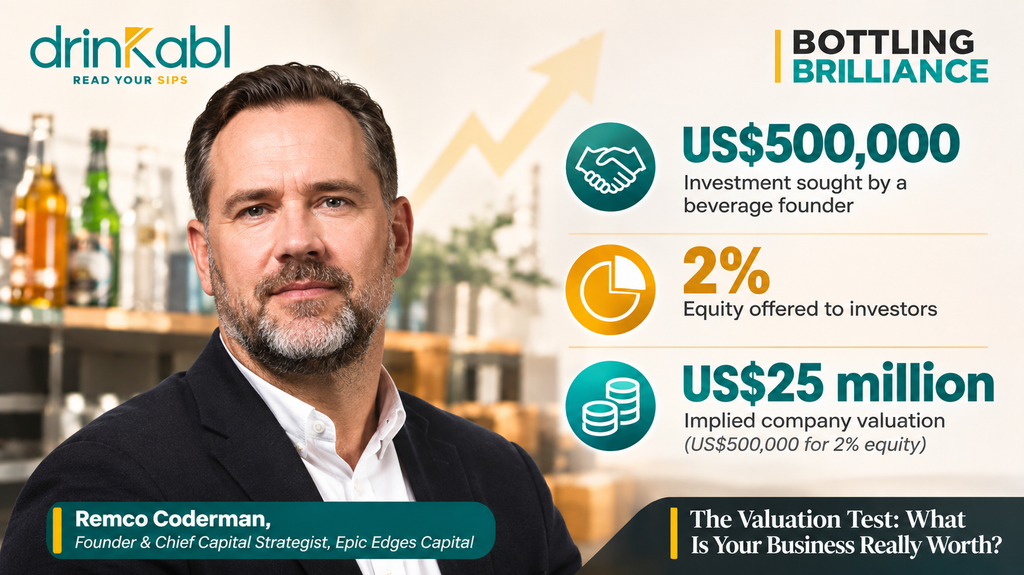
He was particularly dismissive of proposals that offer a small ownership stake without a convincing financial basis. A founder asking for US$500,000 in exchange for 2% of a company is effectively placing a US$25 million valuation on the business. That figure must be supported by commercial evidence, not simply by the founder’s belief in the uniqueness of the idea. Coderman said such proposals can end investment conversations before they properly begin.
His advice to entrepreneurs preparing to raise capital over the next 18 months was to develop a credible valuation and understand what their businesses can realistically deliver. Founders should work towards operational viability, including reaching break-even where possible, and establish how much working capital is needed for the next stage of growth. Investors may also contribute expertise, marketing support or commercial connections, but those contributions do not remove the need for a defensible valuation.
The distinction between an entrepreneur’s effort and a company’s market value is uncomfortable, particularly for founders who have financed their businesses personally. But Coderman was clear about where he believes the decision rests. “You need to keep in mind that we make the valuation of the company, not you,” he told Balogun.
At the end of the conversation, when asked what kinds of opportunities Epic Edges Capital wanted to see more of, his answer returned to the basics. The firm was looking for agricultural businesses in East Africa, particularly chicken farming, cattle and milk production, and food-processing factories. These were not necessarily fashionable technology propositions, but businesses connected to everyday demand and tangible production.
For Coderman, the next investment opportunity could be a beverage company, a food manufacturer or a cold-chain operator. The sector matters, but it is rarely the first thing he wants to understand. He wants to hear why the business exists, meet the person building it and see what happens when the presentation ends and the factory doors open.