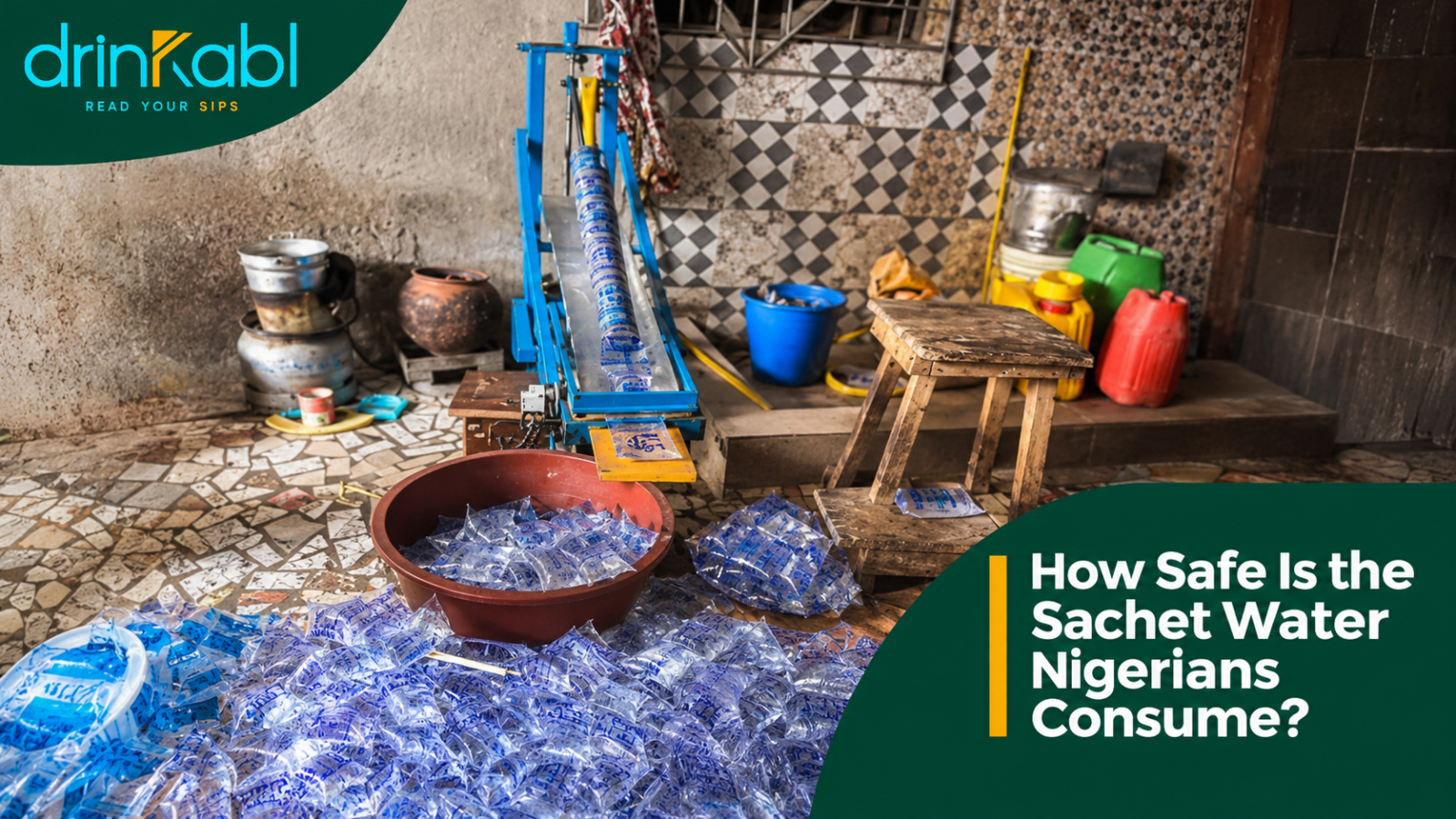

Millions of Nigerians depend on sachet water every day, but recent scientific findings are raising questions about what is actually inside the familiar plastic packaging. From heavy metal contamination and bacterial exposure to regulatory oversight and manufacturing standards, the safety of one of Nigeria’s most accessible consumer products deserves closer examination.
A sachet of water, popularly known as pure water in Nigeria, was once among the cheapest things a consumer could buy. A bag of sachet water that sold for as little as ₦5 per sachet just a few years ago now costs as much as ₦50 in many parts of the country, reflecting the rising cost of production, packaging, transportation and distribution. Yet, as the price has climbed, questions about the quality of the water inside have become harder to ignore. For millions of Nigerians, pure water remains the most accessible source of drinking water, sold at traffic intersections, in markets, outside offices, at motor parks and in neighbourhood shops. But consumers are increasingly confronted with an uncomfortable possibility: they are paying considerably more for a product whose safety and quality may not have kept pace with its rising price.
But how safe is the water inside?
That question has gained renewed attention following a social media video in which a commentator claims that tests conducted on different samples of Nigerian sachet water found them unsafe. The speaker goes further, suggesting that widespread exposure to contaminated drinking water could be contributing to cancer and kidney disease, while accusing businesses of profiting from people’s misfortune.
The allegations are alarming. Yet they also raise a more important question: how safe is the sachet water Nigerians consume, and what does the available scientific evidence actually tell us?
The answer is complicated. Research published in 2026 has identified worrying levels of potentially harmful contaminants in sachet water samples collected across Lagos. Earlier research has also raised concerns about microbial contamination and inconsistent compliance with drinking-water standards. But the evidence does not establish that every sachet water brand is unsafe, nor does it demonstrate that sachet water consumption is responsible for Nigeria’s cancer or dialysis burden. The distinction matters. Millions of consumers depend on this category, and an industry-wide safety question deserves considerably more than a viral warning.
What scientific tests are revealing
One of the most relevant investigations appeared in Scientific Reports on 21 February 2026. Titled Assessment of Heavy Metal and Trace Element Contamination in Sachet Water and Regulatory Gaps in Lagos Nigeria, the study examined 29 sachet water samples collected across Lagos State’s 20 local government areas.
Researchers used laboratory equipment known as inductively coupled plasma optical emission spectrometry (ICP-OES) to measure the concentrations of different metals and trace elements in the samples.
The results raised serious concerns. Lead concentrations exceeded the World Health Organisation’s recommended safety level in 65.5 per cent of the samples. Arsenic exceeded the recommended level in 51.7 per cent, while uranium exceeded its guideline value in 17.2 per cent. Mercury exceeded the recommended level in 3.5 per cent.
These were not simply observations about the appearance or taste of the water. The researchers were measuring chemical substances that cannot reliably be identified through ordinary visual inspection.
Lead, for instance, can affect the kidneys, cardiovascular system and nervous system. Arsenic presents a different concern. According to the WHO’s assessment of arsenic exposure, prolonged exposure to elevated levels of inorganic arsenic through drinking water can cause skin lesions and increase the risk of several cancers, including cancers of the skin, bladder and lungs.
The Lagos study therefore raises a legitimate public-health concern. However, its findings require careful interpretation. The researchers tested 29 samples, not every sachet water brand or production batch in Nigeria. The participating manufacturers were selected from NAFDAC-approved providers who voluntarily agreed to participate.
The results demonstrate contamination concerns within the samples examined. They do not establish that every sachet water product in Lagos, or across Nigeria, is contaminated.
There is another important qualification. The researchers reported that most individual metal hazard quotients were below one, suggesting limited estimated risks from several of the elements assessed. However, arsenic and some other metals presented higher exposure concerns. The paper also contains an apparent inconsistency in its interpretation of the combined hazard index, which warrants clarification from the authors. That detail should not be overlooked when interpreting the research.
What happens before sachet water reaches consumers?
Water safety is a production issue long before it becomes a consumer issue. A packaged water manufacturer must deal with several interconnected processes, including the quality of the source water, treatment, filtration, disinfection, packaging and storage. Water can originate from boreholes, groundwater sources or other supplies. It must then undergo appropriate treatment to remove or control contaminants before packaging.
Microbiological contamination occurs when harmful microorganisms enter the water. These can include bacteria such as Escherichia coli, which can indicate faecal contamination. Chemical contamination presents a different challenge. Heavy metals such as lead and arsenic may originate in groundwater or enter water through environmental contamination. Some contaminants require specialised treatment processes and cannot simply be eliminated through ordinary filtration.
This distinction is important because water can look perfectly clean while containing substances that exceed recommended safety limits. A 2024 review published in the Journal of Environmental Science and Health examined research on sachet water contamination across Nigeria’s six geopolitical zones between 2020 and 2023.
The review, titled More About Making Profits or Providing Safe Drinking Water? A State-of-the-Art Review on Sachet Water Contamination in Nigeria, examined physicochemical properties, heavy metals and microbial loads. Its findings reinforced concerns about inconsistent water quality across different locations and products.
A separate study published in the Ibom Medical Journal in January 2025 assessed packaged water brands sold in a university teaching hospital in southern Nigeria. It reported evidence of gross bacterial contamination in 60 per cent of the sachet water samples examined.
These studies do not establish that every manufacturer is producing unsafe water. They do, however, demonstrate that contamination is not merely a social media talking point. It is a recurring subject in Nigerian scientific research.
Does NAFDAC registration guarantee safe water?
One of the most revealing findings from the 2026 Lagos investigation concerned the information printed on the sachets. All 29 samples carried product names, manufacturers’ addresses and NAFDAC registration numbers.
Yet none contained batch numbers, manufacturing dates, expiry dates or mineral composition information. This raises a difficult question about the relationship between regulatory approval and the quality of products reaching consumers.
A NAFDAC registration number is important. It indicates that a product has undergone the agency’s registration process. But registration should not be interpreted as a guarantee that every subsequent production batch will remain compliant.
Manufacturing conditions can change. Equipment requires maintenance, treatment processes must be monitored, and production environments must remain hygienic.
A manufacturer that initially satisfies regulatory requirements can still experience operational failures that compromise product quality.
NAFDAC has established guidelines for packaged water manufacturing facilities, alongside requirements covering good manufacturing practices for pre-packaged food production. The challenge is ensuring that regulatory oversight continues beyond initial registration. The Lagos researchers specifically recommended more frequent monitoring of sachet water factories, stronger enforcement and improved product traceability through proper labelling.
Batch identification is particularly important. When contamination is discovered, regulators need to establish which production batch is affected, where it was distributed and whether other products from the same facility require investigation. Without reliable traceability, a targeted product recall becomes considerably more difficult.
Can contaminated sachet water cause cancer and kidney disease?
This is where the social media discussion requires the greatest caution. The commentator connects unsafe water consumption with cancer and kidney failure, suggesting that the people who will profit in the future are those investing in dialysis and cancer treatment.
There is a legitimate scientific basis for concern about certain contaminants. Long-term exposure to inorganic arsenic in drinking water is associated with several cancers. Lead exposure can cause kidney damage, while prolonged exposure to other toxic substances can also affect kidney function.
But establishing that a contaminant can cause harm is different from demonstrating that a particular population’s disease burden is being caused by a particular drinking-water product.
The 2026 Lagos sachet water study did not examine cancer patients, dialysis records or the medical histories of consumers. It did not establish a direct relationship between drinking sachet water and the number of Nigerians receiving kidney treatment. Nor does the fact that someone requires dialysis establish that contaminated packaged water caused their condition.
Kidney disease has multiple causes, including diabetes, hypertension, inherited conditions and exposure to certain toxins. The distinction between potential exposure and proven disease causation is essential.
It would be irresponsible to tell Nigerians that their sachet water is giving them cancer without epidemiological evidence establishing that connection. Equally, it would be irresponsible to dismiss the possibility of long-term exposure risks simply because individual consumers cannot immediately see or feel the effects.
The WHO’s drinking-water guidelines recognise the importance of managing chemical and microbiological risks throughout the supply chain. Its 2026 drinking-water guidance reinforces the need for preventive management, independent surveillance and health-based standards. The concern is real. The viral explanation, however, goes further than the available evidence.
The economics behind Nigeria’s sachet water industry
There is another dimension to this issue that deserves attention. Sachet water occupies an unusual position in Nigeria’s beverage economy. It is simultaneously a mass-consumption product, an essential hydration option and a low-cost manufacturing business.
Its affordability has made it accessible to consumers who might otherwise struggle to purchase bottled water regularly.
That affordability also creates a difficult commercial environment. Manufacturers must manage production costs, packaging materials, electricity, water treatment, distribution and regulatory compliance while competing in a market where consumers are highly price-sensitive.
This does not excuse unsafe production. Neither should commercial pressure become a justification for cutting corners on water treatment or quality assurance. But any serious examination of the industry must recognise the economic conditions under which it operates.
If compliance becomes more expensive, smaller manufacturers may face greater financial pressure. If regulatory enforcement remains inconsistent, manufacturers investing in proper treatment and quality assurance may find themselves competing against businesses that do not maintain equivalent standards.
That creates a commercial disadvantage for responsible producers and a safety problem for consumers. The industry needs a regulatory environment in which quality is a basic condition of competition rather than an optional investment.
What should Nigerians expect from regulators?
The emerging research presents a challenge for NAFDAC and the Standards Organisation of Nigeria. How frequently are registered sachet water manufacturers being tested after approval? How many facilities undergo independent water-quality assessments each year? Are results publicly accessible? And what happens when laboratory testing identifies products containing contaminants above recommended limits?
These questions matter because consumers cannot independently test every sachet they purchase. The responsibility for establishing and maintaining product safety rests primarily with manufacturers, supported by effective regulatory supervision.
There is also a need for more representative national research. The Lagos study offers useful evidence, but a sample of 29 products cannot provide a definitive picture of the entire Nigerian packaged-water market. A broader investigation involving multiple states, different production batches, seasonal variations and both chemical and microbiological testing would offer a more reliable assessment.
The researchers themselves acknowledged that seasonal changes, production practices and storage conditions were not evaluated in their Lagos study. That leaves important questions unanswered.
For consumers, checking product registration, manufacturing information, packaging integrity and storage conditions remains sensible. However, none of these checks can independently establish that water is free from chemical contaminants. The bigger responsibility belongs to the institutions that regulate the industry and the manufacturers that put these products on the market.
A sachet of water should not require a consumer to become a laboratory scientist before deciding whether it is safe to drink. The social media commentator’s warning may have overstated what the evidence proves, but the research raises a question that cannot be dismissed with a simple assurance that registered water is safe.
Nigeria does not need panic over every sachet of water. It needs a system capable of identifying unsafe products before they reach the people who depend on them. Until that system becomes more transparent and consistent, the question of how safe the sachet water Nigerians consume really is will remain worth investigating.