
Africa’s Beverage Industry Enters a New Phase of Consolidation, Regulation and Brand Competition
From Coca-Cola HBC’s progress towards acquiring Coca-Cola Beverages Africa to South Africa’s proposed alcohol advertising restrictions, Nigeria’s renewed manufacturing ambitions and Kenya’s cider campaign, the week of 16–22 November revealed an industry navigating expansion, regulatory pressure and changing routes to market.
The African beverage industry closed the week with developments that could influence its competitive structure, commercial relationships and consumer markets. Coca-Cola HBC moved closer to completing its proposed acquisition of Coca-Cola Beverages Africa, a transaction that would significantly reshape the continent’s bottling landscape. In South Africa, a proposed Liquor Amendment Bill raised questions about the future of alcohol advertising, event sponsorship and brand partnerships.
Nigeria’s beverage market also recorded developments across manufacturing, regulation and commercial leadership. Food Basket Brewery prepared to introduce a new beverage range in Benue State, while NAFDAC destroyed products valued at approximately ₦100 billion in Ogun State. In Kenya, KWAL continued its efforts to localise Savanna cider’s brand identity, while Delta Corporation’s position on its struggling Zambian brewery highlighted the strategic value of manufacturing assets beyond their immediate financial performance.
Together, the developments show an industry where expansion is increasingly tied to control of distribution, manufacturing economics, brand visibility and regulatory conditions.
Coca-Cola HBC Moves Closer to Taking Control of Coca-Cola Beverages Africa
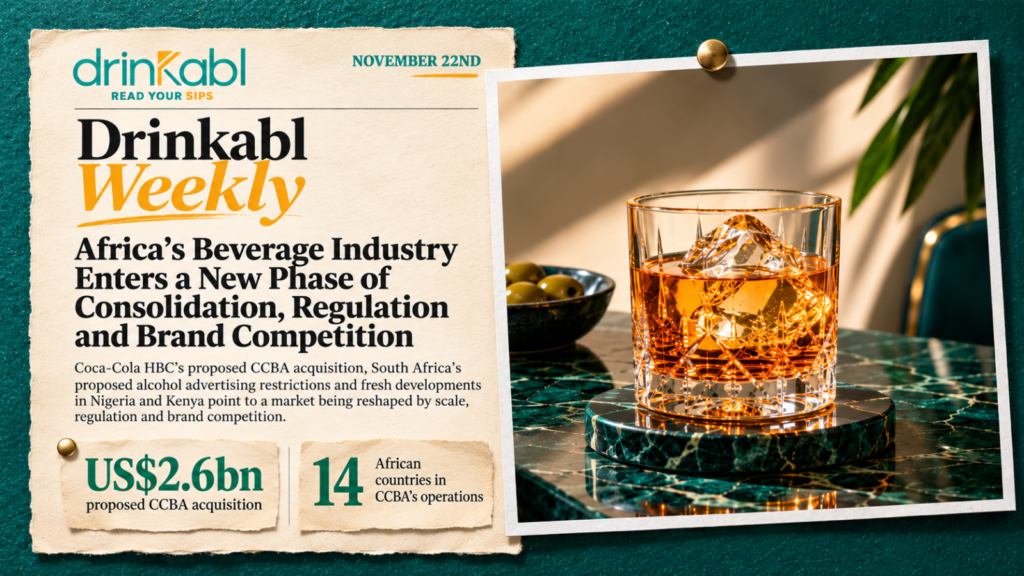
Coca-Cola HBC received approval from the Johannesburg Stock Exchange (JSE) for an inward secondary listing, marking an important step towards completing its proposed US$2.6 billion acquisition of a 75 per cent controlling interest in Coca-Cola Beverages Africa (CCBA).
The approval, announced on 16 November, provides for Coca-Cola HBC shares to begin trading on the JSE on 23 November. The company said completion of the CCBA transaction was expected on 27 November, subject to the relevant conditions.
The acquisition brings together two major Coca-Cola bottling operations. CCBA operates across 14 African countries, while Coca-Cola HBC has a substantial international bottling and distribution network. Following completion, the enlarged business is expected to become the world’s second-largest Coca-Cola bottler by volume, serving approximately 1.2 billion consumers.
The transaction had received merger-control approval in five of the six required jurisdictions by the time of the announcement. Coca-Cola HBC and its transaction partners had agreed to proceed before Tanzania’s clearance was secured, but the acquisition would not be implemented in Tanzania until approval is obtained from the country’s Fair Competition Commission.
The Johannesburg listing also gives South African investors direct access to Coca-Cola HBC shares and signals the importance of the country’s capital market to the transaction.
For the African beverage industry, the acquisition represents more than a change in ownership. It brings a much larger production, distribution and investment platform under one controlling bottler, potentially influencing manufacturing capacity, procurement, route-to-market execution and investment priorities across several African markets.
The immediate question is how the enlarged business will manage its different markets while balancing local operating conditions with the scale advantages of a larger group.
The company’s 16 November regulatory announcement set out the timetable and conditions for the transaction.
South Africa’s Liquor Bill Puts Advertising and Sponsorship at Risk
South Africa’s proposed Liquor Amendment Bill, B21-2025, came under renewed industry scrutiny after its provisions raised the possibility of sweeping restrictions on alcohol advertising, promotional activities and public-event sponsorship.
Introduced in Parliament in September 2025, the private member’s Bill seeks to amend the Liquor Act of 2003. Its proposed restrictions extend beyond conventional advertising to include product placement, indirect brand exposure and financial contributions to qualifying organised events.
The definition of brand elements is particularly broad. It includes brand names, trademarks, logos, graphics, slogans, designs, recognisable colours and typefaces. This could affect how alcohol brands appear in films, television, digital content and social media, including commercially arranged product placements.
The sponsorship provisions could have equally significant consequences. The Bill proposes preventing registered liquor businesses from organising or promoting qualifying public events or making financial contributions to them where liquor, a brand element or an associated company name is used to promote consumption.
Sports competitions, music festivals, cultural celebrations and other publicly accessible events could therefore face restrictions on funding from alcohol manufacturers.
The implications extend beyond beverage companies. Event organisers, broadcasters, advertising agencies, entertainment producers, digital publishers and hospitality businesses could all be affected if the proposals become law.
The Department of Trade, Industry and Competition has previously raised concerns about the Bill’s supporting evidence, enforcement arrangements and possible economic consequences. It also warned that restrictions could disadvantage emerging brands that depend on advertising to build recognition, while established brands retain the advantage of years of consumer exposure.
The Bill remains at the introduction stage and has not become law. Existing advertising and sponsorship arrangements are therefore not automatically prohibited.
For beverage companies, however, the proposal creates a significant planning risk. Sponsorships and brand partnerships are long-term commercial commitments, and uncertainty over their future legality could influence investment decisions even before legislation is enacted.
Read the full analysis in South Africa Liquor Bill Puts Sponsorship at Risk. The South African Parliament’s official Bill tracker provides the legislative status.
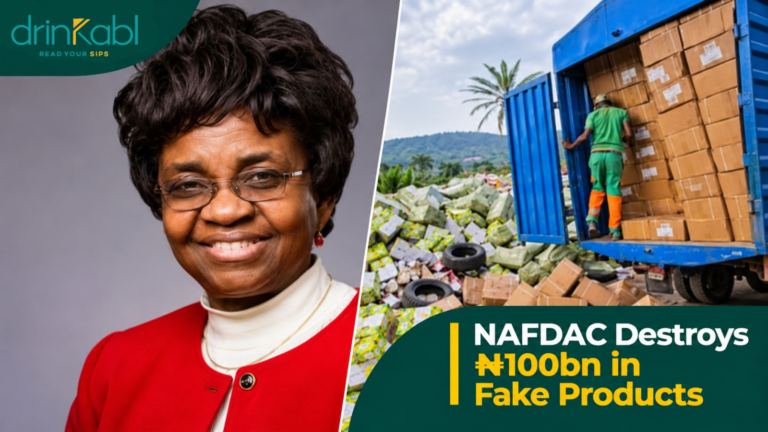
NAFDAC Destroys ₦100bn in Fake Products as Enforcement Intensifies
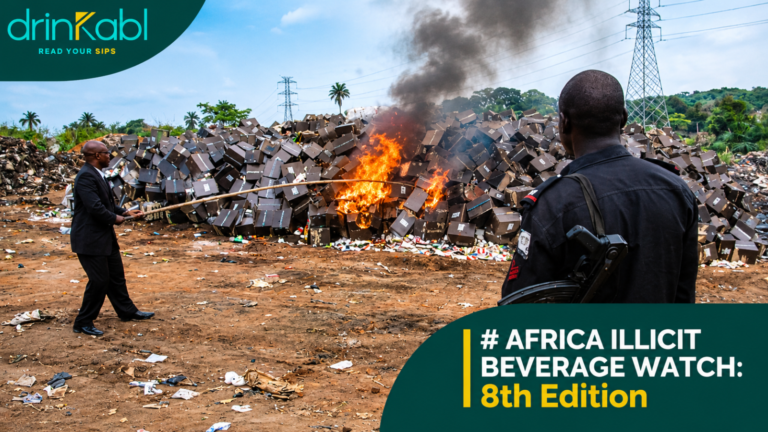
Nigeria’s National Agency for Food and Drug Administration and Control (NAFDAC) destroyed counterfeit, expired, banned and substandard regulated products valued at approximately ₦100 billion during an enforcement exercise in Ogun State on 20 November.
The destruction took place at Ogwama Dumpsite in Ogere Remo and included pharmaceutical products, cosmetics, unwholesome food products and banned alcoholic beverages.
Among the beverage-related products were alcoholic drinks packaged in sachets and PET bottles below 200ml, formats covered by Nigeria’s restrictions on the production and distribution of such products.
NAFDAC Director-General Professor Mojisola Adeyeye said the exercise was intended to prevent the products from re-entering the Nigerian market and to protect public health.
The agency also disclosed that enforcement operations had uncovered illegal manufacturing facilities, including locations used for producing counterfeit alcoholic beverages and revalidating expired energy drinks. More than 100,000 cartons of banned sachet and small-sized PET alcohol products were reportedly removed from manufacturers, wholesalers and retailers across Lagos and Ogun states.
The scale of the destruction highlights the continuing challenge facing Nigeria’s regulated beverage market. Counterfeit production, unauthorised repackaging and the circulation of prohibited products undermine legitimate manufacturers, weaken consumer confidence and complicate regulatory enforcement.
For beverage companies, the issue is not limited to the direct commercial loss caused by counterfeit products. It also involves the cost of protecting brand identities, monitoring distribution networks and ensuring that products reaching retailers comply with applicable regulations.
The destruction exercise is an important enforcement measure, but the longer-term test will be whether regulators can identify and disrupt the production and distribution networks responsible for repeatedly introducing prohibited products into the market.
Further details are available in NAFDAC Destroys ₦100bn in Fake Products.
KRA Moves to Auction 965 Packages of Jack Daniel’s Linked to Maxam
Kenya Revenue Authority (KRA) has scheduled the auction of 965 packages of Jack Daniel’s Tennessee whiskey consigned to Maxam Limited after the shipment remained uncleared at Nairobi’s Inland Container Depot.
The consignment arrived in Kenya on 22 July 2026 aboard the vessel CMA CGM Fort St Georges and was listed among goods held in customs storage beyond the permitted period.
A Gazette notice issued on 10 November gave owners of affected consignments 30 days to enter and remove their goods from the depot. The proposed public auction is scheduled for 28–31 December, with prospective buyers expected to inspect the goods on 22 and 23 December.
Maxam is a Kenyan beverage distributor whose portfolio includes international spirits brands such as Jack Daniel’s, Bacardi, William Lawson’s, Bombay Sapphire, Camino Real and Martini.
The shipment’s inclusion in the customs auction process raises questions about inventory management and the commercial risks associated with delayed import clearance. Imported spirits face multiple statutory charges, including customs duty, excise duty and value-added tax, making the clearance process an important part of distribution economics.
However, the auction notice does not establish that Maxam owes outstanding taxes, is involved in a tax dispute or deliberately abandoned the shipment. Nor does the listing establish the consignment’s total retail value or the number of individual bottles contained in the 965 packages.
The immediate issue is whether the distributor will complete the required customs procedures and recover the goods before the auction deadline.
The development is particularly relevant to international spirits brands and their local distributors, as prolonged customs delays can tie up working capital, disrupt stock availability and expose imported inventory to disposal under customs procedures.
Read the full report: KRA Moves to Auction 965 Packages of Jack Daniel’s Linked to Maxam.
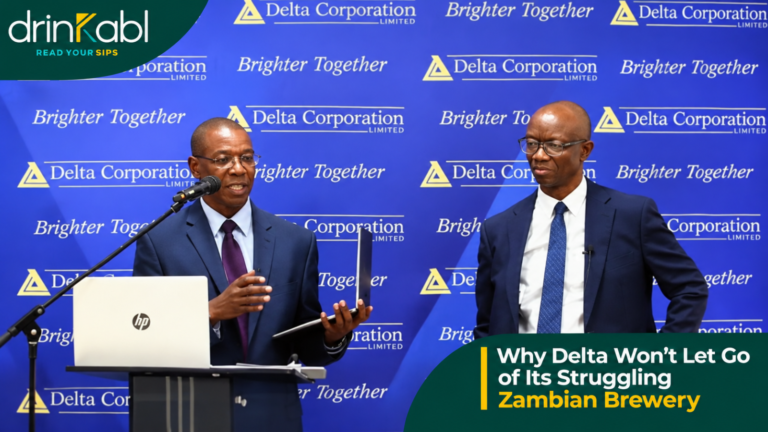
Delta Corporation Holds on to Its Struggling Zambian Brewery
Delta Corporation’s decision to retain its Zambian subsidiary, National Breweries, despite declining volumes and persistent operating difficulties, has brought attention to the strategic considerations behind beverage manufacturing investments across African markets.
National Breweries recorded a 17 per cent decline in volumes to 256,000 hectolitres for the six months ended 30 September 2026, compared with 307,000 hectolitres in the corresponding period a year earlier. The business remained loss-making, although Delta reported improved margins and a narrower loss.
The challenges include competition from unregulated alcohol, the resurgence of illicit beverages and weaknesses in route-to-market execution. These pressures have restricted sales despite improvements in electricity availability and lower cereal and import costs.
Yet Delta believes the Zambian operation has strategic value beyond its immediate financial performance.
During its November analyst briefing, Executive Director of Finance Alex Makamure explained that production costs in Zambia were significantly lower than in Zimbabwe. The cost structure per hectolitre was approximately half the level in Zimbabwe, while maize prices were also around half.
The company is concerned that selling National Breweries could give another operator access to a lower-cost production base from which it could manufacture sorghum beer and potentially export into Zimbabwe, creating stronger price competition for Delta’s domestic operations.
The strategic argument is significant because Delta’s Zimbabwean sorghum beer business recorded 19 per cent volume growth in the six months to September, reaching 2.672 million hectolitres. Its Chibuku Super brand recorded 27 per cent growth.
The contrast between the two markets shows how the same product category can perform differently depending on distribution, production economics, consumer affordability and competitive conditions.
For Delta, retaining National Breweries protects a potential regional manufacturing advantage, but it also means continuing to support an operation that has yet to deliver consistent returns.
The company’s decision illustrates a wider question for African beverage groups: an underperforming subsidiary may still hold strategic value if its production capacity, input costs or market access could strengthen the parent company’s competitive position elsewhere.
The full analysis is explored in Why Delta Won’t Let Go of Its Struggling Zambian Brewery.
KWAL Takes Savanna’s Global Campaign Local With Savenya
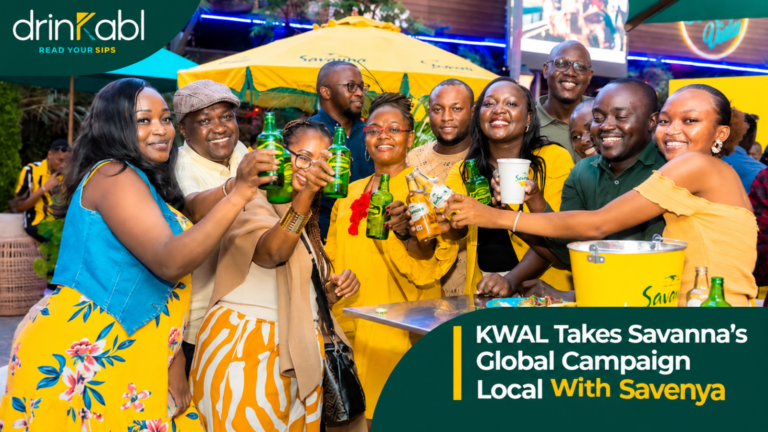
Kenya Wine Agencies Limited (KWAL) has introduced Savenya, a Kenyan adaptation of Savanna cider’s global marketing platform, as the company seeks to strengthen the brand’s cultural connection with consumers ahead of the festive season.
Launched in Nairobi on 5 November and reported during the week, the campaign translates Savanna’s global “We Get You” identity into the local expression “Tuna Wa Get”, reflecting shared experiences, humour and familiar Kenyan social situations.
The campaign covers Savanna Dry, Savanna Angry Lemon and Savanna 0.0, extending the brand’s positioning across alcoholic and alcohol-free cider options.
Rather than introducing a new product, KWAL is using local cultural references to make the brand more recognisable and relevant to consumers. The strategy reflects a growing emphasis on localisation in beverage marketing, particularly in markets where international brands compete with established local products and changing consumer preferences.
The Kenyan cider market has attracted competition from established players, including East African Breweries Limited’s Manyatta and African Originals’ Kenyan Originals.
Historical figures from the Competition Authority of Kenya show Savanna’s share of the cider market rising from 3 per cent in 2020 to 7 per cent in 2022, while EABL’s Tusker Cider held 79 per cent in 2022. These are historical figures, not current market shares, but they illustrate the competitive gap Savanna has been working to close.
The inclusion of Savanna 0.0 also gives the campaign a broader portfolio dimension. KWAL introduced the non-alcoholic cider in Kenya in 2025, extending the brand into an alternative for consumers who want to participate in social occasions without consuming alcohol.
The commercial test for Savenya will be whether cultural recognition translates into stronger consumer demand, repeat purchases and distribution performance. KWAL has not disclosed the campaign’s financial investment or specific sales targets.
The strategy is examined in KWAL Takes Savanna’s Global Campaign Local With Savenya.
Food Basket Brewery Prepares to Launch Zeva Beverage Range in Nigeria
Food Basket Brewery Limited, a subsidiary of the Benue Investment and Property Company (BIPC), is preparing to expand its beverage operations with the introduction of Zeva Malt, Zeva Premium Beer and Bip Water.
The company completed final taste evaluations of the products in Makurdi ahead of their scheduled commercial sales on 25 November 2026.
The development represents an expansion beyond the brewery’s existing beer operations into a broader beverage portfolio. BIPC said the products would be supplied to consumers, retailers and distributors across Benue State and other markets.
The brewery was inaugurated in October 2025 following an investment of approximately US$6.7 million. At the time, BIPC identified an initial production target of 10,000 crates of beer daily and highlighted the potential of Benue State’s beer market.
The latest expansion is also tied to the state’s industrial development ambitions. BIPC Group Managing Director Raymond Asemakaha said the project was intended to support local employment, create demand for agricultural inputs and retain more economic value within Benue.
The company has identified paddy rice, sorghum and cassava among the agricultural materials that could benefit from the brewery’s wider operations.
The launch will place Food Basket Brewery in a competitive market where established national and international beverage companies already have extensive distribution networks and consumer recognition.
Its ability to compete will depend on more than production capacity. Pricing, product consistency, distributor incentives, retail availability and brand acceptance will determine whether the new range can move beyond its home market.
The scheduled launch also creates an opportunity to assess how state-backed industrial investment can translate into commercially sustainable beverage manufacturing.
Further details are available in Food Basket Brewer to Launch Zeva Carbonated Drinks in Nigeria.
Kazeem Olaniyan Joins Mamuda Beverages as Regional Sales and Distribution Manager
Mamuda Beverages Limited has appointed Kazeem Olaniyan as Regional Sales and Distribution Manager, bringing additional commercial experience to the beverage subsidiary of Mamuda Group.
Olaniyan took up the position in September 2026, following commercial leadership roles at Jambitts Limited, Seven-Up Bottling Company and CHI Limited.
His experience includes regional sales management, distributor relationships, business planning, on-premise channel development and route-to-market execution.
Before joining Mamuda, he served as Divisional Commercial Manager for Lagos and the West at Jambitts Limited between January and July 2026. He previously worked as Regional Sales Manager for the North at Seven-Up Bottling Company and held sales management positions at CHI Limited.
Mamuda Beverages manufactures carbonated soft drinks, energy drinks and bottled water under its Pop portfolio. Its products include Pop Cola, Pop Orange, Pop Apple, Pop Chapman and Pop Power energy drink, with beverage operations based in Kano.
The appointment comes as the company develops its presence in Nigeria’s competitive non-alcoholic drinks market. Its commercial challenge will be to translate manufacturing capacity into stronger distributor coverage and reliable product availability across different consumer markets.
For emerging beverage manufacturers, distribution remains a major barrier to competing with established operators. Product quality and pricing may attract initial consumer interest, but consistent availability across wholesalers, traditional retailers and modern trade channels is essential for repeat sales.
Olaniyan’s experience across established beverage businesses gives Mamuda access to commercial knowledge that could support its distribution ambitions.
Read more in Kazeem Olaniyan Joins Mamuda Beverages as Regional Sales Manager.
Nigerian Breweries’ Emmanuel Oriakhi Retires After 23-Year Career
Emmanuel Oriakhi has retired as Sales Director of Nigerian Breweries Plc, bringing an end to more than 23 years with the company and its parent group, HEINEKEN.
His retirement took effect on 10 November 2026 and was reported by Nigerian Breweries during the week. The company said his successor would be announced in due course.
Oriakhi joined Nigerian Breweries in 2003 as a Commercial Management Trainee and went on to occupy senior positions across marketing, business development and sales.
His career included responsibilities for established brands such as Maltina, Gulder and Heineken, as well as international business development work covering Africa, the Middle East and Eastern Europe.
He returned to Nigeria in 2018 as Marketing Director, a position he held for approximately six years before moving into the Sales Director role in March 2025.
During his marketing leadership, Nigerian Breweries introduced products including Desperados, Zagg, Legend Twist, Goldberg Black and Heineken 45cl, reflecting the company’s efforts to broaden its portfolio across different consumer preferences and drinking occasions.
His transition into sales leadership brought together his experience in brand management, consumer understanding and commercial strategy with the operational demands of distribution and trade execution.
The departure comes as Nigerian Breweries continues to navigate a market shaped by affordability pressures, competition and the need for stronger distribution efficiency.
For the company, the appointment of a successor will be important in maintaining continuity across a sales function responsible for translating its extensive portfolio into market performance.
The full career profile is available in Emmanuel Oriakhi Retires from Nigerian Breweries After 23-Year Career.
CAPPA Renews Pressure for Changes to Nigeria’s Sugar-Sweetened Beverage Tax
Corporate Accountability and Public Participation Africa (CAPPA) renewed calls for Nigeria’s House of Representatives to expedite action on the Sugar-Sweetened Beverage (SSB) Tax Amendment Bill, placing the future of beverage taxation back in focus.
The proposed amendment to the Customs, Excise Tariffs, etc. (Consolidation) Act seeks to address weaknesses in the existing framework, which introduced a fixed excise duty of ₦10 per litre on non-alcoholic, carbonated and sweetened beverages under the Finance Act 2021.
The bill had been passed by the Senate on 4 June 2026 and was awaiting concurrence by the House of Representatives before transmission to the President for assent.
CAPPA has argued that the fixed levy has lost effectiveness as beverage prices have increased, and has advocated a tax structure linked to the retail price of sugary drinks, including a proposed minimum 20 per cent levy.
For beverage manufacturers, a shift from a fixed per-litre charge to a percentage-based tax could alter the relationship between product pricing, tax exposure and consumer affordability. The effect would vary across brands and price segments, with implications for manufacturers, distributors and retailers.
The debate also highlights the continuing tension between public-health objectives and the commercial realities of Nigeria’s beverage industry. Any change to the tax framework could influence product pricing, portfolio decisions and consumer demand.
The amendment had not become law during the week. Its progress through the House remains an important development to watch for beverage companies operating in Nigeria.
Read the report on CAPPA’s call for the bill to be fast-tracked.
What comes next
The coming days will be important for the African beverage industry as several of the week’s developments move towards their next stages.
Coca-Cola HBC’s Johannesburg listing was scheduled for 23 November, ahead of the expected completion of its acquisition of CCBA on 27 November. The transaction will be one of the most consequential changes to Africa’s beverage distribution landscape, with its eventual impact depending on how the enlarged bottler manages investment, local operations and market competition.
In South Africa, the Liquor Amendment Bill remains at an early parliamentary stage, but its potential impact on sponsorship and advertising means beverage companies and event organisers will continue to monitor its progress.
In Nigeria, Food Basket Brewery’s scheduled launch of Zeva products on 25 November will test the commercial potential of a state-backed beverage manufacturing investment. NAFDAC’s enforcement campaign will also remain important as regulators attempt to prevent banned and counterfeit products from returning to the market.
Kenya’s cider competition will provide another test of how effectively localised marketing can strengthen an established international brand, while Delta Corporation must demonstrate that retaining its Zambian brewery can eventually translate into improved operating performance.
Across the continent, the broader challenge is becoming clearer: beverage companies must build scale, protect their brands and strengthen distribution while adapting to regulatory changes and increasingly demanding consumer markets.