
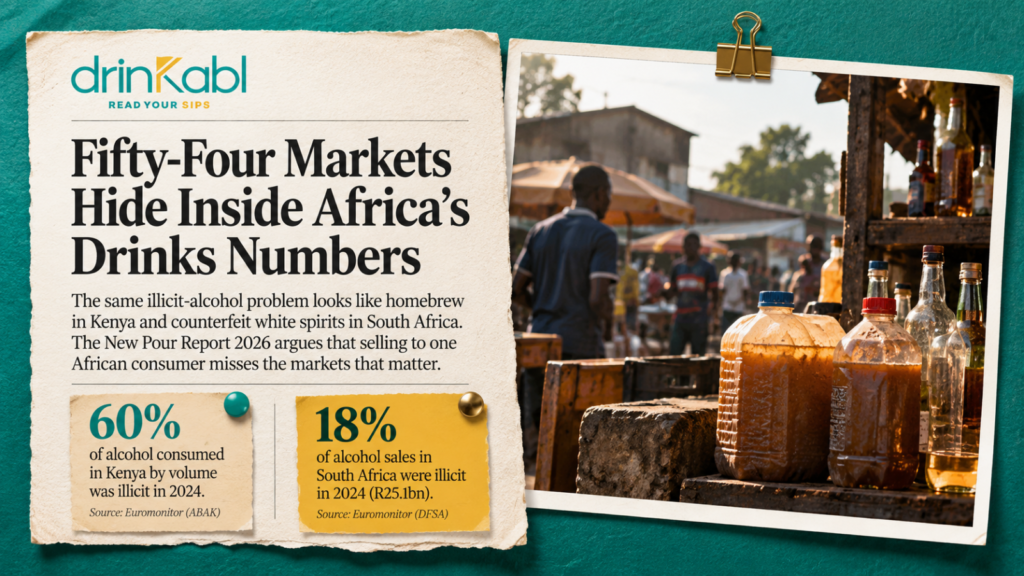
The same illicit-alcohol problem looks like homebrew in Kenya and counterfeit white spirits in South Africa. The New Pour Report 2026 argues that selling to one African consumer misses the markets that matter.
In 2024, 60 per cent of the alcohol consumed in Kenya by volume was illicit, according to a Euromonitor International study commissioned by the Alcoholic Beverages Association of Kenya. Most of that was not counterfeit whisky. About two thirds of the illicit volume was artisanal brew such as chang’aa and busaa.
South Africa’s number looks similar at first. A Euromonitor study for the Drinks Federation of South Africa put illicit alcohol at 18 per cent of sales in 2024, worth R25.1 billion. There, counterfeit white spirits account for the bulk of the tax losses. One problem, two very different drinks.
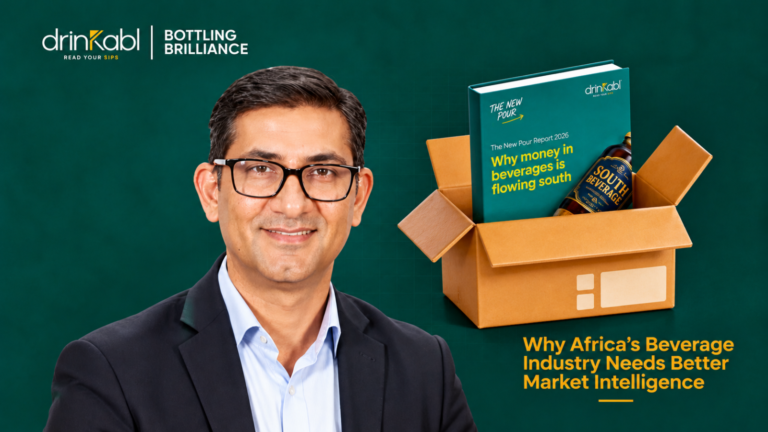
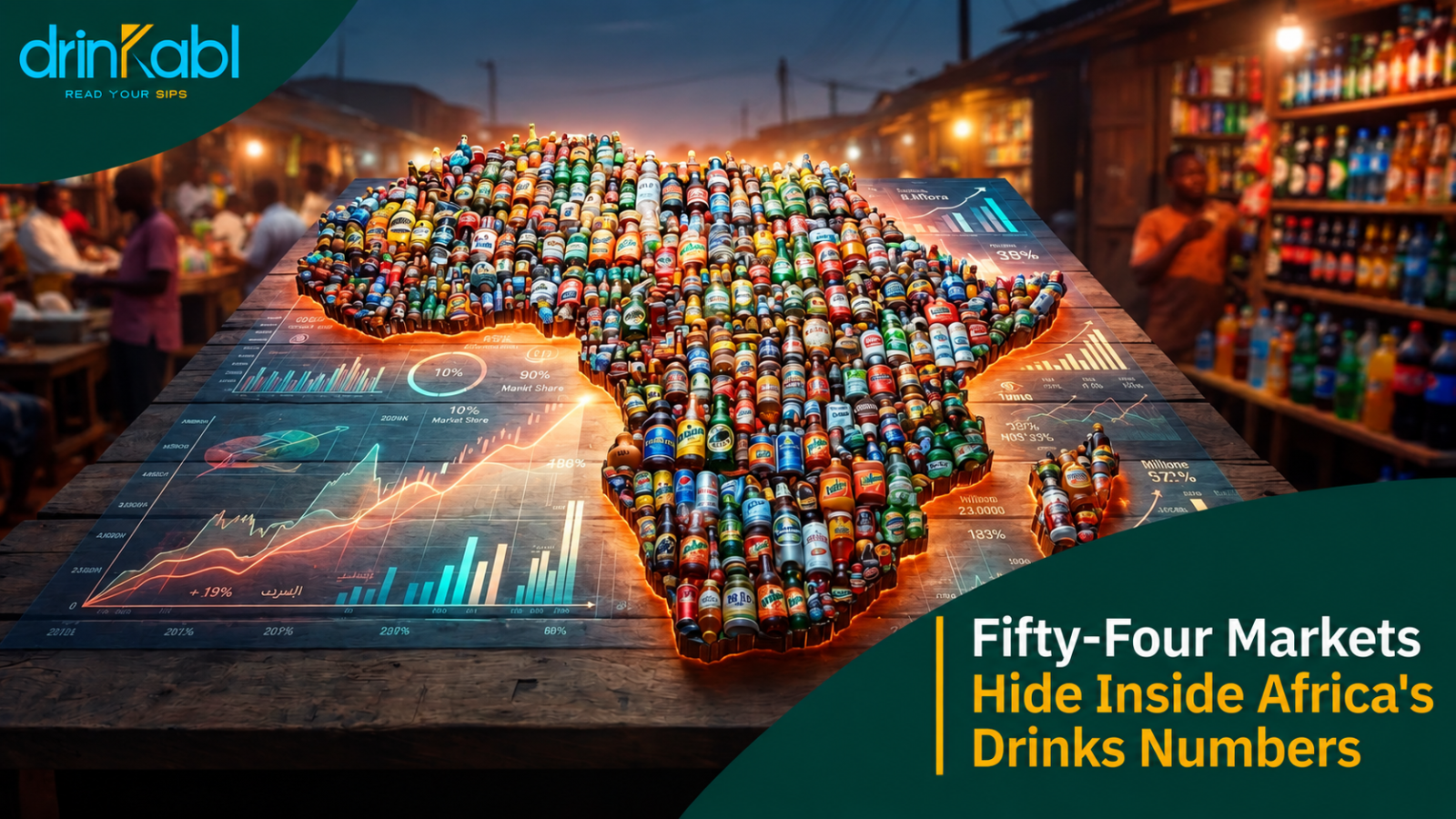
That gap is the argument of The New Pour Report 2026, published by Drinkabl Africa. It treats the continent as a set of distinct consumer ecosystems shaped by culture, income, regulation and infrastructure, rather than a single beverage market. Seyi Adeoye, chief executive of Pierrine Consulting, calls it 54 separate conversations. This piece follows the idea through category data, a Kenyan ruling on a pending deal and the report’s playbook, and asks where it is strong and where it is thinner than it sounds.
What the category data shows
Africa’s headline figures invite one strategy. The continent has more than 1.4 billion people, and the report values its beer market at USD 46.75 billion in 2025, growing to USD 74.65 billion by 2033 at 6.02 per cent a year.
The country figures pull the other way. The report’s country breakdown, drawn from Sagaci Research and Mordor Intelligence, shows spirits at 50 per cent of alcohol consumption in Kenya against 37 per cent for beer. Nigeria leans to spirits by a narrower 46 to 42. In South Africa beer takes half and cider holds 13 per cent, while in Morocco beer and wine sit level at 35 per cent each. A company that averages those five markets learns what is large somewhere and nothing about where to put a sales team.
A fridge in Kenya
Regulation shows the same split. In September the Competition Authority of Kenya cleared Asahi’s USD 2.3 billion purchase of Diageo’s stake in East African Breweries on one notable condition. According to Drinkabl’s reporting, at least a fifth of the refrigeration space EABL supplies to Kenyan shops must be reserved for drinks that belong to neither EABL nor Asahi.
The rule has gaps. It excludes supermarkets, top-end venues and hotels rated above two stars. It also says nothing yet about how the share will be counted. The Standard put EABL’s slice of Kenya’s alcohol market at roughly 80 per cent, which explains why a regulator cares about fridges. The same company also operates in Uganda and Tanzania, where the Kenyan condition does not apply. The sale had not closed when Drinkabl last reported on it.
The report points to the other large deal of the past year, Coca-Cola HBC’s agreement to buy 75 per cent of Coca-Cola Beverages Africa for USD 2.6 billion. That brings the buyer into 14 African markets in one transaction. It does not turn them into one market.
Two ways to size an illicit market
The Kenyan and South African numbers also show why the report tells foreign investors to size the illicit market before sizing the opportunity. The playbook says official figures overstate what a legitimate brand can actually address by 40 to 60 per cent in several countries, though it does not name them. In Kenya, it says, the formal market is 40 per cent of total consumption.
That advice only works if the illicit market is understood locally. A premium brand in Nairobi competes with a brew that costs far less and needs no label. In Johannesburg it competes with a fake bottle made to look like a real one. Both studies were also commissioned by trade bodies representing manufacturers, which is worth remembering when quoting them. The method is consistent across the two countries. The competitor is not.
The case for scale
The strongest opposing view comes from investors, who buy continents as well as countries. Nadine Sarwat, an analyst at Bernstein, described CCBA’s markets as a meaningful total addressable market for non-alcoholic ready-to-drink drinks, pointing to about 493 million people across its 14 countries. On that logic, aggregate volume is the prize, and local differences are a cost of capturing it.
The report does not dispute the scale. Its playbook asks global brands for country-level plans in at least Nigeria, South Africa, Kenya, Ghana and Egypt, and it names the same large deals as evidence of where capital is going. Sarwat’s case also has a limit. A company can own assets in 14 countries and still need fourteen different answers on price, flavour and distribution.
The evidence problem
There is a harder objection, and it comes from inside the report. A country-by-country strategy needs country-by-country data, and Kanessa Muluneh, founder of Nyle, told the New Pour Summit press conference that data is often difficult to source in this market. Brands with compelling stories, she said, gain a disproportionate advantage because of it.
That sits uneasily beside the 54-markets thesis. Most of the figures cited here come from a handful of commissioned studies and regional forecasts. The report’s own text on Tanzania and Morocco is also less precise than its chart. Fifty-four markets is a sound way to think about Africa, but only a few of those markets have numbers detailed enough to plan around.
Kenya’s 60 per cent and South Africa’s 18 per cent share a word, illicit, and little else.
This story is part of Drinkabl Africa’s editorial series, The New Pour Report 2026: The Stories Behind the Data, examining the market forces, consumer shifts and commercial opportunities shaping Africa’s beverage industry. Read the full report.
Read more