
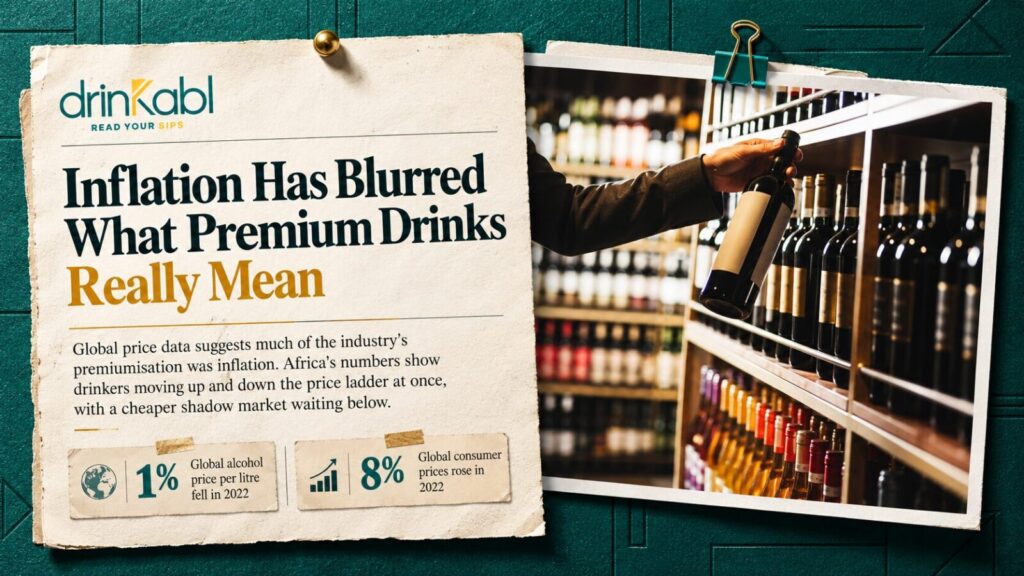
Global price data suggests much of the industry’s premiumisation was inflation. Africa’s numbers show drinkers moving up and down the price ladder at once, with a cheaper shadow market waiting below.
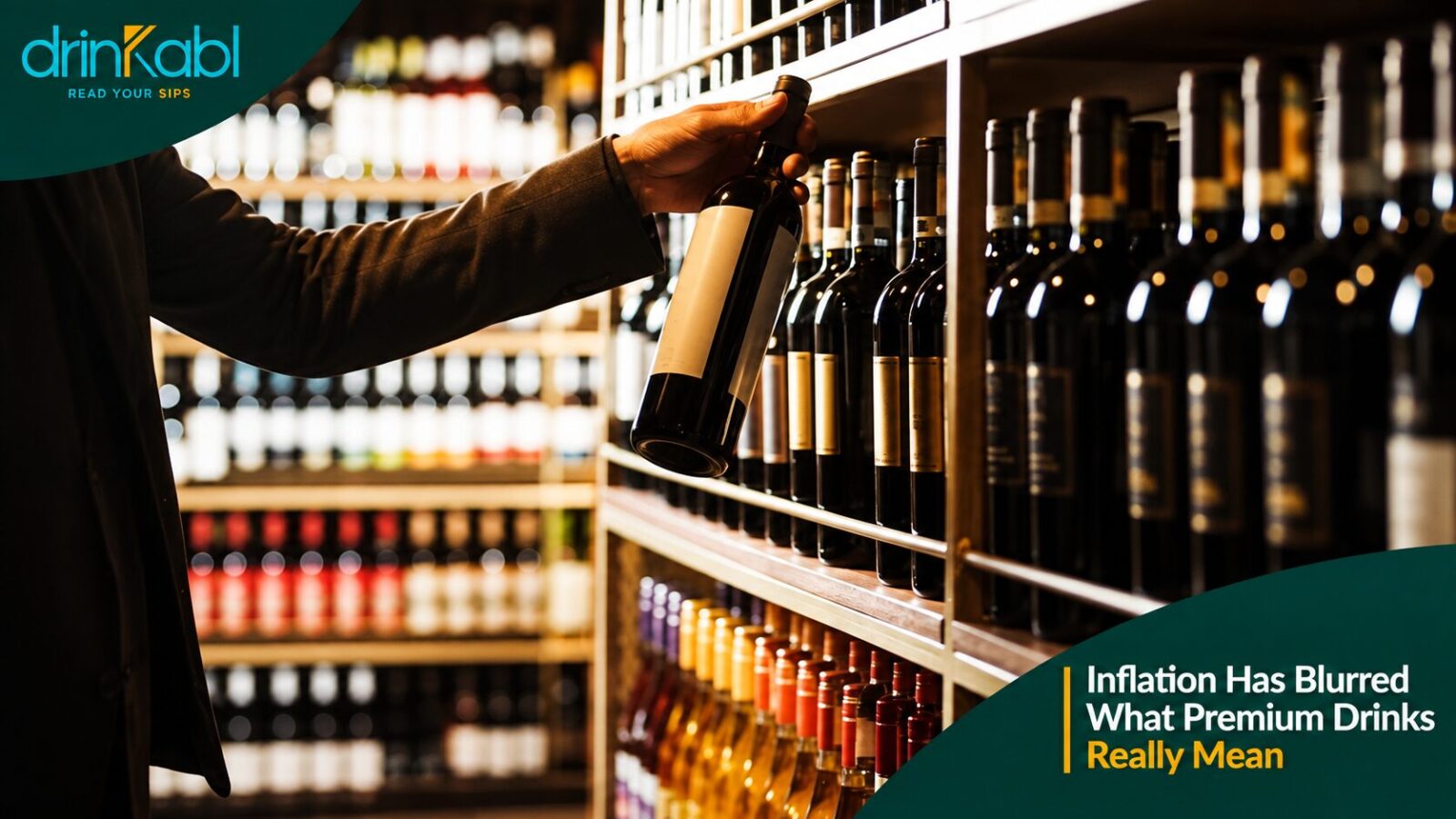
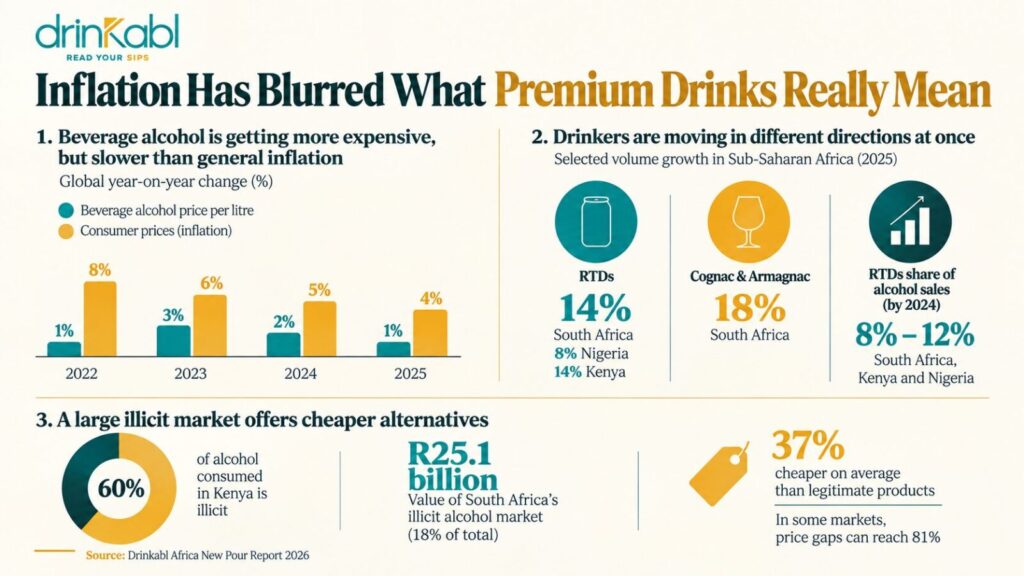
In 2022, the price of an average litre of beverage alcohol fell by 1% worldwide. Over the same twelve months, consumer prices rose 8%. According to IWSR’s analysis, the gap has stayed open every year since. Price per litre rose 3% in 2023 against 6% inflation, 2% in 2024 against 5%, and 1% in 2025 against 4%.
For an industry that has spent a decade telling investors that drinkers are buying pricier bottles, those numbers are awkward. A higher shelf price is easy to read as a higher aspiration, yet a bottle can cost more simply because everything around it does. Drinkabl Africa’s New Pour Report 2026, launched at its Nairobi summit and built on ten trends and more than 15 data sources, makes the premium case in its third trend, which holds that Africa’s middle class is drinking up the price ladder. Its ninth trend, on inflation, describes consumers trading down. This piece reads the two together to ask who is really trading up.
What a price tag hides
Price per litre is the industry’s rough yardstick for premiumisation. If the average litre sells for more each year, the reasoning goes, drinkers must be choosing dearer products. The measure breaks down when general prices climb faster than the drinks do.
IWSR’s Luke Tegner says the premiumisation tailwind has, at the highest level, under-indexed versus inflation. His prescription is to strip inflation out of four years of value growth and see what remains. Globally the answer is uneven. Premium-plus value fell 2% in 2025, though it rose 2% once national spirits, the big domestic brands in markets such as India, were excluded.
None of this measures Africa directly. What it offers is a test that any African premium claim has to pass. A rising price says little until someone shows that drinkers chose something better and not merely something dearer.
Two trends in one report
The New Pour Report’s ninth trend records that high inflation from 2023 to 2025 constrained growth significantly. Nigeria’s market contracted, South Africa managed modest expansion, and consumers traded down to cheaper options or moved to illicit alternatives. That is a different picture from a middle class steadily climbing.
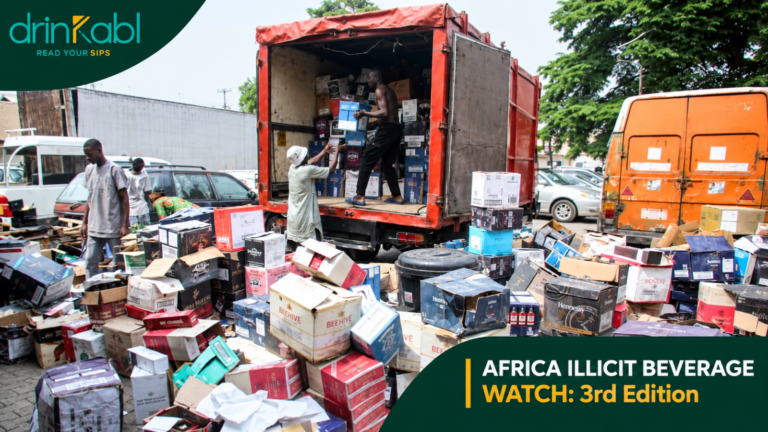
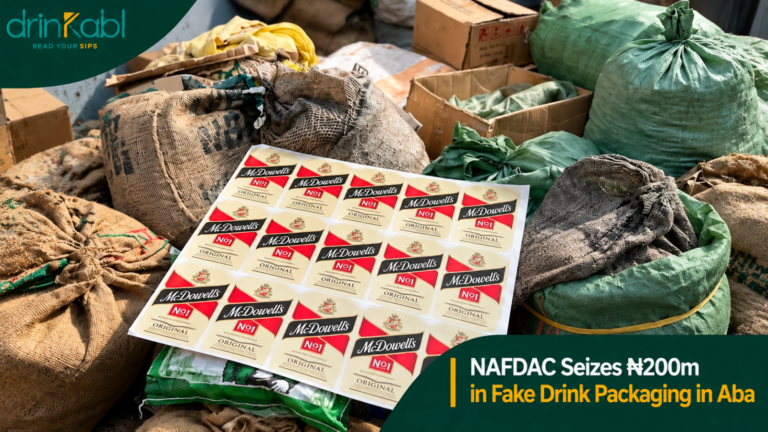
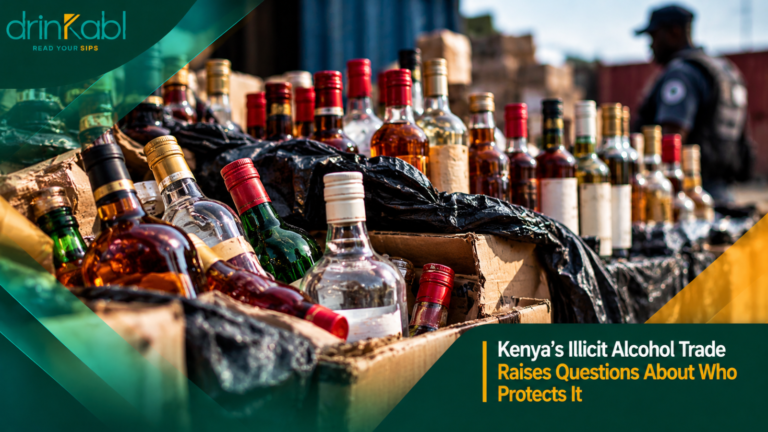
The illicit market is the report’s sharpest measure of how far down drinkers can go. It estimates that illicit sales make up about 60% of alcohol consumed in Kenya, and that South Africa’s illicit trade is worth R25.1 billion, or 18% of all alcohol sold. Citing Euromonitor International, it puts illicit and counterfeit products at around 37% cheaper on average than legitimate ones. Uganda Breweries’ 2025 market report, also cited, found gaps of up to 81%.
The report draws the consequence in plain terms. When legal prices rise, drinkers rarely leave the category. They find another way in.
What the volumes show
Volumes are harder to inflate than prices. IWSR’s Sub-Saharan Africa research, as reported by the drinks business, finds ready-to-drink products, or RTDs, growing fastest. Volumes rose 14% in South Africa, 8% in Nigeria and 14% in Kenya in 2025, which IWSR attributes to consumers looking to manage their budgets.
The same research shows the other end moving too. Cognac and Armagnac volumes in South Africa grew 18% in 2025, and IWSR expects growth of about 5% a year to 2035, tying the appeal to the high-status reputation of those spirits among image-conscious middle and upper classes. The New Pour Report’s RTD chapter adds that these drinks already made up 8% to 12% of alcohol sales in South Africa, Kenya and Nigeria by 2024.
Read together, the figures do not describe a market climbing from cheap to expensive. A budget-minded format and a status spirit are both growing in the same country in the same year.
Buying for the occasion
One explanation is that drinkers are not fixed at a price point. Franklin Ozekhome of Pop Culture Varsity Africa, writing in the report, argues that many purchases in African beverage markets are social before they are transactional. Consumers buy for gatherings, approval, hospitality and status, he says, and brands that have entered those rituals can hold their pricing power under pressure.
Feyi Olubodun, founder of Open Squares Africa, makes a similar point about choice. In the report he says a consumer picking a brand is sending a signal to peers, family and community about who they are becoming. If that is right, the same household may buy a modest bottle in an ordinary week and something grander for a wedding or a promotion, and income bracket becomes a poor guide to who a premium buyer is.
Seyi Adeoye, chief executive of Pierrine Consulting, adds a caution about scale. He tells the report that brands treating Africa as one opportunity will lose to those that treat it as 54 separate conversations, and that Lagos consumers differ from those in Accra and Nairobi.
The case that trading up is real
The sceptical reading has limits. Cognac volumes rising 18% in a year cannot be explained by price inflation, because IWSR is counting bottles and not rand. Someone is buying more of an expensive spirit.
IWSR also draws a line between fake and real premiumisation. In global travel retail, where value grew 7% in 2025 against 5% for volume, its analysts call the trend authentic premiumisation, not inflation in disguise. The phenomenon exists, but it has to be shown with volumes and mix.
The New Pour Report offers one way to hold both truths. Its playbook for local entrepreneurs argues that a premium line and an accessible line from the same brand gave operators a cushion through Nigeria’s 2023 to 2024 contraction, and that those playing only one end were squeezed hardest. That is the report’s own finding and has not been tested here against company accounts. Kanessa Muluneh, founder of Nyle, gives the brand side of it: you cannot always win on numbers alone in Africa, she says in the report, and you win on narrative.
The 40% problem
The report’s advice to foreign investors is blunt. Size the illicit market before sizing the opportunity, because in several countries official figures overstate what a legitimate brand can address by 40% to 60%. In Kenya, it says, the formal market is only 40% of total consumption.
For a premium bottle in Nairobi, the competitor is not only another brand on the shelf. It is a drink that costs about a third less on average, and in some places far less than that.
Read the full New Pour Report 2026. It sets out all ten trends, country-level estimates of illicit trade and a playbook for investors, local entrepreneurs and global brands.