
Franklin Ozekhome asks brands to measure what music, memory and belonging add to a sale. Manyatta cider, poured at the summit where his argument was launched, is the test case, and the numbers behind it are thinner than the story.
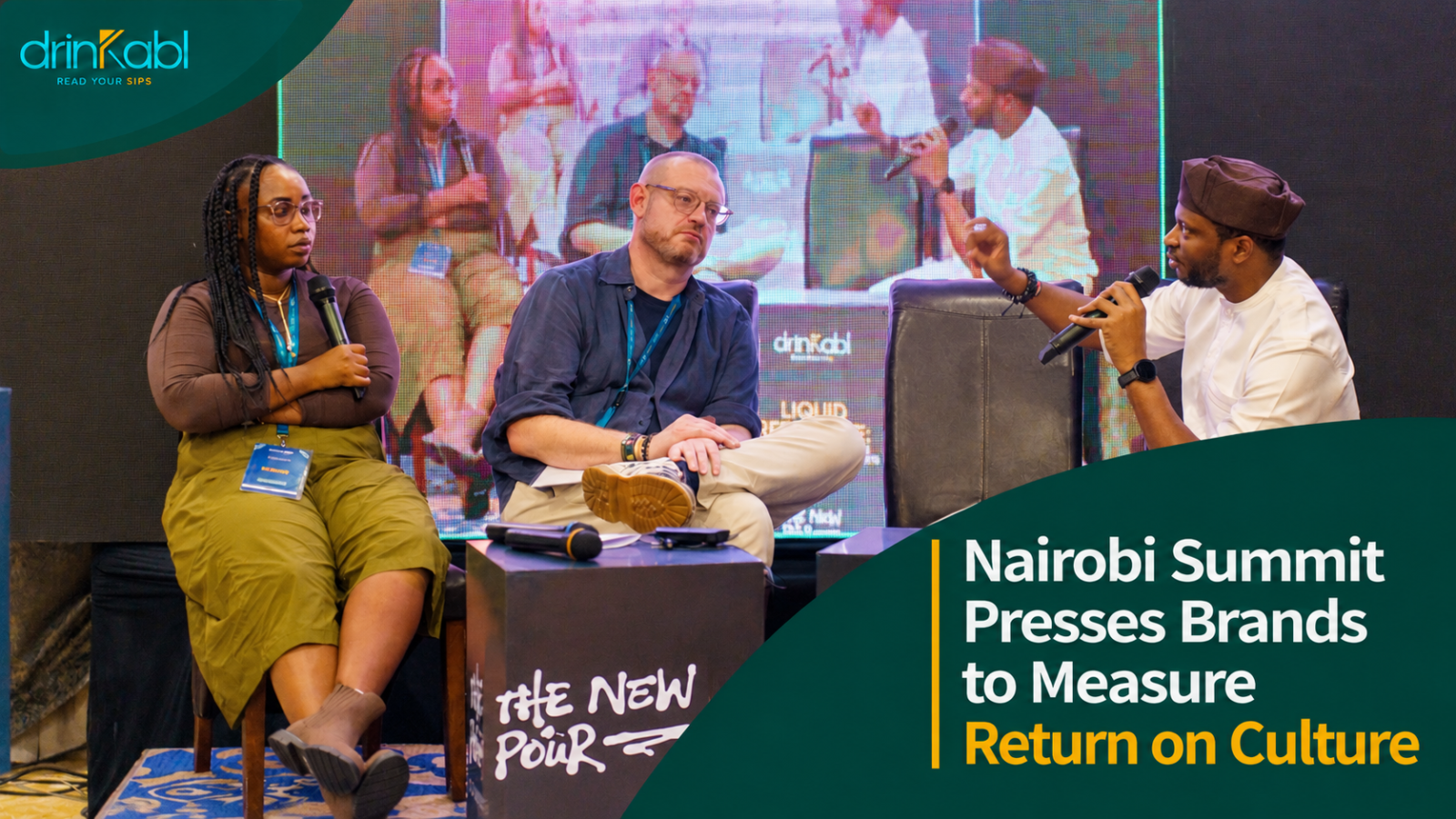
The New Pour Report 2026 was unveiled live on the Nairobi stage at The New Pour Summit on 25 July, and it was handed to the room by EABL’s Effie Thiong’o and Kanyi Kiuru alongside the Drinkabl Africa team. The cider poured for delegates through the day was Manyatta, the EABL brand that served as the summit’s beverage partner. Late in the report sits an essay with an instruction for anyone holding a glass like that, titled Stop Buying Volume. Start Building Culture.
The essay is Ozekhome’s, and its argument is that brands should add return on culture to return on investment. Return on investment asks what a campaign earned. Return on culture asks whether a brand has entered the places, songs, memories and rituals in which people choose a drink. This feature follows that idea through Manyatta, tests it against a rival story from Lagos nightlife and asks what the summit’s evidence can and cannot prove.

A cider with a setting
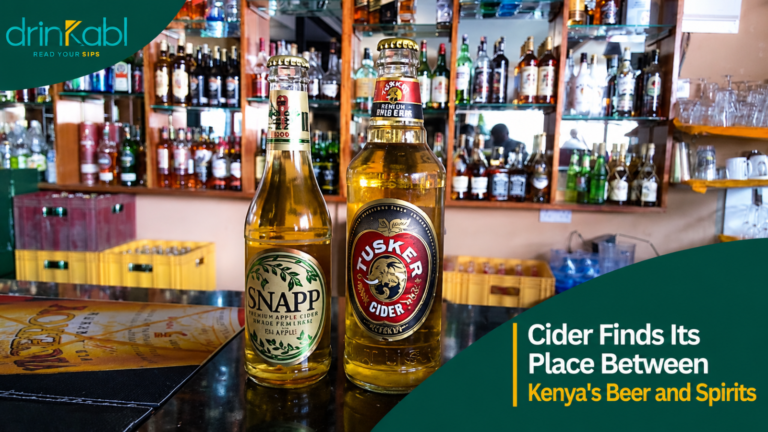
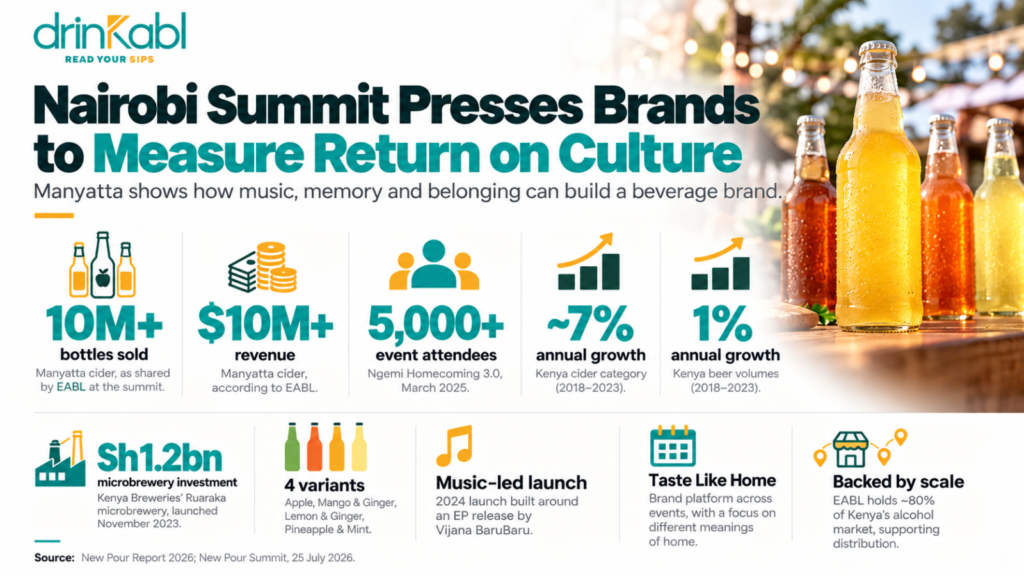
Manyatta did not arrive as a bare product. It was the first brand from a Sh1.2 billion microbrewery that Kenya Breweries built beside its Ruaraka plant and started up in November 2023, and its 2024 launch event was built around an EP release by the music group Vijana BaruBaru. The range was a plain apple cider plus Mango & Ginger, Lemon & Ginger and Pineapple & Mint variants, which EABL says draw on local spices and flavours. A brand with that start is selling a setting as well as a drink.
The events have kept coming. In March 2025 Manyatta powered Ngemi Homecoming 3.0 at Eva’s Garden in Limuru, where more than 5,000 people heard the mugithi singer Samidoh Muchoki and the brand launched a can of Pineapple & Mint. The platform tying these together is called Taste Like Home, and its brand manager says the aim is to celebrate different meanings of home rather than fix one definition of being Kenyan.
What return on culture counts
Ozekhome argues that some drivers of demand form over long periods and never show in a short-term sales report. He lists trust in family settings, status in social venues, familiarity at weddings and celebrations, childhood memory, creator adoption, music association and street acceptance. His claim is that these accumulate until a brand becomes the default for an occasion, which helps explain why some brands hold their prices and recover faster after disruption.
Other speakers came at the idea from different directions. Ozekhome told the room that one person can choose value, premium, wellness or no alcohol on different days of the same week, which makes the occasion a better unit than the consumer. Feyi Olubodun of Open Squares Africa said Africans are modernising without westernising, and that his data shows culture built into point-of-sale design can lift brand patronage by up to 65 per cent. That figure is his own, and it covers shop displays rather than whole brands.
The Manyatta numbers
At the summit, Thiong’o and Maurice “Rizz” Wangalachi of Ogilvy presented the brand in a session called From Manyatta to Millions, describing an identity built on the homestead’s timeless flame and designed to sit anywhere from a local pub to a global club. Thiong’o said taste like home is not geography. The two said the cider has sold more than 10 million bottles and earned revenue in the double-digit millions of US dollars. Those numbers belong to the presenters, and they do not say how much came from music and meaning and how much from price, availability and the pull of a brewer that holds roughly 80 per cent of Kenya’s alcohol market.
Kenya’s cider category was also growing around the launch. Cider sales there have averaged about 7 per cent a year, while beer volumes grew 1 per cent a year from 2018 to 2023. A brand launching into a rising category from the largest distribution network in the country has several reasons to sell. Culture may be one of them, and the summit’s evidence has no way to isolate it.
Where the idea strains
Status can also cut the other way. In Lagos clubs, a bottle of Clase Azul Reposado that shops sell for between ₦200,000 and ₦300,000 can reach a table at ₦800,000 to ₦1 million, delivered with a procession and a song, and a promoter said the people ordering it are buying more than a drink. Then a rumour about scarcity made drinkers wonder whether the bottle in front of them was real. John Paul Emechebe, head of on-premise at Red Bull in Nigeria, argues the brand’s exposure begins after the last pour, when empty bottles can be refilled, and no one has published sales data showing what happened to the brand.
A founder on the summit’s own stage described the practical limit. Brian Kiriba of Handas Juice said his strategy was to be so good the company could not be ignored, and that “we couldn’t find distribution, so we built our own.” Kanessa Muluneh of Nyle told the same audience that story is everything in beverages. Taken together, the two founders describe a brand that needs a story to be noticed and a route to the shelf to be sold.
At the summit the cider in delegates’ glasses was also the case study on the screen. The 5,000 people at Limuru and the 10 million bottles are both on the record, one as an attendance and the other as a claim. What the figures do not give is the share of those bottles that belongs to the music, the flame and the idea of home, and the share that belongs to price and fridge space.
Read more