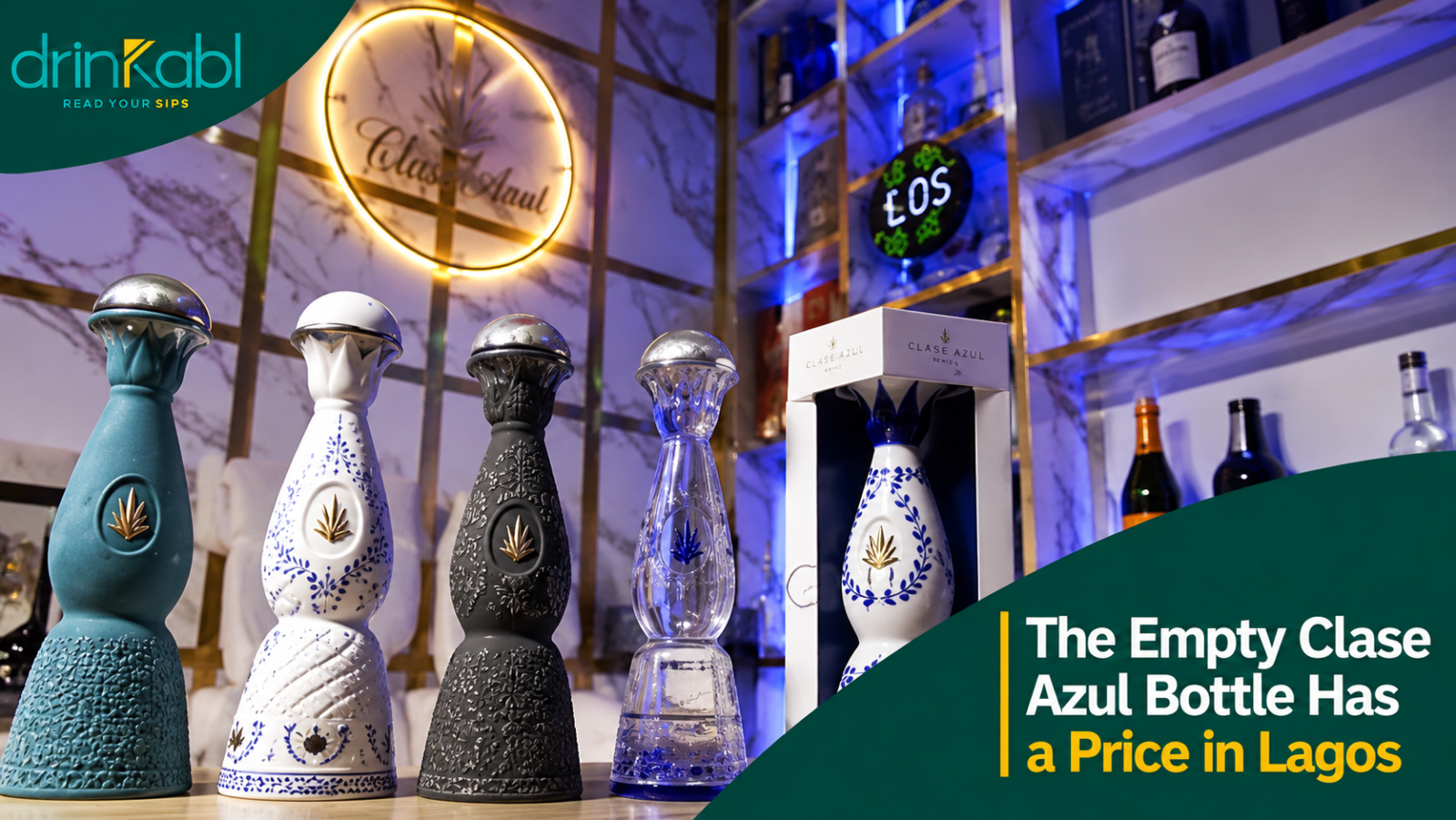

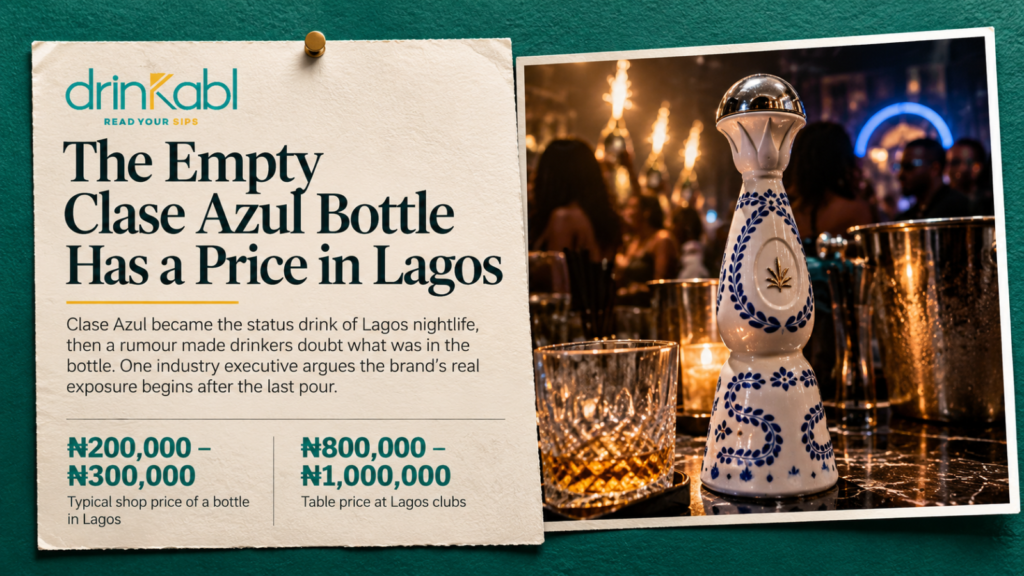
Clase Azul became the status drink of Lagos nightlife, then a rumour made drinkers doubt what was in the bottle. One industry executive argues the brand’s real exposure begins after the last pour.
In a Lagos club, a bottle of Clase Azul Reposado that a shop sells for between ₦200,000 and ₦300,000 can arrive at the table priced between ₦800,000 and ₦1 million. A promoter with more than a decade in the business, identified only as James, called that the standard rate for basic bottle service. The bottle comes in a procession led by women in costume, set to Era’s “Ameno”, a routine known as Dorime. He said the people who order it are buying more than a drink.
John Paul Emechebe, head of on-premise at Red Bull in Nigeria, has set out what he thinks happened next in a LinkedIn post. His argument is that a rumour about scarcity exposed a deeper weakness. Drinkers began to ask whether the bottle in front of them was real, and an empty premium bottle is the cheapest raw material a counterfeiter can find. This feature checks the figures behind his account, sets out what the enforcement record does and does not show, and looks at his remedy, which is to recover, verify and destroy every empty. He adds one caution himself, which this piece repeats: no one has published sales data showing what happened to Clase Azul in Nigeria.
A Rumour With a Real Number Inside
On 10 December 2023, a post claiming that only 100 bottles of Azul are made each year drew 3.2 million views on X. It asked whether everything was being sent to Lagos or whether fake Azul was inside. The number belongs to Clase Azul Ultra, the collector bottling, which retailers describe as limited to fewer than 100 bottles a year. The standard range is made on a different scale. The company sold 234,000 bottles in 2016, and a later estimate put its output at 140,000 cases a year. A Lagos drinker who had just paid club prices for the standard range was left to decide which story to believe.
The doubt was not new. In October 2021 a user on X claimed that some Azul sold in Lagos clubs was made in the city, an assertion with no evidence attached. By 11 December 2023 consumers were lamenting fake Azul in clubs, bars and shops, and the singer BNXN said he would take the microphone from the next hypeman who served him a fake. In the first two weeks of that month, the food and drug regulator NAFDAC shut about 240 shops in Aba, Abia State, in a raid on counterfeit wines and spirits. The brands it named included Hennessy and Gordon’s, and Azul was not among them.
What an Empty Bottle Is Worth
Emechebe’s central point is that the counterfeiter’s first raw material is the genuine bottle, and the market seems to agree the bottle has value. One Nigerian marketplace listing offers an empty Azul bottle for ₦39,000. Counterfeiters in Nigeria have been collecting used bottles from bars and restaurants, and in December 2024 NAFDAC raided a Lagos Island workshop where the main suspect confessed to refilling bottles labelled Rémy Martin. No case reviewed for this feature names Clase Azul, so the mechanism is documented and the link to this brand is not.
Kenya’s regulator describes what happens after the bottle is filled. In September its Anti-Counterfeit Authority told senators that counterfeiters clone genuine QR codes, reuse genuine bottles and labels, replay valid serial numbers and substitute the contents. It cautioned that a QR code alone cannot guarantee a drink is authentic. The authority was talking about Kenyan vodka and cane spirits, not tequila. The point still carries across the border, because a code on a bottle proves little once the code itself can be copied.
Collecting the Empties
The Spirits and Wines Association of Nigeria says the problem is large. Its director-general, Tony Okwoju, told a gathering of brand journalists in Lagos in March that illicit products make up about 40 per cent of the spirits market, and that syndicates scavenge bars and bins for empty branded bottles. He said major manufacturers now send teams into bars and nightclubs to collect and crush their own empties, at a cost to the companies, so the glass cannot return to the trade. These are the claims of an industry body campaigning on the issue, and the 40 per cent figure is an estimate, not a count of bottles.
Emechebe’s prescription follows the same logic. Brands should know where the bottle goes after consumption, then recover it, verify it and destroy or recycle it through a controlled process. For Clase Azul the task is harder than for ordinary glass, because its hand-sculpted decanters are sold as keepsakes that buyers keep as decoration once the tequila is gone. A recovery scheme built for disposable bottles meets an object designed to be kept. Clase Azul has made no public statement on its Nigerian market that this reporting could find.
What Nobody Has Measured
Emechebe is careful on the point that matters most to his title. He wrote that he had found no reliable sales data showing counterfeiting alone caused the brand’s decline in Nigeria. Other pressures are easy to find. Club-goers in Lagos are moving to raves, citing the cost of entry fees and bottle service, and a shop price of about ₦300,000 for a bottle is a large sum to start with. Rivals have also arrived, including Don Julio, which Diageo launched in Reposado and Blanco in Nigeria in July 2025.
The strongest complicating view is that the rumour did more damage than any refilled bottle. A wrong number about scarcity taught drinkers to ask “Is this real?”, and that habit does not need a single proven fake to spread. NAFDAC’s director-general warned in September that social media allegations do not by themselves establish a product is counterfeit, and asked people to report suspected cases through official channels. Taken together, the record shows a real mechanism, a documented market in empties and an unmeasured fall in demand.
When the night ends, the bottle leaves the table. None of the reporting reviewed here records where an empty Clase Azul decanter goes next, and the only price on record for one is a marketplace listing at ₦39,000. Set against a shop price of roughly ₦300,000, that is about an eighth of the cost of a full bottle.